
“It’s clearly not necessary to resurface the patella, ” states Michael Dunbar. “Actually, ” counters Steve MacDonald, “the data is pro-resurfacing. When the patella is resurfaced, patients have improved satisfaction, lower revision rates, less or equal anterior knee pain.”
12 Rounds Over Patella Replacement: Dunbar v. MacDonald
8 min read Premium comments
Great Debates
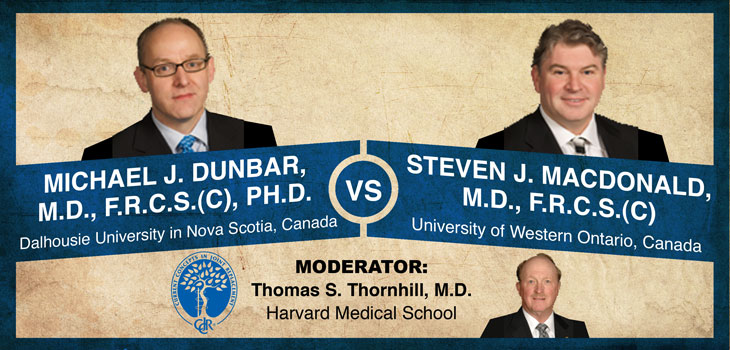
This week’s Orthopaedic Crossfire® debate is “Rethinking Patella Replacement: It Really Isn’t Necessary.” For the proposition was Michael J. Dunbar, M.D., F.R.C.S.(C), Ph.D. from Dalhousie University in Nova Scotia, Canada. Against the proposition was Steven J. MacDonald, M.D., F.R.C.S.(C) of the University of Western Ontario, Canada. Moderating was Thomas S. Thornhill, M.D. from Harvard Medical School.
Dr. Dunbar: “The fact is that there are multiple randomized controlled trials looking at the issue, all of which show no difference in the outcome. So you’d say there is no advantage to resurfacing the patella, so subsequently you’d default to ‘it’s not necessary.’ But this is a power issue and so we need to look at bigger data sets.”
“There are a couple of meta-analyses that I’m sure Steve will bring up to counter the point. One is by Parvizi and one is by Calvisi and they came to the same conclusion. All patients improved, whether their patella was resurfaced or not. That speaks to the standard effect size. But in these studies the investigators identified the fact that there is more anterior knee pain in the un-resurfaced group, decreased satisfaction rates, and increased revision rate.”
“In our study based on the Swedish registry, we looked at satisfaction as an outcome. When we looked at every patient in the country—about 30, 000 people. With that huge power we found a subtle difference in terms of satisfaction rates for the patella resurfaced group. But what Steve probably doesn’t know is that when we looked at what satisfaction means—we correlated satisfaction with every questionnaire we looked at—we found that what patients were really talking about was reduced pain. So I’d submit to you that anterior knee pain and satisfaction are the same thing.”
“So let’s look at it a little differently. If we look at longitudinal outcomes and how patients proportionately reported whether they were satisfied or not with time—and this is working backwards by the cohort—we have un-resurfaced groups that remain the same over time. However, what we like to say from the Swedish registry is that the beneficial effect of early satisfaction is not persistent and it changes with time the further you go out. So the satisfaction that’s obtained is subtle and it’s short-lived.”
“What about the increased revision rate? We heard it from Mike and Bill who both articulated the fact that if you have two patients, one with an un-resurfaced patella and one with resurfaced and they’re both complaining about the same anterior knee pain, there’s a selection bias…you’re much more likely to do a revision. These revisions come early and they’re about flipping the patella and putting a button on. The fact is that when you do that, the satisfaction rates are abysmal.”
“From the Swedish registry data we saw that the incidence of resurfacing the patella changed over time. In 1985 it was about 80% and now it’s down to 5%. So I have the nation of Sweden behind me saying, ‘It’s not necessary to resurface the patella.’”
“The interesting question is, ‘Why did this happen?’ If you look at the revision rates now for resurfaced versus un-resurfaced from 1985-1994 it turns out that the revision risk ratio is flipped…so there was a higher revision rate for the resurfaced group. What happened? There was a transition between the universal to an anatomic femoral component, and when you look at the satisfaction rates (subtle, but because of the power, statistically significant), there was an advantage for the un-resurfaced group in the anatomic component. That wasn’t the case in the resurfaced [group]. So it looks like a lot of the resurfacing was being done to accommodate a universal component, and when we all switched to an anatomic type component that was no longer necessary.”
“In talking to Otto Robertsson—who runs the knee registry—about why this has changed so radically in Sweden, it’s because of the type of revisions and the ratio of revisions that are required. When you resurface the patella your revisions are early and are for simple problems like a tracking issue. If you don’t resurface the patella you do much more complicated revisions later on at a higher ratio for fracture, wear, and loosening.”
“In another meta-analysis looking at the outcome of periprosthetic fracture we find that they almost always occur—99%—in the resurfaced group. If you don’t resurface the patella you’re not going to have a periprosthetic fracture. There is a 92% failure rate with ORIF [open reduction internal fixation], 29% complication rate, and 19% incidence of infection.”
“Based on all of the above, it’s clearly not necessary to resurface the patella.”
Dr. MacDonald: “My opponent is a good critical thinker…most of the time. Evidence of his good thinking: he published a paper about 10 years ago with 27, 000 total knees, increased satisfaction rate—in which group??—those resurfaced!”
“So how do you measure success? Patient satisfaction and implant longevity, failure rates, and revision rates. And we should avoid only un-blinded, small series…that’s the advantage of the registries. There are multiple small series, randomized trials; reasonably well powered…they either show that resurfacing is equal or superior. None show that the un-resurfaced group is better.”
“There are multiple systematic reviews. I quote the conclusions: ‘Patellar resurfacing is the best management; patellar resurfacing reduces the risk of anterior knee pain and patella-related knee pain; patellar resurfacing reduces the risk of reoperation; the literature favors resurfacing the patella routinely; lower risk of reoperation and anterior knee pain with resurfacing.’ There isn’t a systematic review that says the opposite.”
“The advantage of resurfacing is availability for osteoarthritic patients, rheumatoid patients, so regardless of the cohort the satisfaction rate across the board, across the diagnosis, is higher if you resurface the patella. Survivorship: the Swedish registry says there’s a 1.27x higher revision rate if you leave it un-resurfaced. These are quotes from the registry from a few months ago: ‘…the curves have turned to the advantage of the patellar button’ and ‘…previous findings show that patients who have had resurfacing are more often satisfied with their knee’ and ‘…this speaks for a more LIBERAL use of the patellar button.’ So the Swedish registry doesn’t back up not doing it, it backs up the premise that perhaps we should be doing it more liberally.”
“Data from the Australian registry mirrors it almost exactly. There’s a 1% difference in revision rate. It holds true for both PS [posterior stabilized] and CR [cruciate retaining]. The argument often put forth is, ‘You’re only revising it because you can…it’s just like for unis.’ Actually, if you look at unis (registry data) it isn’t just because we can, it’s because they’re having problems. What doesn’t work: going back and trying to resurface it if you’ve done the wrong thing in the first place, i.e., leave it un-resurfaced, to go back later and resurface it…that’s about a 50% success rate.”
“We’re not that good at revising people for pain, so it’s the same for a total knee and it’s the same for an un-resurfaced patella. It’s not an indictment of the original procedure; it’s an indictment of our ability to revise people for pain. The trend in Australia is rapidly changing: 41.5% were resurfaced in 2005 and four years later it was 47%.”
“The weakest argument I’ve seen is, ‘Don’t resurface to preserve bone stock and prevent fractures’. Give me a break. There’s no evidence that that’s true and there’s a great publication about a year ago looking at a series of fractured, un-resurfaced patelli.”
“Patients have improved satisfaction, lower revision rates, less or equal anterior knee pain…and this theoretical late revision rate does not sway me and the data is certainly pro-resurfacing.”
Moderator Thornhill: “Thirty second rebuttal?”
Dr. Dunbar: “I think the strongest argument was the one you said was the weakest, which is the fact that the resurfacing does not lead to increased incidence of complications. That has been published and it’s a germane fact given that we’re operating on younger, heavier patients. If we’re expecting these implants to last 30 years I’m going to want some bone back there to resurface. You must have seen difficult revisions with the patella gone with osteolysis that failed. I think that’s the strongest argument to go forward.”
Dr. MacDonald: “Then I guess we should do bipolars for arthritic hips because we’re going to preserve the acetabulum. The point is, you do today what’s going to give the patient the best satisfaction rate…and I haven’t seen any data at all to suggest the 50 year old cohort presents at 20 years if you resurface or not resurface with increasing patella problems.”
Dr. Dunbar: “How would you rebut the risk ratios from Otto Robertsson? The number one reason for re-revision in Sweden long term is becoming the patellofemoral mechanism. The rest of us are about 10 years out of shift with that country. If you look at what has happened with the UK it’s the same curve…it’s only 5% now.”
Dr. MacDonald: “Otto Robertsson—he’s the one who authored the registry data—is saying, ‘We should be looking at this again and resurfacing at a greater degree.’”
Moderator Thornhill: “Mike, do you resurface the patella in patients with rheumatoid arthritis who have an active synovitis?”
Dr. Dunbar: “Yes. I do a lot of patella resurfacing, but I’m rethinking this. Somebody has to square the circle. Why is that entire nation [Sweden] that’s extremely evidence based that arguably has the largest revision burden in the reporting world on knee replacements, has gone that way? I think that in the younger patient that this is something we need to consider. I think you need to play the Jedi mind trick on these patients. You have got to tell them, ‘You are going to have a bit more anterior knee pain, but that’s a good thing because I’m going to save that bone for you in the future.’ If you warn them and their expectations are met they’re going to have a better outcome.”
Moderator Thornhill: “Steve, what percentage of patients do you resurface?”
Dr. MacDonald: “Close to 80%.”
Moderator Thornhill: “When you resurface the patella do you like to put the largest button you can, do you like it central, medial?”
Dr. MacDonald: “I do an inlay not an onlay. And I put it central.”
Dr. Dunbar: “I do what he does.”
Moderator Thornhill: “Do you think that the desire to do uncemented components is going to drive to more patellar unresurfacing?”
Dr. MacDonald: “I do because it will be a time issue. If you do an uncemented tibia and then an uncemented femur…to mix a batch of glue and fiddle around with the patella…”
Dr. Dunbar: “I agree, expect that we’re going to see a problem with that in the future and we’ll have fixation issues, etc.”
Moderator Thornhill: “Thank you, gentlemen.”
Please visit www.CCJR.com to register for the 2013 CCJR Spring Meeting, May 19 – 22 in Las Vegas, Nevada.

“You may now view CCJR meeting content on your mobile device on the CCJR MobileTM App. Please scan the QR code to download from iTunes.”
React:
Discussion
This is a fascinating development. In my practice we've seen similar outcomes with the revised protocol. The key differentiator seems to be patient selection criteria. Has anyone else noticed the correlation with BMI thresholds?
Great point. I'd push back slightly on the conclusion, the sample size in the cited study is too small to draw population-level inferences. That said, the directional signal is compelling and worth a larger RCT.
We implemented a similar approach last year. Early results are promising but we're still gathering 12-month follow-up data. Happy to share our protocol if anyone is interested.
Join the conversation
Orthopedic professionals are discussing this. Sign in and upgrade to read every comment and add your voice.