
Surgeons and hospitals using Zimmer Spine, Inc.’s PEEK Ardis Inserter instruments should immediately stop using the inserters and return them to Zimmer Spine.
Urgent Recall of Zimmer Spine’s Ardis Inserter
2 min read Premium comments
Secondary
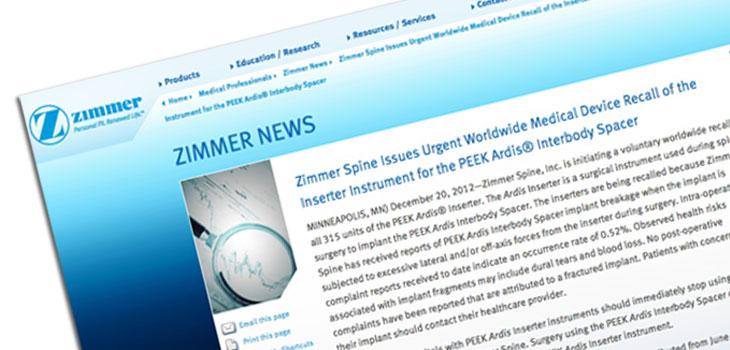
That’s the warning in an urgent worldwide recall issued by the company on December 20, 2012, of all 315 units of the inserter sold since 2008.
The inserters are being recalled because the company has received reports of PEEK Ardis Interbody Spacer implant breakage when the implant is subjected to excessive lateral and/or off-axis forces from the inserter during surgery. Intra-operative complaint reports received to date indicate an occurrence rate of 0.52%.
Observed health risks associated with implant fragments may include dural tears and blood loss. No post-operative complaints have been reported that are attributed to a fractured implant. Patients with concerns about their implant should contact their healthcare provider.
Surgery using the PEEK Ardis Interbody Spacer cannot be performed as intended without the aid of the PEEK Ardis Inserter instrument.
Risks Observed
In a letter to hospitals, the company indicated the most probable risk observed is implant breakage that results in surgical delays up to 60 minutes to remove fragments from the patient. The immediate health consequence could be a prolongation of surgery while trying to retrieve the fragment(s) from the surgical site, resulting in a patient’s extended exposure to anesthesia. Potential extended surgery time could also expose patients to the standard risks associated with general anesthesia.
In certain occasional cases, fragments have been left in the patient. While no post-operative complaints have been received, the long-range health consequence of leaving a fragment in vivo is unknown. The interbody spacer is made from PEEK material and is considered to be biocompatible for long-term implantation.
Implant fragments which are not retrieved carry the risk of migrating within the body and could result in pain and the related need for medical intervention. No post-operative reports have been received related to risks associated with fragment migration.
The worst case observed occasional risk is patient injury associated with intra-operative dural tears and blood loss. Sharp edges of the broken implant may contact and damage adjacent structures, requiring surgical intervention.
Providers should contact their Zimmer representative to arrange for the return of any inserters in their possession.
See list of part numbers in the company’s press release.
FDA Comment
On December 28, the FDA commented on the recall on the agency’s web site:
Initially, in November 2012, Zimmer Spine issued a Medical Device Correction memo to inform surgeons and hospitals of the problem and to provide updated precautions and surgical technique guidance to decrease the risk of implant breakage. In this memo, Zimmer Spine also indicated that on or about May 2013, a redesigned inserter would be available for use when implanting the PEEK Ardis Interbody Spacer.
On Dec. 20, 2012, Zimmer Spine modified their Medical Device Correction memo and initiated a voluntary recall of all 315 units of the PEEK Ardis Inserter. Surgeons and hospitals were instructed to immediately stop using the Ardis Inserter and to return them to Zimmer Spine. Surgeons and hospitals should be aware that surgery using the PEEK Ardis Interbody Spacer cannot be performed as intended without the use of the Ardis Inserter. Therefore the PEEK Ardis Implant System will be unavailable for use until a redesigned inserter is cleared by the FDA.
Class I recalls are the most serious type of recall and involve situations in which there is a reasonable probability that use of these products will cause serious adverse health consequences or death.
Author
React:
Discussion
This is a fascinating development. In my practice we've seen similar outcomes with the revised protocol. The key differentiator seems to be patient selection criteria. Has anyone else noticed the correlation with BMI thresholds?
Great point. I'd push back slightly on the conclusion, the sample size in the cited study is too small to draw population-level inferences. That said, the directional signal is compelling and worth a larger RCT.
We implemented a similar approach last year. Early results are promising but we're still gathering 12-month follow-up data. Happy to share our protocol if anyone is interested.
Join the conversation
Orthopedic professionals are discussing this. Sign in and upgrade to read every comment and add your voice.