
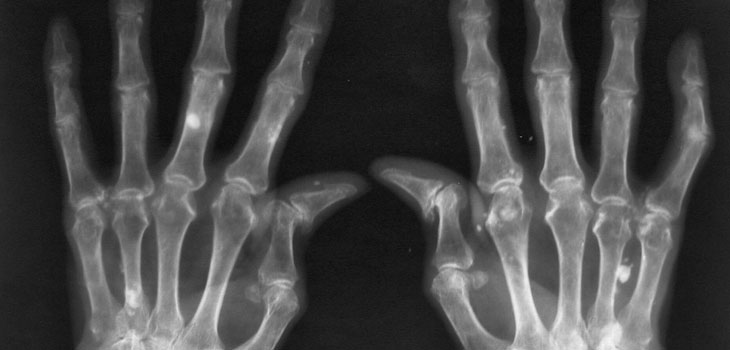
Both rheumatoid arthritis (RA) and osteoarthritis (OA) are disabling ailments but patients with RA have an increased risk for hip dislocation following hip replacement surgery compared to patients with OA. Rheumatoid arthritis patients also have a higher risk of infection following total knee replacement surgery than do patients with osteoarthritis. This is according to a study published online in Arthritis & Rheumatism, a journal of the American College of Rheumatology (ACR).
Rheumatoid Arthritis More Problematic Than Osteo
1 min read Premium comments
Secondary
Bheeshma Ravi, M.D., from the University of Toronto and Women’s College Research Institute (WCRI) in Canada and his colleagues conducted a systemic review of the literature to assess the complication risk in OA and RA patients following joint replacement surgery. They evaluated evidence from January 1990 to December 2011 and included 40 studies in the analysis. The study population included patients aged 18 years or older who had hip or knee replacements and excluded patients who had replacement surgery due to a fracture or cancer. The team found no difference in revision rate, 90-day mortality or blood clot risk between the two patient groups.
In this first systemic review of evidence assessing complications following total joint arthroplasty, the investigators found that patients with rheumatoid arthritis had an increased risk for hip dislocation after hip replacement surgery compared to those with osteoarthritis. They also found that RA patients have a higher infection risk following total knee replacement than do patients with OA.
The study reported that OA—the most common form of arthritis—affects 27 million Americans 25 years of age and older. Another 1.3 million adults are living with RA. According to the Centers for Disease Control and Prevention surgeons performed 676, 000 total knee replacements and 327, 000 total hip replacements in the U.S. in 2009. “Additional studies to confirm our findings are necessary and further investigation of possible reasons for differences in joint replacement complication rates between RA and OA patients is needed, ” Ravi said.
Author
React:
Discussion
This is a fascinating development. In my practice we've seen similar outcomes with the revised protocol. The key differentiator seems to be patient selection criteria. Has anyone else noticed the correlation with BMI thresholds?
Great point. I'd push back slightly on the conclusion, the sample size in the cited study is too small to draw population-level inferences. That said, the directional signal is compelling and worth a larger RCT.
We implemented a similar approach last year. Early results are promising but we're still gathering 12-month follow-up data. Happy to share our protocol if anyone is interested.
Join the conversation
Orthopedic professionals are discussing this. Sign in and upgrade to read every comment and add your voice.