
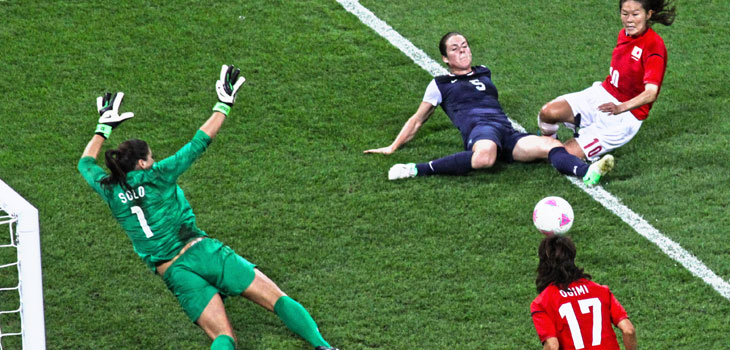
Female athletes tear their anterior cruciate ligament (ACL) six to eight times more than male athletes who play the same sport. A leading sports medicine surgeon contends that by incorporating a program into the regular training regimen teaching women how better to jump and land, more women will be able to stay on the playing field and out of the operating room.
Remedy for Women Athletes’ ACL Tears
1 min read Premium comments
Secondary
“Studies have shown up to a 50% decrease in ACL tears in female soccer players who took part in a jumping and landing program, ” said Patrick McCulloch, M.D., an orthopedic surgeon with the Methodist Center for Sports Medicine in Houston, Texas. “Most of these injuries occur in sports with a lot of cutting and pivoting such as basketball and soccer.”
McCulloch says many women land with their knees straight and their kneecaps pointing inward which puts an incredible amount of stress on the ACL. Men, on the other hand, tend to land with their feet further apart and with more bend in their knees. McCulloch believes a jumping/landing program involving plyometric exercises can help women train their muscles to develop a “muscle memory” that will alert their hamstrings to fire off at the right time and help them land with a bend in their knees.
The program McCulloch designed lasts six weeks. The first two are spent on form and control. Weeks three and four mark the start of jumping off of a single leg. The athletes continue to focus on jump control, but they also learn how to transition more quickly and effectively between jumps. Weeks five and six are considered the performance stage in which quickness and explosiveness are emphasized.
“Women’s college basketball coaches usually recruit more women each year because they know one or two will most likely tear their ACL, ” McCulloch said. “I believe if schools and clubs would incorporate a jumping/landing program into their in-season and off-season training programs they would lessen the chances that their athletes will be put on the disabled list with an ACL tear.”
Author
React:
Discussion
This is a fascinating development. In my practice we've seen similar outcomes with the revised protocol. The key differentiator seems to be patient selection criteria. Has anyone else noticed the correlation with BMI thresholds?
Great point. I'd push back slightly on the conclusion, the sample size in the cited study is too small to draw population-level inferences. That said, the directional signal is compelling and worth a larger RCT.
We implemented a similar approach last year. Early results are promising but we're still gathering 12-month follow-up data. Happy to share our protocol if anyone is interested.
Join the conversation
Orthopedic professionals are discussing this. Sign in and upgrade to read every comment and add your voice.