
The orthopedic robotics market grew by one on December 10 as the FDA cleared Blue Belt Technologies, Inc.’s robotic-assisted NavioPFS orthopedic surgical system for unicompartmental knee replacement.
New Robotic Knee Surgery Device Hits Market
2 min read Premium comments
Secondary
The clearance covers only partial knee replacement, but a Blue Belt press release said the company anticipates expanding further into orthopedic surgery.
Blue Belt received European CE Mark for the system in February and expects to begin commercialization in the U.S. sometime in 2013 and start competing with MAKO Surgical Corp’s RIO system.
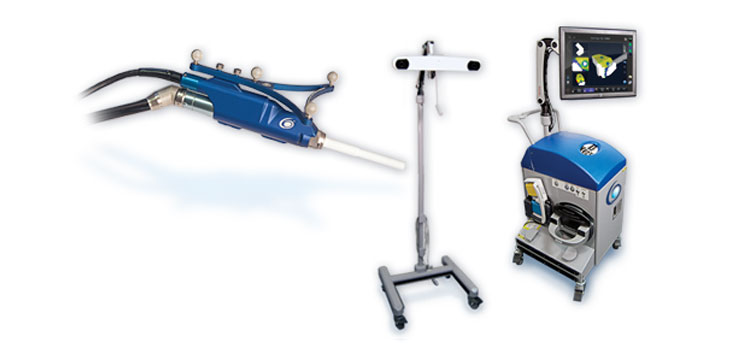
NavioPFS
NavioPFS consists of a navigation system and an intelligent, handheld, computer-assisted bone-cutting tool. The system limits bone cuts to the targeted areas by enabling and disabling the cutting burr as needed which potentially increases implant placement precision and consistency. The system does not require a CT scan and costs around $300, 000 to $350, 000. It’s also an open platform that allows for the use of any manufacturer’s implants. The RIO system, with its partial knee application, costs around $850, 000 and only uses its own line of implants.
MAKO Threat?
The news caught the attention of Wall Street analysts who cover MAKO Surgical. MAKO’s RIO system offers both partial knee resurfacing and hip arthroplasty.
Wells Fargo’s Larry Biegelsen wrote, while he believes Blue Belt’s technology is the first serious threat to MAKO in orthopedic robots, “we think it is too early to tell what impact Blue Belt will have on MAKO’s business longer term. With MAKO’s installed base, clinical evidence head start and hip application (and potential future applications), we believe that Blue Belt’s approval will have a minimal near-term impact on MAKO’s business.”
Biegelsen noted the Blue Belt lacks clinical data and has been used in only 10 procedures at three sites in Europe, with a fourth site expected later this year or early 2013. Blue Belt expects the U.S. launch to be concentrated at three or four sites initially, with a full official launch at the American Academy of Orthopedic Surgeons (AAOS) in March 2013.
Blue Belt CEO: “It’s Economics”
Eric Timko, president and CEO of Blue Belt said the company has remained committed to providing orthopedic surgeons and hospitals “a more precise and consistent technique to perform (unicompartmental knee replacement) procedures that takes into consideration the current economic environment in our healthcare system. We are confident that NavioPFS accomplishes these goals.”
Blue Belt is developing “smart” surgical instruments with precision robotics for use initially in orthopedic procedures and then for other surgical specialties, including neurosurgery, spinal and otolaryngology.
Author
React:
Discussion
This is a fascinating development. In my practice we've seen similar outcomes with the revised protocol. The key differentiator seems to be patient selection criteria. Has anyone else noticed the correlation with BMI thresholds?
Great point. I'd push back slightly on the conclusion, the sample size in the cited study is too small to draw population-level inferences. That said, the directional signal is compelling and worth a larger RCT.
We implemented a similar approach last year. Early results are promising but we're still gathering 12-month follow-up data. Happy to share our protocol if anyone is interested.
Join the conversation
Orthopedic professionals are discussing this. Sign in and upgrade to read every comment and add your voice.