
The U.S. Agency for Healthcare Quality and Research (AHRQ) is reopening the debate about the safety and effectiveness of spinal fusion. Their reports are often used by commercial payers in determining coverage policies.
AHRQ Questions Safety and Effectiveness of Spinal Fusion
2 min read Premium comments
Secondary
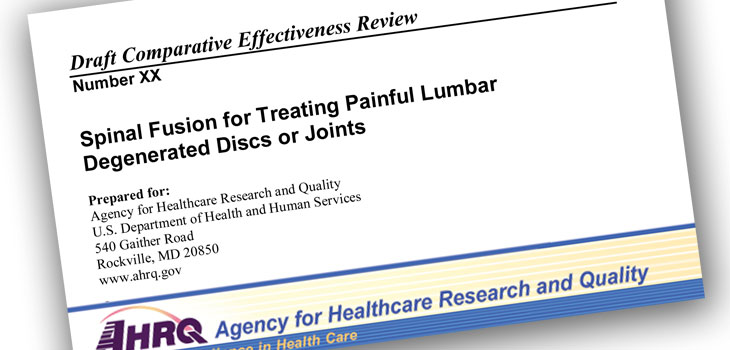
Given that payers have been balking at paying for fusion surgery for lower back pain, it should give providers pause to know that AHRQ just announced it was taking up a comparative effectiveness review of “Spinal Fusion for Treating Painful Lumbar Degenerated Discs or Joints.”
The agency said it was doing this because there is “limited evidence” that spinal fusion is effective and there is insufficient reporting to conclusively determine the incidence of adverse events. Basically they are reopening the question of safety and effectiveness. The purpose of their draft report was to “assess whether previous research is sufficient to support evidence-based conclusions about the benefits and harms of lumbar fusion relative to nonsurgical treatments or other invasive treatments or to support conclusions about outcomes following the use of different fusion strategies.”
“Limited and Insufficient Evidence”
Here is a summary of their draft conclusion:
“Overall, limited evidence suggests that spinal fusion compared with physical therapy improves pain and function for adults undergoing fusion for low back pain due to disc degeneration.
Because of insufficient reporting and variation in surgical methods used in the different studies, the incidence of adverse events (serious and minor) associated with fusion could not be determined conclusively.
The evidence was insufficient to draw evidence-based conclusions for the benefits and harms of spinal fusion for patients with degenerative stenosis or degenerative spondylolisthesis of the lumbar spine.
The evidence was also largely insufficient to draw conclusions about the benefits and harms of fusion compared with other invasive treatments or different fusion approaches or techniques. Thus, future research is needed in these areas.
However, many of the studies reviewed in full for this review were ultimately excluded for lack of relevance to modern treatment practices in the United States. Because implantable devices are frequently replaced by new products and generations of products, either by product line updates or withdrawal of previous implants and instrumentation from the market because of adverse events, ongoing clinical studies of new devices and materials are needed.”
The ISASS (International Society for the Advancement of Spine Surgery) and NASS (North American Spine Society) are both engaging their members to respond to a December 18, 2012 deadline to submit comments to the agency on its “Draft Comparative Effectiveness Review.”
Click here to read the 118-page report and comment by December 18.
Author
React:
Discussion
This is a fascinating development. In my practice we've seen similar outcomes with the revised protocol. The key differentiator seems to be patient selection criteria. Has anyone else noticed the correlation with BMI thresholds?
Great point. I'd push back slightly on the conclusion, the sample size in the cited study is too small to draw population-level inferences. That said, the directional signal is compelling and worth a larger RCT.
We implemented a similar approach last year. Early results are promising but we're still gathering 12-month follow-up data. Happy to share our protocol if anyone is interested.
Join the conversation
Orthopedic professionals are discussing this. Sign in and upgrade to read every comment and add your voice.