
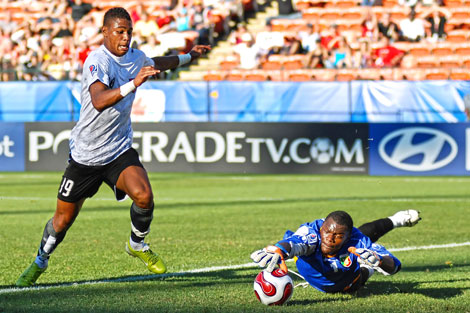
Beware of any-size blows to the head! A study of elite male soccer players found differences in the integrity of their brain white matter similar to that seen in patients with mild traumatic brain injury. The players had not suffered concussions, leading researchers to presume that hits on the head that are below the threshold for causing a concussion may still result in changes in the brain’s white matter. The study was reported by Todd Neale, writing in MedPage Today.
Study Questions Safety of Soccer
1 min read Premium comments
Secondary
Inga Koerte, M.D., of Harvard Medical Schools Psychiatry Neuroimaging Laboratory in Boston, and colleagues compared a group of male soccer players, who often use their heads to direct the ball, with a group of competitive swimmers who were unlikely to have repetitive brain trauma. None of the participants in either group had a history of concussion.
Participants in the study were 12 right-handed male soccer players from an elite-level soccer club in Germany who had trained since childhood for a professional career in the sport. Their mean age was 19.7 and they had been playing for an average of more than 13 years. The control group consisted of 11 competitive swimmers who were matched by age, handedness, and sex. Their mean age was 21.4 and they had trained for an average of more than 9 years.
Neale reported that the soccer players showed increased radial diffusivity “in the right orbitofrontal white matter, the genu and anterior portions of the corpus callosum, association fibers involving bilateral inferior fronto-occipital fasciculus, bilateral optic radiation, and bilateral anterior cingulum, right anterior, right superior, and bilateral posterior corona radiata, right anterior limb of the internal capsule, right external capsule, and right superior frontal gyrus.” The soccer players also had higher axial diffusivity in the corpus callosum, but there were no differences between the groups in fractional anisotropy or mean diffusivity. A neuroradiologist found no abnormalities in structural images of the brain.
Koerte reported the results of the study in a research letter in the November 14 issue of the Journal of the American Medical Association and acknowledged that the study was limited by the small sample size.
Author
React:
Discussion
This is a fascinating development. In my practice we've seen similar outcomes with the revised protocol. The key differentiator seems to be patient selection criteria. Has anyone else noticed the correlation with BMI thresholds?
Great point. I'd push back slightly on the conclusion, the sample size in the cited study is too small to draw population-level inferences. That said, the directional signal is compelling and worth a larger RCT.
We implemented a similar approach last year. Early results are promising but we're still gathering 12-month follow-up data. Happy to share our protocol if anyone is interested.
Join the conversation
Orthopedic professionals are discussing this. Sign in and upgrade to read every comment and add your voice.