
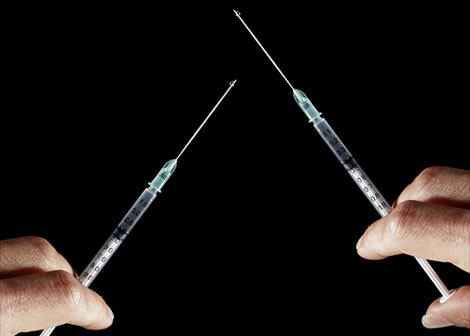
How safe are epidural steroids shots when they are injected into the space around the spinal cord? A study by researcher Shalom Mandel, M.D. of Henry Ford Hospital in Detroit, Michigan, presented at the recent meeting of the North American Spine Society, raised new concerns about the injections that are used to treat millions of back pain sufferers.
Safety of Steroid Shots Questioned
1 min read Premium comments
Secondary
“For a patient population already at risk for bone fractures, steroid injections carry a greater risk than previously thought, ” said Mandel.
Researchers at Henry Ford Hospital examined data on 6, 000 patients treated for back pain between 2007 and 2010. They treated half of the patients with at least one epidural steroid shot and the other half never received the treatment. According to the analysis, spinal fracture risk increased by 29% with each steroid shot. The researchers are quick to point out that this was an association, and does not prove cause and effect.
Steroid treatments, such as those taken orally or by IV, have long been linked to bone loss. However, epidural steroid shots were thought to have little impact on bones because they were delivered directly to the problem area and thus had less effect on the rest of the body. Mandel says this may not be the case.
If epidural steroids are causing fractures, it is probably because the treatment is not localized, ” he said. “The drug may be entering the circulatory system.
The final word is that more study is needed.
Author
React:
Discussion
This is a fascinating development. In my practice we've seen similar outcomes with the revised protocol. The key differentiator seems to be patient selection criteria. Has anyone else noticed the correlation with BMI thresholds?
Great point. I'd push back slightly on the conclusion, the sample size in the cited study is too small to draw population-level inferences. That said, the directional signal is compelling and worth a larger RCT.
We implemented a similar approach last year. Early results are promising but we're still gathering 12-month follow-up data. Happy to share our protocol if anyone is interested.
Join the conversation
Orthopedic professionals are discussing this. Sign in and upgrade to read every comment and add your voice.