
Both patients and staff prefer the anterior approach argues Joseph Moskal, “A day doesn’t go by that I don’t hear from a staff member or patient that it’s night and day between a total hip through an anterior approach and the posterior approach.” Not so fast, says Tom Sculco, “The posterior is an expeditious approach that we all know and I can’t see any advantage of the anterior approach.”
Moskal, Sculco Duel Over Anterior THA
8 min read Premium comments
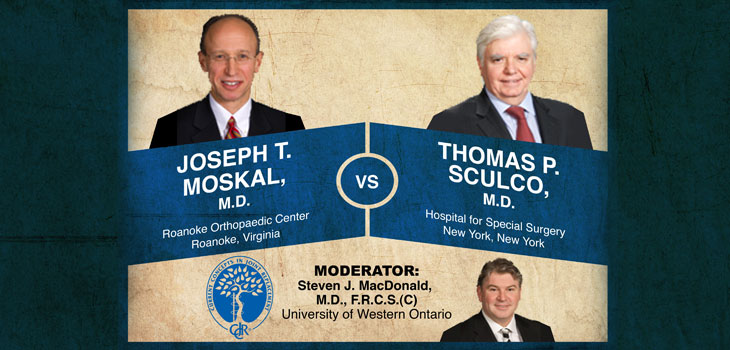
This week’s Orthopaedic Crossfire® debate is “The Anterior Approach Optimizes THA [total hip arthroplasty].” For the proposition was Joseph T. Moskal, M.D. of Roanoke Orthopaedic Center in Virginia. Against the proposition was Thomas P. Sculco, M.D. from Hospital for Special Surgery. Moderating was Steven J. MacDonald, M.D., F.R.C.S.(C) of the University of Western Ontario.
Dr. Moskal: “I’d like to acknowledge the many contributions made by my opponent, Dr. Tom Sculco, including one of the first affirmations in less extensive surgery that he presented at the 2003 Current Concepts in Joint Replacement meeting. I quote: ‘The rationale for performing hip arthroplasty through a less extensive exposure is to reduce hospital stay, speed recovery, and decrease surgical trauma. Certainly patients are happier with a smaller incision. Recovery is faster.’ I can’t say it any better.”
“But, there have been advances since 2003. In a clinical comparative study of the direct anterior approach to the mini-posterior approach done by a single senior joint surgeon, there were 182 consecutive patients (195 hips); more rapid recovery for hip function and gait ability after total hips done through an anterior approach as compared to a mini-posterior approach. Cups were more accurately positioned in the anterior approach, and there was no difference in complications.”
“In a prospective randomized gait analysis study showing statistically significant improvement with direct anterior total hips in a large number of gait parameters; there was also earlier return to near normal gait. In a lead study in the Journal of Arthroplasty—prospective randomized—from the Rothman Institute…single surgeon, same pre- and post-operative protocol. At six weeks, six months, and one year direct anterior was significantly better using mental and physical validated outcome measurement tools.”
“The direct lateral approach was my ‘workhorse’ for over 20 years, and I used it in 96% of primary hips. I considered change because of Louis Ripley, the founder of my group. Every day he reminded me that ‘One cannot live on yesterday’s kisses.’”
“So in 2010 I utilized the anterior approach in 97% of all my primary hips, and a day doesn’t go by that I don’t hear from a staff member or patient that it’s night and day between patients who have had a total hip through an anterior approach versus another approach. Why? Because this is a muscle sparing approach, therefore the tensor fascia lata is not violated.”
“The other approaches are muscle splitting approaches, and therefore do violate the tensor fascia lata. So when you cut or detach a muscle you disturb the important role it plays in hip function and dynamic stabilization. This is true regardless if you use an anterior lateral, direct lateral, or posterior approach. Therefore in a muscle splitting procedure patients require at least six weeks of muscle healing plus time to recover muscle strength. Patients need time to recover from both the surgical approach and the procedure.”
“The biggest improvements that my patients appreciate postoperatively and immediately are that we’ve allowed everyone to be weight bearing as tolerated, we’ve used a multimodal pain management protocol, and now, the anterior approach. In addition, optimal hip exposure is able to be maintained with one assistant and the use of a fracture table. This better exposure allows more accurate component placement, determination of leg length and component offset. There is a learning curve, and I strongly recommend that people attend cadaver-based learning centers, and do surgeon visitations. But if you’re truly happy with your results and what you’re doing I think it’s fine to say so.”
“We must ask ourselves, ‘Is there room for improvement?’ In orthopedics it’s not uncommon for today’s heresy to become tomorrow’s dogma or gold standard. We must remember the oath we took…do no harm…especially when embarking on a new procedure or technology. But the issue is not whether we will embrace this or other new techniques or technologies, but rather, how should they be introduced.”
Dr. Sculco: “Why do I use the mini-posterolateral approach, which is something I popularized about 12 years ago? It’s a commonly utilized approach in hip surgery, it can be easily extended, there’s less blood loss, and it’s an expeditious approach to the hip. Its main disadvantage has been that it has an increased dislocation rate. In the femoral exposure one can see three dimensionally all the way around the inferior portion of the calcar as well as the entire proximal femur.”
“In an ongoing study of my cases—almost 1, 500 followed out to 10 years the skin incision is a little over 8cm. Radiographically, the results have been quite good. The abduction angle for the cup has been 42 degrees on average; cement technique for those cemented early on was excellent, and the stem position was quite good. The dislocation rate was a little over 1%; 0.3% femoral fractures; neuropraxia, primarily in the earlier cases, with the sciatic nerve because of too much compression, and a bit of overzealous attempt to make the incision too small. Wound complications have been dramatically small in number. In a younger patient you can mobilize them to full weight bearing and all of them will go home on a cane…and most are off the cane in two to three weeks.”
“The anterior approach has tremendous media popularity—and some hype. Patients come into my office asking if I’ll do the operation through the anterior approach. On the Internet there are now 62, 000 sites discussing the anterior approach to the hip joint. Claims made: it’s tissue sparing, there’s less pain, faster recovery…very little evidence of this.”
“The disadvantages of the anterior approach: you need a special OR table (twice the price of a normal OR table); most surgeons are using intraoperative fluoroscopy that adds time and potential complication; femoral exposure is difficult; increased OR time; and there is a question about whether complications are higher.”
“Is it really muscle sparing? This is a study done by Meneghini—a cadaveric study looking at muscle damage in the posterior versus the anterior approach. As you’d expect in the posterior approach, there’s a little more damage to the gluteus compared to the anterior approach. But the anterior approach in this study showed significant muscle damage to the tensor fascia lata, and 50% of the external rotators were transected with the femoral approach.”
“A study looking at injury in anterior versus posterior approach…they looked at IL 6 and another heart fatty acid binding protein. There’s no difference in these markers of injury in a standard posterolateral approach versus the anterior approach. Dislocation rates: in four published studies we see similar rates to our dislocation rate of 1.2% (0.96%, 0.61%, 1.3%, 1.5%). Femoral fractures: Joe Matta is the one who has popularized this approach. He has had a 2.4% fracture rate—three ankle fractures because of the severe external rotation of the limb that’s needed with that fracture table.”
“A recently published paper: 132 patients utilizing the anterior approach, both for hip resurfacing and total hip replacement surgery. There was significant injury to the lateral femoral cutaneous nerve, which arborizes very differently in different patients and can be injured. Over 80% of these patients had some kind of lateral femoral neuropraxias after surgery. In a paper involving five community hospitals (by Woolson), these surgeons had almost a three hour surgical time, significant blood loss, and a 9% complication rate. So is this the operation for the everyday surgeon who doesn’t do them frequently…and should you have special training?”
“Keep it simple. Use whatever approach you want. If you’re going to use this approach study it and be well experienced prior to attempting it.”
Moderator MacDonald: “Joe, are you aware of a single blinded, randomized clinical trial? I don’t think the Philadelphia one was blinded?”
Dr. Moskal: “They stated that it was blinded, that it was prospective, same surgeon, same preoperative protocol, etc.”
Moderator MacDonald: “So that’s the one paper out that backs up the thesis. Tom, what evidence would you need to support the feeling that there’s a bit more to this anterior approach than the 62, 000 internet sites?”
Dr. Sculco: “You’ve got to do what you’re comfortable with and that’s easy for you. Any time you make surgery a little more difficult you add potential danger/complications. I think the posterior approach is so simple, and that the dislocation rate is becoming less of a problem with these larger femoral heads…and it’s an expeditious approach that we all know. So I can’t see any advantage of the anterior approach. If you look at Parvizi’s study, that’s really a direct lateral approach, and that’s where some of the abductor is often removed and I don’t think you can compare that to the posterolateral.”
Dr. Moskal: “I agree, but I think those of us who have been in practice one, two, three, or four decades are doing things a lot differently than since our formal training. I had to subsequently go to cadaver courses or visit someone or teach myself. The issue with the Woolson paper is that it was five community surgeons who all did the posterior approach, but chose to go to this approach to decrease their dislocation rate. Four of those five trained only by visiting a surgeon one time; the fifth surgeon didn’t visit anyone and started doing it. Despite the fact that they had a sixfold higher incidence of complications, they are all still choosing to do the approach…so there must be some benefit that warrants them to continue to do it.”
Moderator MacDonald: “They might be scared to do anything else after that [complication rate]. Are there patients, Joe, that you don’t do it in?”
Dr. Moskal: “Skinny patients are a good way to start. It might be easy to even do femoral neck fractures. The ones I don’t do are those who I have to use a modular type of stem like the S-ROM or a derotation osteotomy, a bad DDH (developmental dysplasia of the hip), someone who has had previous ORIF [open reduction with internal fixation] of the posterior column where I may have to take their hardware out or ankylosing that I need access to the hardware, I will go posteriorly. But that’s the exception.”
Moderator MacDonald: “Tom, what do you think is the best way for us to be introducing these things because sometimes there’s a bit of a potpourri approach?”
Dr. Sculco: “It should be done slowly. Look at the two incision technique. That was a huge thing at the AAOS [American Academy of Orthopaedic Surgeons] about eight years ago. I’ll bet there are not 1% of the people in this room that are using that technique. If you want to try something new, as Joe said, study it.”
Moderator MacDonald: “Thank you, gentlemen.”
Please visit www.CCJR.com to register for the 2012 CCJR Winter Meeting, December 12 – 15 in Orlando, Florida.
 “You may now view CCJR meeting content on your mobile device on the CCJR MobileTM App. Please scan the QR code to download from iTunes.”
React:
Discussion
This is a fascinating development. In my practice we've seen similar outcomes with the revised protocol. The key differentiator seems to be patient selection criteria. Has anyone else noticed the correlation with BMI thresholds?
Great point. I'd push back slightly on the conclusion, the sample size in the cited study is too small to draw population-level inferences. That said, the directional signal is compelling and worth a larger RCT.
We implemented a similar approach last year. Early results are promising but we're still gathering 12-month follow-up data. Happy to share our protocol if anyone is interested.
Join the conversation
Orthopedic professionals are discussing this. Sign in and upgrade to read every comment and add your voice.