
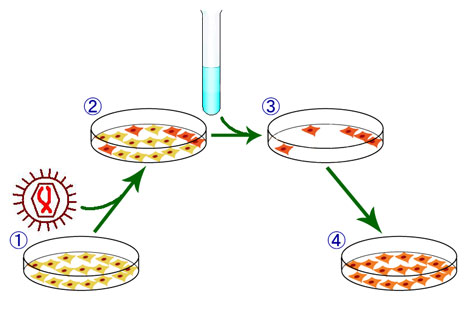
Building on the work of Shinya Yamanaka, winner of the 2012 Nobel Prize for Medicine, Korean scientists report on a breakthrough technology that, they say, can more efficiently and safely reprogram adult cells to an embryo-like state where they can grow into various organs. Yamanaka first created this type of cell in 2006 by delivering four genes into a lab mouse through the use of viral vectors.
Korean Scientists Speed Up iPS Development
1 min read Premium comments
Secondary
Instead of viral vectors that, they said, often cause cells to die and develop cancer, the Korean scientists used nanoparticles, a biodegradable agent, and liposomal, which works like a magnet, to deliver genes into an adult stem cell nucleus of a mouse.
The two research teams, led by Professor Park Se-pill at Jeju National University Stem Cell Research Center and Mirae Biotech, succeeded in generating induced pluripotent stem cells (iPS). Non-viral vectors usually consist of DNA that can be delivered to a target cell, Park said. The findings were featured in the latest edition of the peer-reviewed scientific journal PLOS last month.
The research teams found that the iPS cells first reverted to their initial type and then differentiated into various cells such as neurons, cardiac muscular cells and cartilage cells. They reported that this is the first time that a non-viral system has been developed. According to Park, not only is it free from dangerous side-effects, the method significantly boosts the efficiency and shortens the time of iPS cell production.
Park is well known in Korea for his animal cloning and embryonic stem cell research. His findings should boost hopes for developing therapies for patients with nervous system diseases, he said, adding that his new method of cell modification is simple.
Author
React:
Discussion
This is a fascinating development. In my practice we've seen similar outcomes with the revised protocol. The key differentiator seems to be patient selection criteria. Has anyone else noticed the correlation with BMI thresholds?
Great point. I'd push back slightly on the conclusion, the sample size in the cited study is too small to draw population-level inferences. That said, the directional signal is compelling and worth a larger RCT.
We implemented a similar approach last year. Early results are promising but we're still gathering 12-month follow-up data. Happy to share our protocol if anyone is interested.
Join the conversation
Orthopedic professionals are discussing this. Sign in and upgrade to read every comment and add your voice.