
“There are many disadvantages of a tourniquet, ” says Richard Jones. “Let it bleed!” “Wait, ” says Steve MacDonald, “There can be no argument that a tourniquet reduces intra-operative blood loss. You use a tourniquet if you’re good looking and highly intelligent.”
Jones Debates MacDonald Over Tourniquets
7 min read Premium comments
Great Debates
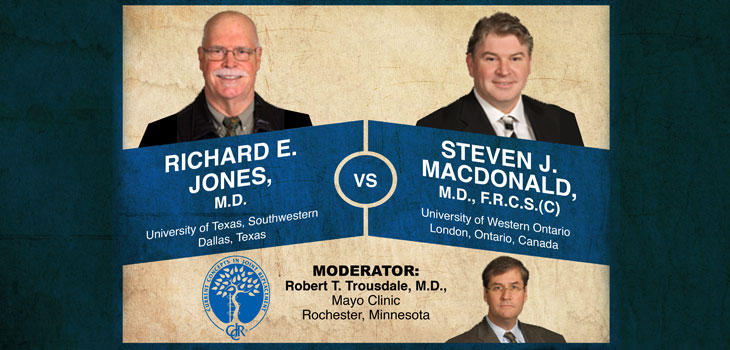
This week’s Orthopaedic Crossfire® debate is “TKA Sans Tourniquet: Let it Bleed.” For the proposition was Richard E. Jones, M.D. of the University of Texas, Southwestern. Against the proposition was Steven J. MacDonald, M.D., F.R.C.S.(C) from the University of Western Ontario. Moderating was Robert T. Trousdale, M.D., of Mayo Clinic in Rochester, Minnesota.
Dr. Jones: “The benefits of TKA [total knee arthroplasty] with tourniquet: you could operate in a bloodless field and potentially there’s a better bone-cement-implant interface for fixation. The potential problems: 1) Neuromuscular: direct nerve damage secondary to pressure and indirect nerve damage secondary to hypoxia; also, a delay in recovery in muscle function. 2) Vascular: altered hemodynamics with limb exsanguination…you actually increase the circulatory volume by 15-20% when you’re putting your tourniquet up. When you release it you get reactive hyperemia which gives you a 10% increase in limb size. That may increase soft tissue tension and it may give you secondary pain.”
“Vascular injury is higher in patients that have atherosclerotic or calcified arteries. Also, increased risk of DVT with direct trauma for the vessel walls, increased levels of thrombin-antithrombin complexes, and a 5.3 times greater risk for large venous emboli propagation and transesophogeal echogenic particles. 3) Furthermore, you get an increase in wound healing disturbances and a higher propensity for wound leakage. Early experience for us with no tourniquet was in the high risk patient with a previous DVT or PE, multiple scarring, or compromised cardiovascular status. For the last eight years we have used no tourniquet on all comers.”
“The operative protocol is regional anesthesia to control blood pressure and reduce bleeding; incision and approach made with 90 degrees of knee flexion; meticulous hemostasis—all vessels readily seen and coagulated with an argon beam coagulator. We use 0.25% ropavicaine with epinephrine injected peri-articular to diminish some of the bleeding. We coagulate all the posterior tissues at the flexion-tension balancing stage after you’ve cut your tibia and your femur. And we use saline jet lavage. We then use filtered carbon dioxide which is delivered through a high pressure Carbo-Jet to dry and prepare bone ends for cementation. We do a routine closure and we use a compressive dressing.”
“Our observations: no differences in blood loss or transfusion rates; less postop pain, faster straight leg raise and knee flexion gain; fewer wound healing disturbances; consistent cement penetration and mantles, so we see no changes in our X-rays and in our follow up in the tourniquet phase and in the post no tourniquet phase. So our recommendation is: give it a try…let it bleed. Thanks to the Rolling Stones.”
Dr. MacDonald: “I have performed TKAs without tourniquets in a select few patients: vasculopaths with no distal pulses and the non-complaining patient in the cadaver lab. There are pros and cons, and there are few randomized clinical trials (RCTs) to guide us in this; there is no registry data. Why use it? There can be no argument that a tourniquet reduces intra-operative blood loss. In a paper published this year—a meta analysis of 15 papers including 1, 040 TKAs there was significantly greater blood loss.”
“However, if you look at overall blood loss—intraop and postop—there was not a significant difference between the two groups. So you have a choice…you can have bleeding in your operative field or you can have bleeding later when you’re finished. I’ll take it later—not in my operative field. But I can’t make an argument that tourniquet use reduces overall blood loss.”
“It’s a given that we want a dry bone surface for cementing. If you don’t have a dry bone surface there is the risk of late loosening. So without a tourniquet you need an alternative…meticulous hemostasis and this crazy thing about filtered carbon dioxide. But they all come with the following: a dollar cost and a time cost. If you don’t have a tourniquet it’s probably going to take you a bit longer.”
“There’s an excellent paper that was published just a couple of months ago showing a direct correlation between OR time and infection in TKA (Willis-Owen CA, et al., JBJS[Am]). Their recommendation was that ‘Steps to minimize intra-operative delay should be instigated.’ and ‘Care should be exercised when introducing measures which prolong the duration of joint replacement.’”
“The proposed downsides to a tourniquet? They’re either basic science theories or they’re rare or short term in my opinion. Vessel wall damage leading to increased DVT…is there a single clinical paper supporting this? There is a paper that refutes that—a tourniquet versus no tourniquet RCT where their outcome measure was to evaluate any evidence of vessel damage using an ultrasound. There was no difference in the incidence of DVT or thrombis between the two groups. This paper showed less intraoperative and total blood loss with a tourniquet.”
“Another proposed downside to a tourniquet is an increase in wound healing disturbances, but there is no clinical evidence for this. Another is delay in muscle function recovery; there is no clinical evidence for that theory. Nerve damage…true…you can get transient changes, but I’m unaware of permanent ones.”
“It’s a judgment call. You don’t use a tourniquet if you are concerned about the theoretical risks and you have alternatives to achieve a dry field…and they are cost neutral…and you don’t increase the OR time…and you don’t need published data on the long term results. So Dickie, there you go. You do use a tourniquet if you’re good looking and highly intelligent.”
Moderator Trousdale: “Dickie presented 15—and granted, you stated some are theoretical—disadvantages of a tourniquet. The one potential advantage—the drier surgical field—you look at Dickie’s intraoperative surgery and his field is pretty dry. Its blood loss…that meta analysis is good. It implies the postop blood loss is lower if you don’t use the tourniquet…so the real issue is transfusion. What are your transfusion rates?”
Dr. MacDonald: “It’s dependent upon a lot of things. We have a protocol…based on their preop hemoglobin we use tranexamic acid in every case…which significantly changes your blood loss. Our transfusion rate in a primary total knee setting is between 3 and 4% depending on the quarter. We get quarterly analysis and it’s variable surgeon to surgeon.”
Moderator Trousdale: “Dickie?”
Dr. Jones: “Same.”
Moderator Trousdale: “Both of these guys are using tranexamic acid. Dickie’s using it topically. Steve?”
Dr. MacDonald: “IV during the OR. With a knee it’s when we’re cementing the patella.”
Dr. Jones: “I’ve been chicken to use it systemically because of possible complications. We’ve used it topically and found that there’re no issues.”
Moderator Trousdale: “Last month a group from Toronto (Wong J, et al., JBJS[Am]) showed that topical use is very effective…and there’s very good data in multiple surgical subspecialties documenting the use of that in an IV. We use a gram at the beginning of the case and a gram at the end.”
Dr. Jones: “One of most specious arguments I’ve ever heard is increased time in the OR. There’s no increased time. Don’t you jet lavage your total knee patients before you cement?”
Dr. MacDonald: “Yes. That’s not really evidence of no increased OR time. I think it’s a hard argument to tell somebody if they stop using a tourniquet it’s going to be exactly time neutral.”
Moderator Trousdale: “Dickie, without a tourniquet you showed us you’re cementing the cobalt chrome tray in flexion. Do you bring the knee in extension when you cement it?”
Dr. Jones: “Yes.”
Moderator Trousdale: “And you don’t think that affects your cement mantle at all?”
Dr. Jones: “No.”
Moderator Trousdale: “You’d think in theory the blood would permeate…”
Dr. Jones: “You would, but it does not. We do it at about 15-20 degrees of flexion and axial compression so that we ensure we’re equivalent with our pressure on both sides. If you cement an extension and you haven’t fully released a valgus or varus deformity, then you’ll end up with an uneven cement mantle. We saw no difference in cement penetration looking at the lateral X-rays and the spot laterals in the OR of the patients that were with tourniquet or without.”
Moderator Trousdale: “Steve, in defense of Dickie, does cement mantle make a difference in total knee replacement? Do we have data in the knee about what thickness cement mantle we want to get?”
Dr. MacDonald: “I would say no. There’s been RSA [radiostereometric analysis] studies done on different things like whether you should cement the keel or the post, and I think we have evidence for micromotion with that. But that’s not a surrogate measure for absolute tray cement mantles.”
Moderator Trousdale: “There are two issues with bleeding. One is hemoglobin and transfusion rates and most of the studies look at tourniquet/no tourniquet, pre- and post-op hemoglobin. That’s a very weak surrogate because the hemoglobin rates both pre- and post-op are directly related to hemodilution issues. Same with the transfusion triggers–it’s different from every hospital and every surgeon. Part of that is how you use drains.”
Dr. MacDonald: “We use a drain for 24 hours—no, actually, until the next operative day. They pull the drains somewhere between 8 and 9am the following day. Every single person gets a drain.”
Dr. Jones: “I haven’t used a drain in a hip or a knee in 20 years; we use compressive dressings.”
Moderator Trousdale: “How do you handle a patient with a PFO [patent foramen ovale]?…25% of our patients have a little atrial septal defect and when you let the tourniquet down you get a showering effect of some emboli. Do you look for patients with a PFO prior to surgery? Do you change your tourniquet based on a cardiac situation or previous embolic stroke?”
Dr. MacDonald: “We don’t look. Do you?”
Moderator Trousdale: “I don’t look.”
Dr. MacDonald: “You don’t know. Trousdale’s trying to sound smart? He has no idea what he just said.”
Dr. Jones: “The good news for me is since I never used a tourniquet I don’t have to worry about all of those issues.”
Moderator Trousdale: “Dickie, you won hands down. You should all stop using tourniquets unless you’re from Canada. Gentlemen, thank you.”
Please visit www.CCJR.com to register for the 2012 CCJR Winter Meeting, December 12 – 15 in Orlando, Florida.
 “You may now view CCJR meeting content on your mobile device on the CCJR MobileTM App. Please scan the QR code to download from iTunes.”
React:
Discussion
This is a fascinating development. In my practice we've seen similar outcomes with the revised protocol. The key differentiator seems to be patient selection criteria. Has anyone else noticed the correlation with BMI thresholds?
Great point. I'd push back slightly on the conclusion, the sample size in the cited study is too small to draw population-level inferences. That said, the directional signal is compelling and worth a larger RCT.
We implemented a similar approach last year. Early results are promising but we're still gathering 12-month follow-up data. Happy to share our protocol if anyone is interested.
Join the conversation
Orthopedic professionals are discussing this. Sign in and upgrade to read every comment and add your voice.