
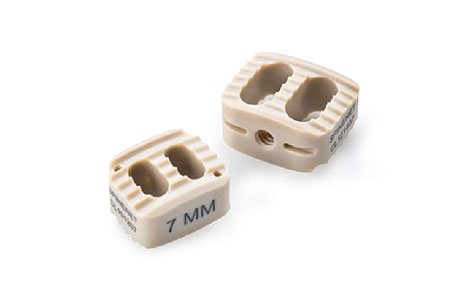
SpineNet, LLC, a manufacturer of spinal fusion implants located in Winter Park, Florida, has received 510(k) clearance from the FDA for its SpineNet ACC anterior cervical cage. The device is made of Zeniva polyetheretherketone (PEEK) rods from Solvay Specialty Polymers USA, LLC. SpineNet officials describe Zeniva PEEK as having characteristics very close to those of bone plus toughness and fatigue resistance. They reported that the FDA clearance was based, in part, on Solvay’s well-developed access file for Zeniva PEEK.
FDA Clears SpineNet’s Cervical Cage
1 min read Premium comments
Secondary
“We chose Zeniva® PEEK for its similarity to the modulus of elasticity of bone, radiographic properties, and the widespread commercial and regulatory acceptance of the material, ” said Rick Kitain, vice president of SpineNet.
SpineNet officials say that the ACC cervical cage is designed to reproduce a tri-cortical iliac crest bone, providing structural support as an interbody spacer for anterior cervical fusions. The superior and inferior surfaces allow for intimate contact with the endplate surfaces for optimum stability and to resist subsidence. The cervical cages are offered in 10x12mm and 12x14mm footprints (5 – 10mm height) with multiple sizing options. The ACC implants have windows which allow bone to grow through the device, fusing the adjacent bony surfaces of the vertebrae. Radiopaque tantalum rod markers allow for improved positioning.
Author
React:
Discussion
This is a fascinating development. In my practice we've seen similar outcomes with the revised protocol. The key differentiator seems to be patient selection criteria. Has anyone else noticed the correlation with BMI thresholds?
Great point. I'd push back slightly on the conclusion, the sample size in the cited study is too small to draw population-level inferences. That said, the directional signal is compelling and worth a larger RCT.
We implemented a similar approach last year. Early results are promising but we're still gathering 12-month follow-up data. Happy to share our protocol if anyone is interested.
Join the conversation
Orthopedic professionals are discussing this. Sign in and upgrade to read every comment and add your voice.