
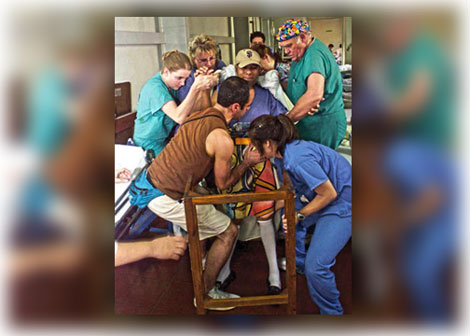
Two Sikh orthopedists, Harpal Singh Khanuja and Gurminer Singh Huja, lead a volunteer medical service organization that will perform free knee and hip replacements next year for about 50 impoverished patients in El Salvador. Khanuja and Huja are from Baltimore and their non-profit organization is called Operation Walk Maryland.
El Salvador Poor to Get Implants
1 min read Premium comments
Secondary
A team of about 45 medical personnel plan to go to the San Rafael Hospital in San Salvador at the end of January 2013. Patient screening has already begun. Juan Jose Daboub, a former minister of the El Salvador treasury, estimates that El Salvador experiences 4, 400 new cases of disabling arthritis every year.
El Salvador will be Operation Walk Maryland’s fifth annual trip to another country. The team previously went to Lima, Peru, and Quito, Ecuador, and went twice to Ludhiana, India, where surgeons performed 47 joint replacements in 2011 and 59 in 2012. A few months after each surgical mission, Khanuja and his wife, Maria, a nurse, return to run a follow-up clinic and check-up on their patients. They checked in on 38 of their patients in Ludhiana, in July.
The original Operation Walk USA was founded in 1994 by orthopedic surgeon Lawrence Dorr. Khanuja volunteered for a surgical trip with him to El Salvador in 2007, after which he and Maria formed Operation Walk Maryland.
Khanuja and Huja organize the medical team; the surgeons, doctors, nurses, implant specialists, technicians and therapists. Businessman Prabhjot Singh finds sponsors, equipment donors, medicine donors, and transportation discounts for people and cargo. Shipping the medical equipment alone costs up to $30, 000.
According to Khanuja, the total cost is about $125, 000. But the actual value of the surgeries would be well over a million dollars if they were done in the United States. “The respect the patients have for providers who come from across the world is truly amazing, ” he said. “And it really gives me a lot of faith and hope.”
Author
React:
Discussion
This is a fascinating development. In my practice we've seen similar outcomes with the revised protocol. The key differentiator seems to be patient selection criteria. Has anyone else noticed the correlation with BMI thresholds?
Great point. I'd push back slightly on the conclusion, the sample size in the cited study is too small to draw population-level inferences. That said, the directional signal is compelling and worth a larger RCT.
We implemented a similar approach last year. Early results are promising but we're still gathering 12-month follow-up data. Happy to share our protocol if anyone is interested.
Join the conversation
Orthopedic professionals are discussing this. Sign in and upgrade to read every comment and add your voice.