
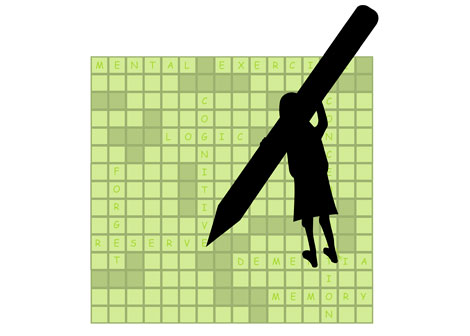
It is physical exercise, not doing crossword puzzles, that keeps aging brains sharp according to research by Alan J. Gow and colleagues from the University of Edinburgh, Scotland. It is the shrinking of the brain, which takes place in late adulthood, that researchers believe is involved in the loss of memory experienced by the aging. “It is pretty clear that exercise is one of the most potent things we can do to protect our brain as we age, ” said University of Pittsburgh exercise and aging researcher Kirk Erickson, Ph.D. The research is reported by Salynn Boyles of WebMD Medical News.
Crossword Fails as Brain Exercise
1 min read Premium comments
Secondary
Alan J. Gow gave brain scans to 700 individuals in the United Kingdom when they reached age 70. They then repeated the brain scans when the subjects were age 73. People in the study who reported being the most physically active tended to have larger brain volumes of gray and normal white matter, and physical activity was linked to less brain atrophy.
Regular exercise also appeared to protect the brain against the formation of white matter lesions, which are linked to thinking and memory decline. The researchers found that non-physical leisure activities, such as the solving of puzzles, did not appear to protect the brain from shrinkage. Though more research is needed, it appears that mental activity may be less important than regular exercise for preserving brain function into old age.
Author
React:
Discussion
This is a fascinating development. In my practice we've seen similar outcomes with the revised protocol. The key differentiator seems to be patient selection criteria. Has anyone else noticed the correlation with BMI thresholds?
Great point. I'd push back slightly on the conclusion, the sample size in the cited study is too small to draw population-level inferences. That said, the directional signal is compelling and worth a larger RCT.
We implemented a similar approach last year. Early results are promising but we're still gathering 12-month follow-up data. Happy to share our protocol if anyone is interested.
Join the conversation
Orthopedic professionals are discussing this. Sign in and upgrade to read every comment and add your voice.