
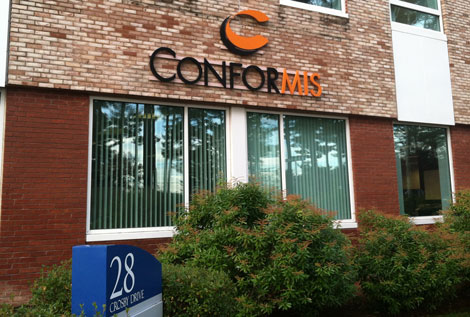
ConforMIS, Inc. has relocated its headquarters to 28 Crosby Drive in Bedford, Massachusetts, bringing the company’s total existing property to more than 120, 000 square feet. The new space, combined with the manufacturing facility in Burlington, quadruples the total square footage of the company’s existing property. The expansion will facilitate the development of advanced manufacturing capabilities, new product development initiatives and a broader commercialization strategy, resulting in more than 100 new jobs over the next 12 to 18 months.
ConforMIS Growing, Moving
1 min read Premium comments
Secondary
“The expansion to our Bedford facility is an important milestone for ConforMIS as we continue to grow our application of image-based technology and support the rapid adoption of our personalized knee replacements, ” said Philipp Lang, M.D., CEO of ConforMIS, in the November 1, 2012 news release. “This brisk growth is a testament to the clinical difference our products make in the lives of patients and the innovation that surgeons feel when they try our technology.”
ConforMIS recently announced the broad commercial availability of its iTotal G2 total knee replacement system and the additional manufacturing space will accommodate the growth of this product line as well as its other knee systems. To support its expanded product line, ConforMIS has also grown its personnel, more than doubling its local employee base in the last two years.
“Thanks to our growth strategy of investing in education, innovation and infrastructure, including our ten-year, $1 billion Life Sciences Initiative, Massachusetts continues to lead the world in life sciences, ” said Governor Deval Patrick. “I congratulate ConforMIS, and appreciate the company’s ongoing commitment to growing in Massachusetts.”
Dr. Lang told OTW,
Our move gives us the ability to do in house development of new manufacturing approaches not previously available to the company that are optimized for our just-in-time delivery model. This will be vital for our company as we continue to expand with new products in knees, as well as in other joints. While our future plans are confidential, we believe the technology we are building today will be the way much of orthopedic joint replacement will be done in the future.
React:
Discussion
This is a fascinating development. In my practice we've seen similar outcomes with the revised protocol. The key differentiator seems to be patient selection criteria. Has anyone else noticed the correlation with BMI thresholds?
Great point. I'd push back slightly on the conclusion, the sample size in the cited study is too small to draw population-level inferences. That said, the directional signal is compelling and worth a larger RCT.
We implemented a similar approach last year. Early results are promising but we're still gathering 12-month follow-up data. Happy to share our protocol if anyone is interested.
Join the conversation
Orthopedic professionals are discussing this. Sign in and upgrade to read every comment and add your voice.