
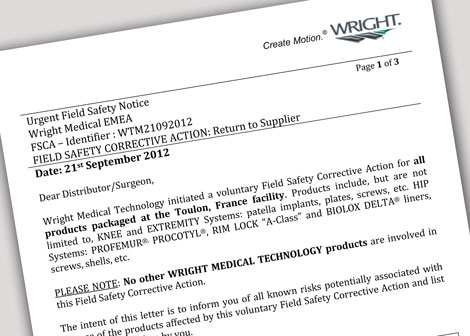
Wright Medical Technology wants providers who have products manufactured at its closed Toulon, France, facility to return them due a shelf life labeling issue.
Wright Issues Voluntary Correction Action
1 min read Premium comments
Secondary
The company issued a voluntary Field Safety Correction Action in September for all products packaged at the facility which closed in 2007.
The products include, but are not limited to:
-
Knee and Extremity Systems: patella implants, plates, screws, etc.
-
Hip Systems: Profemur, Procotyl, Rim Lock “A-Class” and Biolox Delta liners, screws, shells, etc.
No other Wright products are involved in the correction action and, according to a company spokesperson; only some of the products subject to the action are sold in the U.S. The spokesperson also said company management does not anticipate any impact on their ability to supply replacement products. To date, there have been no adverse events reported to the company.
The correction is being taken because there may be a label discrepancy that affects the shelf life listed on the products produced in Toulon facility. The products function as intended. However there is not adequate justification on file to support packaging shelf life listed on the current label.
There have been no reported issues related to the packaging integrity or sterility of those products. This recall is being initiated because there is a potential risk to health that may arise if a packaging integrity failure were to occur.
The company notified users that Wright’s records indicate the user has received the referenced products and are requesting that the user:
-
Immediately check the internal inventory and quarantine all subject products
-
Circulate the Field Safety Notice internally to all affected parties
-
Complete and return an acknowledgement
-
Inform Wright Medical Technology of any adverse event immediately
-
Return any unused product to the local Wright Medical representative
-
The item will be replaced by a new item
Wright does not recommend prophylactic revision surgery but does advise that users continue to monitor patients according to standard followâ€up protocol.
Author
React:
Discussion
This is a fascinating development. In my practice we've seen similar outcomes with the revised protocol. The key differentiator seems to be patient selection criteria. Has anyone else noticed the correlation with BMI thresholds?
Great point. I'd push back slightly on the conclusion, the sample size in the cited study is too small to draw population-level inferences. That said, the directional signal is compelling and worth a larger RCT.
We implemented a similar approach last year. Early results are promising but we're still gathering 12-month follow-up data. Happy to share our protocol if anyone is interested.
Join the conversation
Orthopedic professionals are discussing this. Sign in and upgrade to read every comment and add your voice.