
Stryker Corporation says it’s “revolutionary” and can helping avoid revision hip surgery.
Stryker’s “Revolutionary” Computer-Assisted System
2 min read Premium comments
Secondary
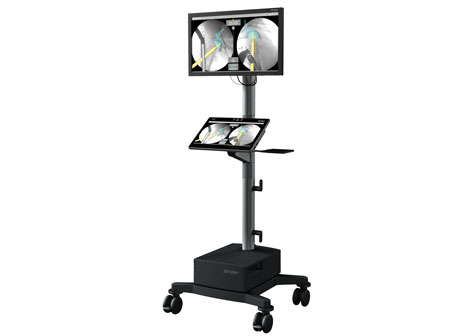
On October 4, the company announced the launch of a computer-assisted surgery system called the Stryker Adapt for the Gamma3 Locking Nail System.
Jim Bruty, senior director of Marketing, Stryker Navigation, said the system allows surgeons to more accurately position nail and lag screws with no significant difference in procedure time during hip surgery.
Proper positioning of the lag screw in the femoral head is an important aspect of achieving positive patient outcomes, according to the company. Failure of a cephalomedullary nail may occur if the lag screw has not been properly placed within the femoral head. A “cut out” of the lag screw in the femoral head is one potential result, which may necessitate a revision surgery.
During conventional hip fracture surgery, surgeons use mechanical instruments and x-ray images to place the nail and lag screw. Stryker’s new system is a computer-assisted surgery system designed to help surgeons in lag screw positioning by using Stryker’s proprietary adaptive positioning technology. The system, according to the company, automatically identifies the Gamma3 Locking Nail relative to the patient’s anatomy and provides computer guidance to assist the surgeon with implant alignment, lag screw length and lag screw positioning.
The Gamma3 Locking Nail System consists of a cephalomedullary nail, a lag screw and a distal locking screw. The cephalomedullary nail is placed into the canal of the femur, and then the lag screw is placed through the nail and into the neck and head of the femur. The lag screw and nail together help unite the fracture, allowing it to become more stable to help promote proper healing.
The company claims the system has been proven to assist surgeons in more accurately positioning the lag screw, regardless of their level of clinical experience. “Optimal lag screw placement has been identified as the primary factor in prevention of lag screw cut out, ” said James Maxey, M.D., orthopedic surgeon in Peoria, Illinois. “The combination of clinical research, trauma engineering and elegant positioning technology allows novice and expert surgeons to accurately place the lag screw. The Stryker Adapt system is a great innovation and advance in hip fracture repair.”
Stryker Adapt was designed specifically for use with Stryker’s Gamma3 Locking Nail System and does not work with any other device.
Author
React:
Discussion
This is a fascinating development. In my practice we've seen similar outcomes with the revised protocol. The key differentiator seems to be patient selection criteria. Has anyone else noticed the correlation with BMI thresholds?
Great point. I'd push back slightly on the conclusion, the sample size in the cited study is too small to draw population-level inferences. That said, the directional signal is compelling and worth a larger RCT.
We implemented a similar approach last year. Early results are promising but we're still gathering 12-month follow-up data. Happy to share our protocol if anyone is interested.
Join the conversation
Orthopedic professionals are discussing this. Sign in and upgrade to read every comment and add your voice.