
Product release with a purpose…Spinal Elements has announced its intention to improve the image of tissue donation when it launches its Hero Allograft human tissue product at the upcoming meeting of the North American Spine Society (NASS) later this month. Hero consists of various configurations of human allograft tissue including demineralized bone matrix (DBM) in paste or putty form, compressible cancellous blocks and strips, and structural grafts.
Spinal Elements Introduces Hero Allograft, Honors Donors
2 min read Premium comments
Secondary
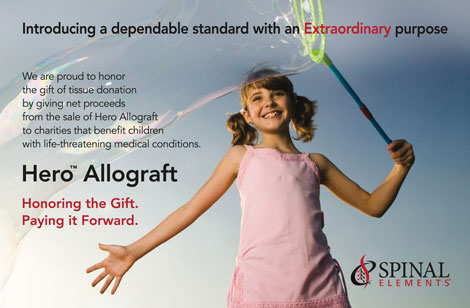
Spinal Elements chose to name its first-ever allograft tissue product “Hero” to honor those whose donation made the tissue possible. The company will donate its net proceeds from the sale of Hero Allograft to charities that benefit children with life-threatening medical conditions.
Spinal Elements launches Hero on the heels of the release of the book The Dark Side of Tissue Donation by Chris Truitt. Truitt comments in the October 1, 2012 news release, “What Spinal Elements is doing by donating the net proceeds from the sale of Hero Allograft to charities that benefit children is unprecedented and extraordinary. It honors the altruistic and noble gift that families give.”
Todd Andres, CEO and co-founder of Spinal Elements, added, “We feel that the best way to pay respect to the donation of human tissue is to donate our efforts to get it to the patients who need it and to extend that gift to ailing children. We refer to that as honoring the gift and paying it forward.”
Jason Blain, president and co-founder of Spinal Elements, told OTW,
Spinal Elements has never been a company that does something because of the status quo. When we develop a product or introduce a technology, we do it because it’s the right thing to do and because we can offer something no one else addresses. If you look at allograft as a product, it is a commodity…and that’s how the spine and orthopedics market sees it. To me that is shame. Allograft is the physical embodiment of a human life and deserves that level of respect. It is a gift.
Regarding the product background, Blain told OTW, “As our company grows, we are continually able to support a broadening range of spinal fusion procedures due to our expanding product offering. We have offered a synthetic graft material for some time, but until now we have not offered allograft in any form. We needed a solution for our distributors and surgeons who wanted just one sales representative in the room during a procedure. Therefore, we knew that we needed to offer allograft products based on the needs of our customers.”
“Our decision to donate our proceeds is an easy decision…it’s the only possible route for us. The decision at its core defines the culture of our company. By donating the proceeds to the Make-A-Wish Foundation and St. Jude Children’s Research Hospital we’re furthering the donor’s gift to those who can’t help themselves. I feel that Hero is more than about a product. It’s about a statement of what we want to be and how we feel allograft should be treated.”
React:
Discussion
This is a fascinating development. In my practice we've seen similar outcomes with the revised protocol. The key differentiator seems to be patient selection criteria. Has anyone else noticed the correlation with BMI thresholds?
Great point. I'd push back slightly on the conclusion, the sample size in the cited study is too small to draw population-level inferences. That said, the directional signal is compelling and worth a larger RCT.
We implemented a similar approach last year. Early results are promising but we're still gathering 12-month follow-up data. Happy to share our protocol if anyone is interested.
Join the conversation
Orthopedic professionals are discussing this. Sign in and upgrade to read every comment and add your voice.