
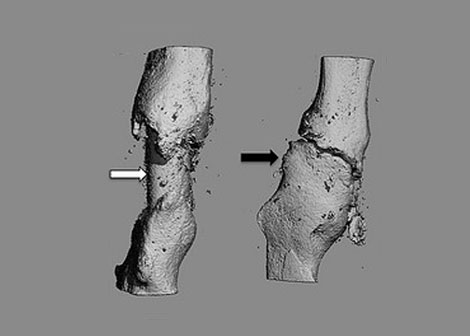
A team of researchers at Penn State has found that coating a bone graft with an inorganic compound found in bones and teeth may significantly increase the likelihood of a successful implant. The scientists have developed a way to create a rough surface on bone grafts that is similar in texture to the surface of an untreated bone. This similarity promotes healing in the bone.
Revolutionary Bone Graft Coating
2 min read Premium comments
Secondary
“We created a method for resurfacing bone that had been processed, and resurfacing that bone so that it is now nearly as osteogenic as unprocessed bone—meaning it works nearly as well as bone that hadn’t been processed at all, ” said Henry J. Donahue, Michael and Myrtle Baker Professor of Orthopaedics and Rehabilitation, Penn State College of Medicine, in the September 24, 2012 news release. “That’s the bottom line.”
Donahue, who is also a faculty member of the Huck Institutes of the Life Sciences, and Alayna Loiselle, postdoctoral fellow in orthopedics and rehabilitation, Penn State College of Medicine, teamed up with Akhlesh Lakhtakia, Charles Godfrey Binder Professor of Engineering Science and Mechanics.
To find the optimum thickness of hydroxyapatite, Drs. Donahue and Loiselle sterilized the graft samples in their lab at Penn State Hershey Medical Center. After sterilization, the samples went to the University Park campus, where physical vapor deposition layered different amounts of hydroxyapatite on the grafts. Then the samples were returned to Hershey for the researchers to test.
The researchers saw that the optimum thickness of hydroxyapatite was in the middle of what they tested. If the hydroxyapatite coating was not thick enough—or there was none—the graft implant worked, but did not integrate as well as if there were a few nanometers more layered onto the surface. If the hydroxyapatite was too thick, the graft implant again worked, but did not integrate as well as the researchers had seen was possible.
Fifteen years ago Dr. Lakhtakia started an area called sculptured thin films. He thought these might be used to heal broken bones, but wasn’t sure how. He suggested that for two bones to be joined, coating the two opposing faces with sculptured thin film might bring them together. The idea was that the bone would grow through the sculptured thin film and fuse together and create some sort of adhesive bond.
Dr. Donahue told OTW,
We have submitted a provisional patent. The next experiments include ongoing studies that examine the cellular mechanism by which the nanotopographies stimulate osteogenesis; large animal studies, most likely in sheep; and experiments to determine whether the technology can be applied to orthopaedic implant material.
React:
Discussion
This is a fascinating development. In my practice we've seen similar outcomes with the revised protocol. The key differentiator seems to be patient selection criteria. Has anyone else noticed the correlation with BMI thresholds?
Great point. I'd push back slightly on the conclusion, the sample size in the cited study is too small to draw population-level inferences. That said, the directional signal is compelling and worth a larger RCT.
We implemented a similar approach last year. Early results are promising but we're still gathering 12-month follow-up data. Happy to share our protocol if anyone is interested.
Join the conversation
Orthopedic professionals are discussing this. Sign in and upgrade to read every comment and add your voice.