
“These types of implants have served patients well, and we have good clinical data to support that, ” argues Stephen Murphy. “No!” counters Michael Dunbar. “The use of modular necks in primary routine arthroplasty isn’t justified because there’s no proof of superiority, increased risks, and increased cost.”
Murphy v. Dunbar on Femoral Neck Modularity in THA
8 min read Premium comments
Great Debates
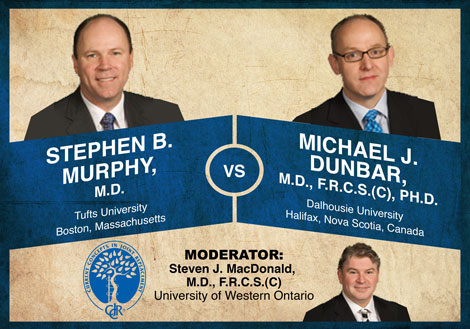
This week’s Orthopaedic Crossfire® debate is “Femoral Neck Modularity in THA: The Missing Link.” For the proposition was Stephen B. Murphy, M.D. from Tufts University in Boston. Against the proposition was Michael J. Dunbar, M.D., F.R.C.S.(C), Ph.D. of Dalhousie University in Halifax, Nova Scotia; moderating was Steven J. MacDonald, M.D., F.R.C.S.(C) of the University of Western Ontario.
Dr. Murphy: “Proper reconstruction of femoral pathomechanics has always been determined by control at the neck shaft junction. In my practice measuring anteversion on CT the variation is from 4 degrees to 61 degrees and I don’t think it’s possible to properly reconstruct the hip during total hip replacement [THA] in all patients without control above the medullary canal.”
“You can do a lot of that by putting a junction at the base of the neck. For example, you can preserve tissue to a greater extent. The technique we use is behind the abductors right through the piriformis and an incision in the superior capsule…ream through the top, cut the neck off, take the neck out without dislocating the hip, reaming the cup and putting it in with a double angle cup impactor. When we do this with a modular neck we can assemble the hip in situ and better preserve the surrounding soft tissues and close the capsule anatomically. We’ve shown in a prospective, peer-reviewed study that it’s a faster recovery, less morbidity, and a lower complication rate using those methods.”
“In terms of revisions, having a neck you can remove facilitates revision. You can take the neck off and revise a cup. If you have a problem with the neck you can change the neck angle/length without revising the stem; and no other design will allow you to do this other than one with a junction at that level.”
“In terms of the regular long necks and short necks, beginning in 2002 we have experience with 960 cases, 73% of which are long necks…almost 600 are more than two years out and a number of them are over 300 pounds. There have been no neck fractures in this group with a standardly available titanium neck since 2002. We have had no failures or revisions in the standardly available neck lengths because of a modular neck, and we have four revisions that were much easier because of a modular neck.”
“I understand that Michael’s group in Halifax has had problems with neck fractures, and it’s largely one particular implant combination…and all of the case reports in the past year related to neck fractures concern the same device. All of these are a particular implant and any others have also been titanium necks that have broken. There haven’t been any cobalt chrome necks that have broken. A Garbuz article showed higher metal levels in these metal-metal bearings and I don’t feel that there’s any evidence that the metal ions were coming from the neck taper rather than from the articulation itself.”
“So we had 0% fractures, they had 3% fractures; we had different stems with the same neck so I think that’s clearly a stem related issue. It reminds me of the ceramic squeaking issue—it took awhile to realize that it was a small number of specific implants that had the problem.”
“Recommendations Dr. Dunbar has made in the past: 1) Cement a stem in varus. We know that a varus stem predisposes to thin cement mantles and has a higher failure rate and predisposes to stem fractures. So I’d say this is a biomechanically imprudent recommendation. 2) Control version with a cemented stem. I’d say that’s the same thing. Thin cement mantles lead to higher failure rate and controlling version extremely through the cement mantle is biomechanically imprudent.”
“Recommendation 3) Use a transgluteal exposure…if you can’t properly control version your hip is going to stay stable anyway if you preserve the tissues. My take? Soft tissue preservation and component placement are both important and just because you do a good job on one doesn’t give you the license to do a poor job with the other.”
“Torque: if you can control version better through modularity then torque can be controlled more into anatomic levels rather than in the wrong direction. In our experience using tissue preservation and in situ assembly of the component over half the patients go home the next day, 85% go home by day two; only 3% go to rehabs and some are back to work at a week. This is much less expensive than conventional alternatives.”
“So it’s possible to design implants that are strong and don’t break. Our patients have been well served by these types of implants, and we have good clinical data to support that. Using basic biomechanics it’s clear that the neck-shaft junction is the place to be.”
Dr. Dunbar: “Advantages to modularity: reduced impingement, reduced dislocations, and better balancing of leg length and soft tissue through offset. Impingement: it can be an issue, but it’s mostly been driven by the ceramic audience with respect to the tension that can occur on the neck of the ceramic liner. But you don’t have to use ceramic. Impingement is very based on component positioning.”
“Stability: Steve [MacDonald] and Bob Bourne have reported on a very low incidence of dislocation when you have meticulous attention to detail with respect to closure of the soft tissue through the direct lateral approach. Dislocation doesn’t have to be a clinical issue, however if you look at all comers with respect to modular versus nonmodular necks with the Australian registry—and you look at reasons for revisions—dislocation stands out as a higher incidence with a modular neck.”
“I do think that the ability to fine tune leg length and offset are important. I think you can do it through a cemented stem…there are differences in cemented stems and how they behave through radiostereometric analysis (RSA) migration. A stem with a flat, cross-sectional area has been shown to be resistant to aseptic loosening.”
“Disadvantages: we’re adding a new mechanical interface. Also, we think there is a risk of dissociation and fracture. Also, some of the data coming out now, particularly with the nine year midterm results, are describing worse outcomes…and I think there is an unintended adverse effect by decreasing the anteversion of the component through RSA data—and certainly there is increased cost.”
“What about fretting? In a paper by my colleagues from Vancouver and Montreal (Garbuz, et al.) they looked at a resurfacing bearing—same cup versus a total hip. In this case the only difference was a modular junction allowing them to put on a larger head. They found a 4.6x increase in incidence of metal ion production, particularly cobalt. So it’s not benign to add another interface.”
“What about the fractures? There are several series now, with the largest being from Europe, on a different kind of stem…5, 000 patients with a 2.4% fracture rate. I think that’s probably an unacceptable rate. At our center we have reported a case study with pitting corrosion with tension fracture on scanning electron microscopy (SEM). Unfortunately we’ve had a larger series now with 16 fractures in 452 implants (3.5% fracture rate).”
“What about the effect of retroversion? In a paper by Richie Gil and others from Oxford they looked at the RSA migration patterns of two different stems, one with a round cross-sectional area and one with a flat cross-sectional area…and it was stem dependent. But in the round cross-sectional area stem, as you decrease the anteversion you have the unintended effect of increasing the lever arm which is particularly important for getting out of a chair or stair climbing in terms of the posterior migration pattern. And they found a deleterious effect with respect to the RSA migration pattern, particularly in the round cross-sectional stem.”
“There’s supporting data from the Australian registry—in this case a modular neck versus fixed neck, and you find that the number one reason for revision is not fracture, but loosening. So this is indirect evidence that we’re creating unintended adverse biomechanical forces on these components.”
“These are premium products and what we all must be aware of is that the market has tanked and the appetite for adding more bells and whistles to our implants that drive up costs probably isn’t there. So I think the use of modular necks in primary routine arthroplasty isn’t justified because there’s no proof of superiority, increased risks, and increased cost.”
Moderator MacDonald: “Mike, a couple of the main reasons for doing a modular neck junction are improvements in stability, perhaps decreased impingement. Do you think there’s any clinical evidence that they do that?”
Dr. Dunbar: “There’s no clinical paper I could find showing that they’ve decreased the incidence of impingement. There’s one biomechanical study that shows they do that, but it’s yet to be translated. There’s also one other paper that looks at reconstitution of leg length and offset and it does appear that in that case—that series—there was improved reconstitution of leg length and offset. This is a three dimensional problem and we’re measuring it with plain films in that study. He [Dr. Murphy] is measuring it with CT scan which is probably the only way you can do it.”
Moderator MacDonald: “Steve?”
Dr. Murphy: “If a patient has 60 degrees of anteversion and you’re using an uncemented stem, you just cannot put that stem in the right place if it’s fixed. So that hip will be malpositioned and can impinge posteriorly. There are many examples of hard bearings impinging in the back or the neck, rubbing against the rim. You can attribute a lot of that to femoral component and acetabular component malposition…and the combined positioning is critical. In our group of tissue preserving patients that’s over 900, the dislocation rate is less than 0.3%, and I think the tissue preservation has something to do with it…femoral component also does.”
Moderator MacDonald: “Mike, are you concerned about corrosion, fretting, ions, at that second junction?”
Dr. Dunbar: “Not overly concerned, but we need to be aware of it. Every time we add a new interface or junction we should be studying it rigorously. What I’d object to is that we’re putting it in without knowing. And I don’t think that Garbuz’s group was expecting to find that just putting this little junction on might increase the ion level.”
Moderator MacDonald: “Steve, regarding fretting and ions, you said you don’t think it’s much of an issue.”
Dr. Murphy: “In terms of fretting and metal debris, that was a titanium junction and you were talking about cobalt and chromium levels. Certainly, if you have a high degree of fretting and corrosion at the junction you might have problems, but it wouldn’t be cobalt and chromium unless it was affecting bearing wear. Every one of those case reports was one particular implant combination so it wouldn’t be surprising that you’d find corrosion in that particular combination since that’s the one that’s having a problem.”
Moderator MacDonald: “Thank you, gentlemen.”
Please visit www.CCJR.com to register for the 2012 CCJR Winter Meeting, December 12 – 15 in Orlando, Florida.
 “You may now view CCJR meeting content on your mobile device on the CCJR MobileTM App. Please scan the QR code to download from iTunes.”
React:
Discussion
This is a fascinating development. In my practice we've seen similar outcomes with the revised protocol. The key differentiator seems to be patient selection criteria. Has anyone else noticed the correlation with BMI thresholds?
Great point. I'd push back slightly on the conclusion, the sample size in the cited study is too small to draw population-level inferences. That said, the directional signal is compelling and worth a larger RCT.
We implemented a similar approach last year. Early results are promising but we're still gathering 12-month follow-up data. Happy to share our protocol if anyone is interested.
Join the conversation
Orthopedic professionals are discussing this. Sign in and upgrade to read every comment and add your voice.