
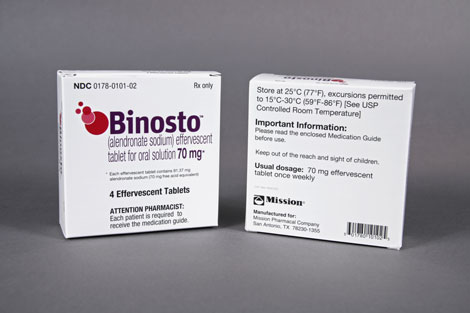
Mission Pharmacal Company has announced that BINOSTO (alendronate sodium) Effervescent Tablet is now available by prescription in the U.S. The FDA has approved BINOSTO—now in a once weekly, buffered solution—to treat osteoporosis in postmenopausal women and to increase bone mass in men with osteoporosis.
Effervescent Tablet for Osteoporosis: FDA Approved
1 min read Premium comments
Secondary
BINOSTO delivers osteoporosis treatment and fracture prevention at the hip and spine – alendronate sodium – in a once weekly, buffered solution. BINOSTO is a strawberry flavored tablet containing alendronate (70mg) that rapidly dissolves in half a glass (4 oz.) of plain room temperature water to make a buffered solution.
“We are very pleased to add BINOSTO to our line of bone health products, ” says Terry Herring, President of Commercial Operations at Mission Pharmacal, in the October 11, 2012 news release. “With this exciting new treatment option, physicians can rest easily, knowing they are prescribing an easy-to-take and proven therapy for their osteoporosis patients that protects against fracture risk at the hip and spine.”
React:
Discussion
This is a fascinating development. In my practice we've seen similar outcomes with the revised protocol. The key differentiator seems to be patient selection criteria. Has anyone else noticed the correlation with BMI thresholds?
Great point. I'd push back slightly on the conclusion, the sample size in the cited study is too small to draw population-level inferences. That said, the directional signal is compelling and worth a larger RCT.
We implemented a similar approach last year. Early results are promising but we're still gathering 12-month follow-up data. Happy to share our protocol if anyone is interested.
Join the conversation
Orthopedic professionals are discussing this. Sign in and upgrade to read every comment and add your voice.