
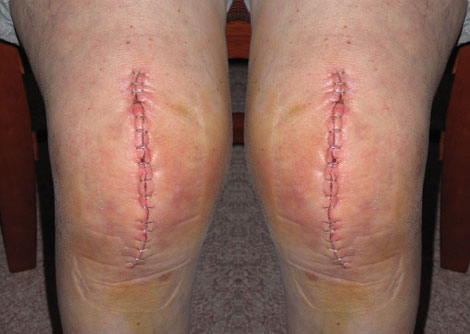
Due to the inherent risks, doctors in recent years have been selecting younger and healthier patients for bilateral total knee replacements. Now researchers from Hospital for Special Surgery have found that although patients are younger and healthier than those undergoing only one-sided surgery, they are becoming sicker and some complication rates have risen.
Bilateral Knee Patients: Complication Rates Increasing
2 min read Premium comments
Secondary
The team says that an increase in obesity appears to be driving the complication rates, as well as the increase in total knee replacements. Researchers identified 258, 524 bilateral total knee replacements performed between 1999 and 2008. The number of annual bilateral procedures increased by 75%. Over the time period studied, the researchers identified a 3% increase in pneumonia, a 6% increase in pulmonary embolism, and a 3% increase in nonmyocardial infarction cardiac complications.
Stavros Memtsoudis, M.D., Ph.D., director of Critical Care Services at Hospital for Special Surgery, was asked how workups can be done more thoroughly/appropriately. He told OTW,
This was at the heart of the recent Consensus Conference on Bilateral Total Knee Arthroplasty, organized by Hospital for Special Surgery, at which experts from around the country came together to address this kind of question. In brief, appropriate selection of patients and workup were deemed of utmost importance in order to achieve the best possible outcomes. While a number of specific comorbidities and patient characteristics were identified as exclusion criteria, the overarching theme was that patients with significant cardiac, pulmonary, renal and cerebrovascular disease as well as poorly controlled diabetes and excessive weight should not be considered to be adequate candidates. Workup for bilateral procedures should be performed with the notion that these interventions are higher risk, thus requiring more thorough testing, to unveil difficult to diagnose problems like pulmonary hypertension which occurs more frequently in patients with sleep apnea and COPD, for example. Further, co-management with a medical service was recommended, as was more intensive monitoring perioperatively.
Dr. Memtsoudis added, “The most surprising finding was the recognition that many complications did not decrease over time and that some of them even increased. Also, the fact that the bilateral population of patients was getting sicker over time was interesting. While we expected to see these trends among the general orthopedic patient population, we thought that temporal changes in bilateral knee arthroplasty candidates would somehow behave differently. Before the study we speculated that the desire of clinicians to select healthier patients given the heightened awareness of increased risk when dealing with these patients would have led to a very different epidemiologic picture. However, it seems that although still younger and healthier then unilateral knee arthroplasty patients, trends towards increasing comorbidity burden persist even in the bilateral group and may represent the underlying reason for our findings regarding complication rates.”
React:
Discussion
This is a fascinating development. In my practice we've seen similar outcomes with the revised protocol. The key differentiator seems to be patient selection criteria. Has anyone else noticed the correlation with BMI thresholds?
Great point. I'd push back slightly on the conclusion, the sample size in the cited study is too small to draw population-level inferences. That said, the directional signal is compelling and worth a larger RCT.
We implemented a similar approach last year. Early results are promising but we're still gathering 12-month follow-up data. Happy to share our protocol if anyone is interested.
Join the conversation
Orthopedic professionals are discussing this. Sign in and upgrade to read every comment and add your voice.