
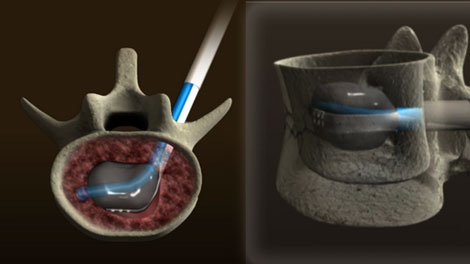
Ascendx Spine is now in the market with their innovative line of vertebral compression fracture (VCF) repair products. Their system is brand named Ascendx VCF Repair System and Acu-Cut Vertebral Augmentation System. While it is not yet available in the United States the company has begun commercialization in Europe. “We have begun commercial shipments to Europe of our VCF repair which is designed for the treatment of vertebral compression fractures, “said Julian M. Mackenzie, Ascendx Spine CEO in the September 12 press release. The company’s distribution network includes Germany, Austria, Switzerland, Italy, Portugal, Spain, Turkey and France.
Ascendx Spine Enters EU VCF Market
1 min read Premium comments
Secondary
“Our distribution partners in Europe are now able to offer spine surgeons and interventional radiologists a uniquely proprietary balloon kyphoplasty method designed to secure effective clinical outcomes for their patients with vertebral compression fractures, ” Mackenzie added.
The company has conducted extensive clinical testing of the Ascendx VCF Repair System. One study, which can be found on the company’s website, was a prospective and multicenter evaluation of 60 subjects treated with the Ascendx System and the Ascendx cement. Patients in the study reported that they’d experienced pain relief and improved function and quality of life. In fact, according to the company, the improvement was significant while complications were minimal.
Ascendx Spine, based in Winter Park, Florida, is a medical device company focused on the development and commercialization of orthopedic devices for the spine and trauma markets. Its initial focus is the treatment of a vertebral compression fracture. A VCF forces a vertebra to collapse and the spinal column above it to assume an abnormal forward curve, resulting in back pain and a hunchbacked appearance.
Author
React:
Discussion
This is a fascinating development. In my practice we've seen similar outcomes with the revised protocol. The key differentiator seems to be patient selection criteria. Has anyone else noticed the correlation with BMI thresholds?
Great point. I'd push back slightly on the conclusion, the sample size in the cited study is too small to draw population-level inferences. That said, the directional signal is compelling and worth a larger RCT.
We implemented a similar approach last year. Early results are promising but we're still gathering 12-month follow-up data. Happy to share our protocol if anyone is interested.
Join the conversation
Orthopedic professionals are discussing this. Sign in and upgrade to read every comment and add your voice.