
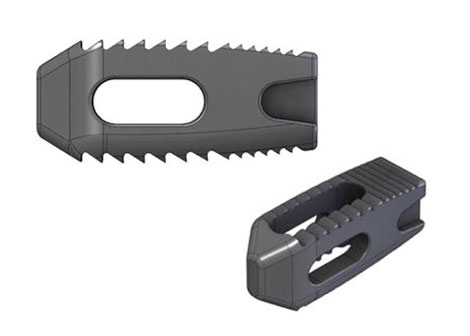
Amedica Corporation, a spinal and reconstructive implant manufacturer, has received 510(k) clearance from the FDA to market the firm’s second generation family of cervical and lumbar interbody fusion devices (IBF). An interbody fusion device is prosthesis to restore and maintain disc space height following a spinal decompression while fusion occurs. Spinal fusions are performed to eliminate the pain caused by abnormal motion of the vertebrae as a result of diseased discs, slippage of the vertebrae, or other degenerative spinal conditions. The goal is to immobilize the faulty vertebrae themselves. Amedica launched its first generation of implants four years ago and inserted about 8, 500 devices.
Amedica Launches New Fusion Devices
2 min read Premium comments
Secondary
Eric Olson, president and CEO of Amedica, told OTW that “the second generation is a complete redesign of our entire family of interbody devices. From cervical to lumbar there are new angles, new footprints, new design features for enhanced fixation—primarily the insertion method for these interbody devices. For the first time that I am aware of in industry, our manufacturing plant has been able to thread ceramic (silicon nitride) material. It allows us to put all of our interbody devices on a threaded inserter so surgeons can have more precise placement of the device and also easier extraction of the device if that were ever necessary.”
The FDA ruling also includes clearance for marketing an extreme lateral device (LLIF) which, according to Olsen, allows the firm to enter a $147 million market. Olsen suggests that minimally invasive LLIF procedures may offer improved patient outcomes by allowing reduced operative time, post-operative pain and hospital stays, as well as a rapid return to normal activity.
Among the challenges in performing an LLIF procedure is the proximity to nerves during implantation which requires the use of neuromonitoring to ensure precise, safe placement of the implant. Silicon nitride, Olsen says, is semi-radiolucent which enables an exact view of the implant for precise intraoperative positioning, thereby alleviating this challenge. Amedica officials also claim that silicon nitride provides superior osteointegration and anti-infective characteristics than do products made from poly-ether-ether-ketone (PEEK) or titanium (T).
Amedica Corporation is a privately held, private equity-backed company founded in 1996 and located in Salt Lake City, Utah. The company is ISO 13485 certified, its spine products are FDA cleared, CE marked, and sold in ten countries.
Author
React:
Discussion
This is a fascinating development. In my practice we've seen similar outcomes with the revised protocol. The key differentiator seems to be patient selection criteria. Has anyone else noticed the correlation with BMI thresholds?
Great point. I'd push back slightly on the conclusion, the sample size in the cited study is too small to draw population-level inferences. That said, the directional signal is compelling and worth a larger RCT.
We implemented a similar approach last year. Early results are promising but we're still gathering 12-month follow-up data. Happy to share our protocol if anyone is interested.
Join the conversation
Orthopedic professionals are discussing this. Sign in and upgrade to read every comment and add your voice.