
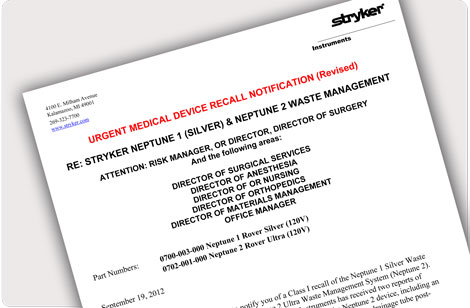
Stryker Corp. issued an “Urgent” worldwide Class 1 Medical Device Recall of the Neptune Rover Waste Management System through a Product Bulletin on September 25.
Stryker Recalls Neptune System After Fatality
2 min read Premium comments
Secondary
The company said the recall was initiated on June 5, 2012 after receiving two reports of serious injury as a result of tissue damage associated with the use of the Neptune 2, including an event in which one customer connected the Neptune 2 System to a passive chest drainage tube post operatively, resulting in a fatality.
Customers were notified in June that the current IFU (instruction for use) did not specifically warn against connecting the Neptune Rover, which is a high vacuum/high flow device, to a passive drainage tube. Customers were instructed to review the revised IFU, distribute to affected departments, and educate users of the Neptune on this warning. Customers had to confirm with Stryker via business reply form that they have completed these actions.
Customers who have the Neptune 1 Gold, Neptune 1 Gold International or Neptune 1 Bronze will receive a follow-up mailing in October containing warning labels for the device and instructions detailing how to apply them. Customers may continue to use the Neptune 1 Gold, Neptune 1 Gold International, and the Neptune 1 Bronze. Users must be aware of the warning that was added to each device.
No FDA 510(k) Clearance
On September 18, 2012, Stryker notified customers via overnight delivery that it had expanded the recall on the Neptune 1 Silver, Neptune 2 Ultra (120V) and Neptune 2 Ultra (230V) because FDA has advised them that these devices require, but do not currently have, 510(k) clearance. FDA is therefore unable to determine whether these devices are as safe and effective as their legally marketed predicate, the Neptune 1 (Gold) Waste Management System (510(k) K012992). As such, Stryker has ceased distribution of the Neptune Silver, Neptune 2 Ultra (120V) and Neptune 2 Ultra (230V) devices until FDA clears these devices.
The company bulletin also said that the FDA does not consider the Neptune Silver, the Neptune 2 Ultra (120V) or the Neptune 2 Ultra (230V) to be legally marketed devices because their safety and effectiveness have not yet been determined. As such, FDA advises that the devices not be used.
However, customers who do not have an alternative device to use should weigh the risks and benefits associated with continued use of these devices. If customers choose to continue use of the Neptune Silver, Neptune 2 Ultra (120V) or Neptune 2 (230V), they must complete a Certificate of Medical Necessity and return it to Stryker by October 12, 2012.
Customers who submit their signed Certificate of Medical Necessity to Stryker will receive a follow-up mailing containing warning labels for the device and instructions detailing how to apply them.
Directors of orthopedics were included in the recall notification.
Customers who have questions about this recall should contact Stryker Instruments’ Recall Coordinator, Angela Ragainis, Monday – Friday, 8am – 5pm ET, at 269-389-2316 or strykerinstrumentsrecalls@stryker.com.
Author
React:
Discussion
This is a fascinating development. In my practice we've seen similar outcomes with the revised protocol. The key differentiator seems to be patient selection criteria. Has anyone else noticed the correlation with BMI thresholds?
Great point. I'd push back slightly on the conclusion, the sample size in the cited study is too small to draw population-level inferences. That said, the directional signal is compelling and worth a larger RCT.
We implemented a similar approach last year. Early results are promising but we're still gathering 12-month follow-up data. Happy to share our protocol if anyone is interested.
Join the conversation
Orthopedic professionals are discussing this. Sign in and upgrade to read every comment and add your voice.