
With extended trochanteric osteotomy “You get unparalleled exposure and it addresses all of these issues to enhance the potential for results. What’s not to like?” asserts Wayne Paprosky. “Osteotomy is the gold standard, but there is a place for the slot…100% union rate, no problem with ingrowth and the intraoperative fracture is less, ” counters Richard Kyle.
Paprosky, Kyle Debate Extended Trochanteric Osteotomy
8 min read Premium comments
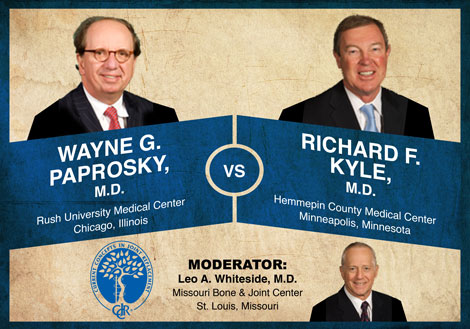
This week’s Orthopaedic Crossfire® debate is “Cemented Stem Failure Requires Extended Trochanteric Osteotomy.” For the proposition was Wayne G. Paprosky, M.D. from Rush University Medical Center in Chicago. Against the proposition was Richard F. Kyle, M.D. of Hemmepin County Medical Center in Minneapolis; moderating was Leo A. Whiteside, M.D. from Missouri Bone & Joint Center in St. Louis.
Dr. Paprosky: “You must look at the main problem when revising the cemented stem. You want improved exposure…don’t break the greater trochanter, be able to get the component out as well as the cement. Ideal conditions would certainly be to put the component back in, so you need a straight tube. Try to use the shortest possible stem that gives you fixation. You want the trochanter to heal, so it should have a broader surface area to heal…and you don’t want it to dislocate.”
“Over the years we have published data on several studies; our average from the time of beginning the osteotomy to prosthetic insertion is about 35 minutes—this is after the acetabulum is done. We know that the proximal femur isn’t supportive anyway in most of these cases where you’re going to consider doing an osteotomy. Many of these are remodeled into varus, and we’re using distal fixation so basically that upper circular femur really isn’t providing a lot of value to the situation.”
“You can do an extended osteotomy before dislocation, such as when you have a subsided stem, a lot of scarring, heterotopic ossification, a protrusion-migrated acetabular component and so forth. You can also do it after dislocation, when the stem is well fixed. The most common time to do this with respect to cement is when the stem is loose and after dislocation. This has become very attractive procedure in dealing with cement removal. We go along the posterior linea…we do the distal feathering to avoid propagation stress fractures and then we can do a microsaw to open it up. Now we can advance the osteotomy when we reattach the greater trochanter, making sure that we advance it posteriorly somewhat to increase the tension. And it is kind of like an orthopedic orgasm, removing that cement under direct vision. You can get access to the distal cement as well, and those little areas of well-fixed cement that can get you in trouble, especially when the femur is remodeled.”
“In the case of an encased heterotopic ossification, you have well fixed cement and the stem has subsided. You can do the osteotomy down to the tip of the stem; grab the stem by the tail, pull it out, making reinsertion very easy. With long cement canals it makes a lot of sense. We feel now that almost 45-50% of these canals are remodeled in varus. To try and achieve 4 cm of distal fixation with an 8 or a 10 inch stem…well, it is difficult to get it in. You’re likely to break the trochanter or it’s going to go out the side of the femur.”
“Osteopenic or osteolytic greater trochanters are at risk. Most importantly, an extended proximal trochanteric osteotomy allows for neutral reaming because of the remodeled femur. Our average 12-year follow up: we had only two non-unions, bone ingrowth was present 92% of the time and there are fairly low complications so we feel this is a safe, efficient and accurate method of revision of cementless or cemented stems. You get unparalleled exposure and it addresses all of these issues to enhance the potential for results.”
Dr. Kyle: “Removal of well fixed cement is daunting, especially when there’s a very long cement tail and a well fixed cement column—I’ve seen these a lot when we were doing hybrids with very small stems and in bigger people with very thick cortical canals. The blind technique has been abandoned: it’s specialized hand tools, ultrasound, fluoroscopic guidance, and some laser. The biggest problem is postoperative fractures at 28%, and fractures are problematic because most of the time they need to be fixed—particularly if it’s in a postoperative period, it’s a disaster.”
“I agree…the extended trochanteric osteotomy is the gold standard. There is an alternative, and one of the problems I’ve seen are iatrogenic fractures during surgery, which is a much better deal than postoperatively with the blind technique—and it’s been reported up to 20%. Femoral windows can be an alternative…introduced by Muller in 1970. Harry Rubash did a study in 1993 and had no intraoperative fractures and very good results. We’ve looked at a small series and reported on those: the results are similar to Wayne’s. We’ve had excellent results, but the difference is the complication in intraoperative fractures, which was only 3%.”
“We did some biomechanical studies…we looked at an intact femur, a cut and a wired construct. The slot was biomechanically stronger in bending. The biggest difference was in torsion where with the slot we retained about 60% strength compared to 20% with the slide. Then after wiring it was still quite a bit stronger.”
“The slot technique is not in the varus femur, it’s in the straighter femur. We measure down to the cement canal, remove the cement proximally as needed and then extend the incision. We open up the vastus lateralis and take a Christmas tree burr and measure preoperatively the length of the cement mantle, and particularly the very long cement mantles that go all the way down to the diaphysis are problematic. I use mostly curved revision prostheses that are fully coated. Once that window is outlined we can remove that window, look at the cement, and use a small hook osteotome to remove the cement.”
“The femoral component is inserted, and again you can see it bypass the window, but you’ve maintained the tube all the way down. The key is to get the prosthesis back into valgus and then put the slot back in. Lateral trochanteric bone is removed, you use an extensively porous coated canal filling stem. You bypass the slot by at least two femoral diameters and you reinforce the slot with cortical strut only if the bone is very osteoporotic and deficient.”
“I use the slot frequently: 100% union rate, no problem with ingrowth and the intraoperative fracture rate is less. Osteotomies are length limited because you don’t want to go down into the metaphysis in difficult cases…and there is a slight increase in incidence of fractures. The slot is a bit stronger and all cement, including the very distal tip, is removed under direct vision. In conclusion, the extended femoral slot is a safe and effective technique for cement removal during revision total hip arthroplasty.”
Moderator Whiteside: “Wayne, how often in the process of elevating that extended osteotomy does the greater trochanter fragment, fall off and actually separate from the diaphyseal segment?”
Dr. Paprosky: “It’s not going to happen very often when the stem is out because then you can increase the thickness of the osteotomy fragment. However, when you have a large, bulky stem, especially cementless that’s ingrown, and an osteolytic greater trochanter, the chance of fracture is higher. In those cases removing a well fixed stem, it’s probably in the range of 15%.”
Moderator Whiteside: “What happens when you break off the greater trochanter? You’ve elevated your osteotomy and you find the greater trochanter just breaks into an osteolytic lesion and separates. How do you repair that later?”
Dr. Paprosky: “In many of these revisions when the fracture occurs it’s almost like a trochanteric slide. You have the abductor mechanism intact with the vastus lateralis and by the time you put your new implants in, and with the scar tissue that’s there, it often is not a big problem.”
Moderator Whiteside: “So you don’t do a big repair on that?”
Dr. Paprosky: “If I can, but I’ll certainly do the repair but most of the time there’s nothing there—there’s not a big downside to it.”
Moderator Whiteside: “That may be a significant difference between the slot and the greater trochanteric slide. What do you think, Dick?”
Dr. Kyle: “I try to ensure the slot is below the lesser trochanter and then I’m very careful when I ream. I’ll protect it so when you’re reaming you protect it against hoop stresses. I haven’t had a problem, but the one fracture we had was of the trochanter. I agree with Wayne completely…if it’s just a crack and seems stable I might use a cerlage wire and leave it alone. But if it’s completely dissociated then I’ll use a hook plate.”
Moderator Whiteside: “But my impression from your talks is that you’re probably less likely to break off the greater trochanter.”
Dr. Kyle: “I’ve actually used the slot a lot and it’s rare that I break the trochanter off, but I pay particular attention—and this is where the difference is—you must get back into the trochanter to get a long stem down and not put it in varus. So you have to clean out the bone in the back of the trochanter. If you don’t, you’ll break the trochanter—in a primary or a revision.”
Moderator Whiteside: “Which is an advantage of the extended trochanteric osteotomy?”
Dr. Kyle: “In the varus hip, yes.”
Moderator Whiteside: “Infection: you have a well fixed cement mantle, but an infected total hip…do you still feel free to do a big slot osteotomy, lift off that bone and put that dead bone piece back in (in the face of a cleaned up infected area)?”
Dr. Kyle: “In an infected total hip I think either a slot or an osteotomy is problematic. I’d try to get it out from the top, but personally I would rather have the slot down there and not put it back in right away.”
Moderator Whiteside: “You’d leave the slot out?”
Dr. Kyle: “I’d do as small of a slot as I could and probably leave it out when I go back in…put an allograft on it. Sometimes I’ve actually put either a prosthetic that’s coated with cement so it bridges that or I’ll take an intermedullary rod and coat it with cement.”
Moderator Whiteside: “That may be one of the differences between the two techniques. Wayne, do you think you preserve the vascularity of this greater trochanteric slide such that you could open a femur in the face of infection and then put that back down?”
Dr. Paprosky: “Yes, we maintain the vascularity. Craig Della Valle and I published a paper on this and they all healed…all different organisms…and we reosteotomized in many of the cases. Actually, I think because of vascularity it’s probably safer to put it back and let it heal in the face of infection.”
Moderator Whiteside: “Wayne, when you put everything back together and the tip of the stem is at the end of your osteotomy, do you ever leave it like that?”
Dr. Paprosky: “If you’re using a fully coated stem you should have bypassed it.”
Moderator Whiteside: “But you can’t do it…too far down.”
Dr. Paprosky: “Then you’ve probably done the osteotomy too far down.”
Dr. Kyle: “I like to have the ability to keep that tube intact and go all the way down and that’s the limitation of the osteotomy.”
Moderator Whiteside: “Thanks, gentlemen.”
Please visit www.CCJR.com to register for the 2012 CCJR Winter Meeting, December 12 – 15 in Orlando, Florida.
 “You may now view CCJR meeting content on your mobile device on the CCJR MobileTM App. Please scan the QR code to download from iTunes.”
React:
Discussion
This is a fascinating development. In my practice we've seen similar outcomes with the revised protocol. The key differentiator seems to be patient selection criteria. Has anyone else noticed the correlation with BMI thresholds?
Great point. I'd push back slightly on the conclusion, the sample size in the cited study is too small to draw population-level inferences. That said, the directional signal is compelling and worth a larger RCT.
We implemented a similar approach last year. Early results are promising but we're still gathering 12-month follow-up data. Happy to share our protocol if anyone is interested.
Join the conversation
Orthopedic professionals are discussing this. Sign in and upgrade to read every comment and add your voice.