
“Cementless fixation can work, but it must be equal to or better than cement. I think it’s equal to, ” asserts Aaron Hofmann. “All good things ultimately prevail, ” says Chitranjan Ranawat. “And I think, like in the hip, non-cemented fixation in the knee will prevail when it becomes reproducible and cost effective.”
Hofmann v. Ranawat: Cementless Tibial Fixation in TKA
8 min read Premium comments
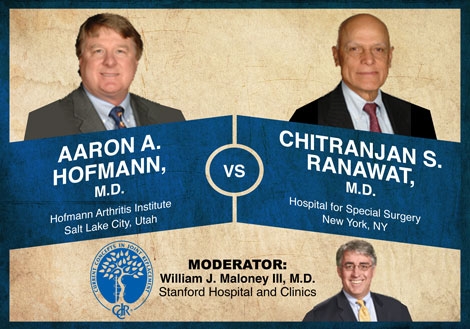
This week’s Orthopaedic Crossfire® debate is “Cementless Tibial Fixation in TKA [total knee arthroplasty]: A Second Coming.” For the proposition was Aaron A. Hofmann, M.D. from the Hofmann Arthritis Institute. Against the proposition was Chitranjan S. Ranawat, M.D. of Hospital for Special Surgery; moderating was William J. Maloney III, M.D. from Stanford Hospital and Clinics.
Dr. Hofmann: “I’ll discuss five points: knowing your porous coating, avoiding porous coated pegs, using biologic cement, matching the tibial slope, and avoiding thermal necrosis. Cementless fixation can work, but it must be equal to or better than cement. I think it’s equal to.”
“We have made some huge mistakes, starting in the early ‘80s, thinking that all rough surfaces will work. You must know the surface technologies—they’re not all the same. I think the more porosity it has and the rougher the micro/nano structure; the better. Surface spraying—not as good. Titanium surfaces of various degrees are better than cobalt chrome.”
“In a study I did, side-by-side comparison in human cancellous bone—beaded cobalt chrome next to beaded titanium shows spot welding on the cobalt chrome and diffused ingrowth into the titanium. It doesn’t mean you can’t get ingrowth with cobalt chrome, but I think titanium is just more predictable. Some of the early designs had porous coated pegs. Whether it’s on the femoral component or the tibial component, if you ever have to remove these it can be difficult. Some of the porous coated tibial components have had this same problem.”
“A porous coating should be easy to remove. The bone shears off from the subchondral surface of the porous coating. You get ingrowth into the surface, but you can remove these easily. The challenge has never been on the femoral side, it’s always been on the tibial side…I can get good tibial fixation on any tibia…but should we? The proximal tibia is 76% space and 24% bone—hence the problems. You must use something like cement—either acrylic cement or biologic cement. If you don’t you can’t rebuild that subchondral plate on the tibia. We take the ground bone from the cut surface of the tibia, spread it across, and dramatically improve not only the initial contact, but the amount of bone that is next to the implant.”
“We know from our award winning plug study looking at it with and without graft that you can improve the amount of ingrowth by 67% by using this biologic cement as opposed to using nothing.”
“Matching the cut of the tibia: that was one of the other early mistakes. On tibial fixation especially, if you match the patient’s slope you can improve the weight carrying capacity of the proximal tibia by 40%. A cadaver study looking at anatomic slopes versus 0% slope basically showed us what we were seeing clinically—anatomic subsidence. Thermal necrosis occurs at 55 degrees C, so if you are smokin’ through your bone, burning the bone, there’s no way you’re ever going to get bony attachment. It can be taken down to 37 degrees by using irrigation while you’re doing it.”
“My study from 1991: no difference between patients before or after 65—you can get great fixation in these patients. When I started in 1985 89% of my patients were done cementless; it’s less than 40% now for cost reasons. The results of our 10-14 year follow up: component survival was 98% for femoral components, 98% for tibial components. Polyethylene was an issue…only 94% of those survived 10-14 years. And the patella—which was metal backing—did well [95%]. Looking at postmortem retrievals, there has always been great ingrowth. You don’t ever get more bone inside the porous coating than you have outside the porous coating.”
“So there can be good clinical results using cementless, equal to cemented, we haven’t seen loosening over time, once you have ingrowth it doesn’t retreat, and on our retrievals we found that there is a great amount of ingrowth. Whether cementless knees are back is going to depend on the manufacturers.”
Dr. Ranawat: “Cemented tibial fixation is the gold standard. To judge the superiority of cement versus non-cemented fixation one has to examine the long term data, which only looks at the mechanical fixation and survivorship from that. At 10-15 years survivorship in my hands is around 94%. We have published 20-year data on the total condylar with a survivorship of 92%.”
“If I summarize the experience of 10-15 year survivorship for failure due to mechanical reasons, the number is around 90-97%. There are reports in recent literature of 15-20 year follow-up of around 90-98%. I also reviewed cementless fixation, and the best information we have is a recent paper by Gandhi—a meta-analysis—and his conclusion was that the cement fixation had better survivorship.”
“We’ve also looked at quality of function in cemented total knees and one can get 110-115 degrees most of the time; our goal is 125 degrees range of motion (ROM) because there are many activities of daily living which would require higher flexion than what we get. Recently we completed a study of 81 matched pair, fixed bearing versus mobile bearing knees—matched for age, body mass index and gender. We gave a patient administered questionnaire and found that a third of patients are quite active and participating in many sports. So based on 15-20 year data, cemented tibial fixation is reproducible, durable, has excellent survivorship, and a high degree of quality of function.”
“Although the results on non-cemented tibial fixation are improving, the overall long term data suggests that cemented fixation is more reproducible and superior. We need prospective, randomized studies with long term follow-up to settle this issue. I have always said that in life, ‘All good things ultimately prevail.’ And I think, like in the hip, non-cemented fixation in the knee will prevail when it becomes reproducible and cost effective.”
Moderator Maloney: “Aaron?”
Dr. Hofmann: “We both agree that there’s going to be a place for cementless fixation. When I look at my own patients, the average age for my cemented knees is 76, the average age for my cementless knees is 64, so it’s the younger, active group—the fastest growing segment in our patient population. I’m cementing the majority of my patients. So we know that an implant costs maybe $100 to porous coat it, so why is it $1, 000 more? If the price of the implants were the same—cemented and cementless—we would have a different conversation because so many more implants would be put in without cement.”
Dr. Ranawat: “Two issues: Although we have a good technology, it has not been translated with the different knee designs. Also, you need to prepare the bone more precisely if you are going to use non-cemented fixation. Then there’s cost. I’m hoping that things will improve and when that day comes we will have more non-cemented fixation. I use non-cemented fixation for revision total knee and in those patients you have significant damage of the metaphyseal cancellous bone because in that patient the cement doesn’t work.”
Moderator Maloney: “Aaron, you said in the young patient you lean towards cementless designs. Does the data suggest that loosening is a problem in the young patient?”
Dr. Hofmann: “Not in my patients because in my patients for 25 years have been done cementless.”
Moderator Maloney: “With modern design, Chit, even with designs that are 10-15 years old, was age an independent risk factor for loosening of cemented components?”
Dr. Ranawat: “If you look at the earlier data it suggests so. However, in my personal experience I don’t do total knees often below age 55. Therefore, 55 and above, I don’t think there is a significant issue.”
Moderator Maloney: “Aaron, you discussed your bias for titanium beads over cobalt chrome beads. What are your thoughts on some of the newer porous metals? Also, address Dr. Ranawat’s comments about having to be more exacting with cementless total knee arthroplasty for those early fixation factors.”
Dr. Hofmann: “I think that’s true. Certainly the femoral fixation is more forgiving. You can have some gaps, some imperfections…but when you’re creating a flat surface on the tibia you have to have a flat surface. So many people are used to going fast and not checking it, and there are a few extra steps you must do like checking for flatness, checking the trials and seeing if they’re rocking and rolling, and then having extra fixation on your tibial component. So it is more exacting. I have residents that I’ve just said, ‘This guy needs to cement all his knees.’ And I have those guys who will slow down to the point of checking it, who I think are better candidates for doing cementless fixation. One point: not every young person should even be considered for a cementless knee. For a smoker, I won’t do a cementless knee. You only have one micron per day of ingrowth anyway, and a smoker’s bone metabolism has slowed way down. I also won’t go cementless on a workman’s comp and most of the VA patients that are on disability.”
Moderator Maloney: “You said not to porous coat the pegs—does not doing that lead to access channels for wear debris and osteolysis?”
Dr. Hofmann: “You have access channels if you have screw holes, so I think you can have a cementless device. But if you have a poly problem/backside problem it’s going to track down the screw. It’s actually a place to look rather than not being able to see it.”
Moderator Maloney: “So Dr. Ranawat, what do you think the porous metals’ role will be in cementless fixation in total knee arthroplasty? What’s it going to take to do what we did in the hip with that technology?”
Dr. Ranawat: “On the tibial side we need either a titanium trabecular metal or tantalum or the like, and some osteoinductive/osteoconductive agents to ensure rapid bone ongrowth/ingrowth. More failures occur from soft tissue imbalance than from fixation.”
Moderator Maloney: “So the name of the game in cementless fixation is maintaining initial implant stability, minimizing implant micromotion, and assuring that you’ve got a viable surface to ingrow. So Aaron, you do it with your bone paste, and you [Dr. Ranawat] are talking about HA (hyaluronic acid), but some way to bring all three of those factors together. Thank you, gentlemen.”
Please visit www.CCJR.com to register for the 2012 CCJR Winter Meeting, December 12 – 15 in Orlando, Florida.
 “You may now view CCJR meeting content on your mobile device on the CCJR MobileTM App. Please scan the QR code to download from iTunes.”
React:
Discussion
This is a fascinating development. In my practice we've seen similar outcomes with the revised protocol. The key differentiator seems to be patient selection criteria. Has anyone else noticed the correlation with BMI thresholds?
Great point. I'd push back slightly on the conclusion, the sample size in the cited study is too small to draw population-level inferences. That said, the directional signal is compelling and worth a larger RCT.
We implemented a similar approach last year. Early results are promising but we're still gathering 12-month follow-up data. Happy to share our protocol if anyone is interested.
Join the conversation
Orthopedic professionals are discussing this. Sign in and upgrade to read every comment and add your voice.