
Anthony Ramos, a firefighter in Rockledge, Florida, was performing routine physical training with his squad and took his turn practicing with the hoseline. While handling with the firehose—and with water blasting at approximately 150 pounds per square inch—he heard a loud ripping sound.
Firefighter’s Trauma Illuminates Importance of Diagnosis
2 min read Premium comments
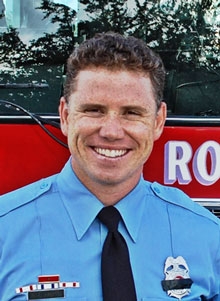
Ramos was mistakenly diagnosed with a shoulder injury and even cleared to go back to work at the fire station after a few months. Things didn’t feel right, however, so Ramos did some research and found Matthew Stiebel, M.D., an orthopedic surgeon at Jupiter Medical Center specializing in sports medicine—and he had performed more than 40 pectoralis major repairs.
“I wanted to hug Dr. Stiebel for finally confirming that something was still wrong with my chest (and not my shoulder). You know when your tire on your car is flat. I knew something wasn’t right. I was so fortunate to find Dr. Stiebel in South Florida. The next closest doctor I found was in Puerto Rico!” said Ramos in the August 24, 2012 news release.
Dr. Stiebel explained, “I make a trough or a cavity in the proximal humerus and drill holes in the lateral side of it. Then, I pull the muscle into the trough I’ve created, pull the sutures out of the holes I make in the bone and tie them over a bone bridge. The trick is to mobilize the muscle and free it away from all the adhesions to make sure the nerves around it are okay. To get a good repair the muscle has to go to the bone. You can’t repair the muscle back to the tendon.”
Ramos told OTW, “As for my impression of orthopedic surgeons prior to my injury, quite frankly I had heard horror stories from other co-workers and friends, but I knew I had to do my own research and form my own opinion. As for ‘going under the knife’ I was a little reluctant at first, but I knew that surgery was my only option at this point. Going through this experience, and working in the medical field myself, I have learned that there are two ways to retrieve information verbally from patients, hearing and listening. Key word: ‘LISTEN’ to your patients! Dr. Stiebel is a doctor that listens.”
Dr. Stiebel commented to OTW,
As these are somewhat rare injuries, Mr. Ramos was misdiagnosed. Also, most of the time these injuries occur with weight lifting/bench press. In this case it happened via work.
Asked if there was anything else he would like the orthopedic community to know about this situation/surgery. Dr. Stiebel told OTW, “To the surgeons who don’t do a lot of pec repairs, please let them know that a repair back to the humeral tendon stump usually fails, and that the tendon must be re-attached to the bone– usually via a trough. Too big a trough, however, can result in late humerus fractures.”
React:
Discussion
This is a fascinating development. In my practice we've seen similar outcomes with the revised protocol. The key differentiator seems to be patient selection criteria. Has anyone else noticed the correlation with BMI thresholds?
Great point. I'd push back slightly on the conclusion, the sample size in the cited study is too small to draw population-level inferences. That said, the directional signal is compelling and worth a larger RCT.
We implemented a similar approach last year. Early results are promising but we're still gathering 12-month follow-up data. Happy to share our protocol if anyone is interested.
Join the conversation
Orthopedic professionals are discussing this. Sign in and upgrade to read every comment and add your voice.