
“MIS is not for all patients. MIS risk factors for failure are multifactorial (infection, fracture, poly resin, etc.), asserts Michael Berend. “Michael, I agree with most things you said. It’s not that traditional technique doesn’t work…car brakes worked but ABS is better. Maps work, GPS is better, ” says Aaron Rosenberg.
Berend, Rosenberg Debate MIS Total Knee Arthroplasty
8 min read Premium comments
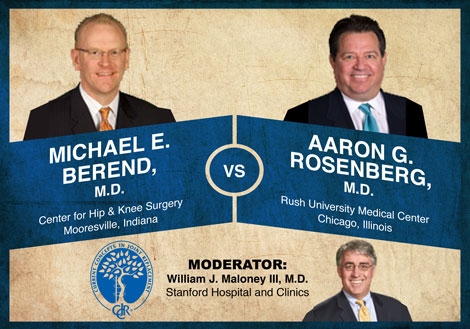
This week’s Orthopaedic Crossfire® debate is “MIS: A Risk Factor of Early TKA Failure.” For the proposition was Michael E. Berend, M.D. from the Center for Hip & Knee Surgery in Mooresville, Indiana. Against the proposition was Aaron G. Rosenberg, M.D. of Rush University Medical Center; moderating was William J. Maloney III, M.D. from Stanford Hospital and Clinics.
Dr. Berend: “There are emerging studies that are prospective and randomized and well designed. For example, Karpman and Smith (J Arthroplasty 2009) compared three different approaches to total knee replacement (TKA) and remarkably at two weeks the patients had improved scores.”
“I was early to minimally invasive surgery (MIS), and in 1999 performed a total knee through a two inch incision. I cut no tendons or muscles; the patient was at work in four hours, left the recovery room with 0-145 degrees range of motion (ROM). So we’ve changed our vernacular from inches to centimeters, from years to weeks; and perhaps we’re training folks—us and our patients—to ask the wrong questions. Perhaps we should redefine MIS to ‘must insist on seeing’ and ‘must insist on doing a reproducible and quality job.’”
“There’s not much minimally invasive about a total knee replacement, regardless of incision or approach. There’s the same biologic response, the same amount of bone removal, same or similar implants, same postoperative rehab. Perhaps it’s less predictable, and I think an important message is new anesthesia protocols.”
“Reasons for TKA revision: infection, instability, aseptic/wear, patellofemoral—these things may be made worse by an MIS approach. Another prospective, randomized study showed no improvement clinically, no difference in X-rays, the 12 week outcomes were the same…however, in the MIS group 10% of the patients had wound healing problems, and I think this puts patients at risk for perioperative infection.”
“MIS risk factor for failure is multifactorial (infection, fracture, poly resin, etc.). Robert Barrack and others have recently suggested that MIS is a risk factor for early revision in TKA, and if you look at the combined increased risk of infection, increased operative time, possible risk of malalignment, and ligament imbalance, I think it is a significant question for us all. He reported a multicenter study of early revision in 237 knees—MIS versus standard approaches—and the most important consideration was those knees that had an MIS total knee had early revision at 14 months compared to 80 months in the standard total knee. Importantly, the indication for revision was loosening and instability.”
“Steve Incavo has also reported early revision for malrotation, with symptoms of pain, instability and poor ROM…and 81% of these knees were revised at less than two years. So assessing rotation is critical. Doug Dennis and David Dalury looked at 30 MIS knees and 30 standard knees, and unfortunately 13% had greater than 4 degrees of malalignment. We and others have shown the catastrophic effects of malalignment on tibial loosening, at least with a flat on flat articulation. If you combine that with a large body mass index (BMI) patient, there’s a precipitous drop in survivorship in patients with varus malalignment and a high BMI.”
“Do we have the time to invest in MIS? Yasutaka Tashiro reported clinical measurements, radiographic measurements, and operative time. At one to two weeks the MIS patients were better, had no change in coronal alignment; they noted a medial shift in the implant, which may have implications for patellofemoral tracking and long term loading of the implants. They found it took nearly an hour longer to perform MIS; and we’ve learned from HSS [Hospital for Special Surgery] that TKA infection rates are higher in patients that had a total knee that took more than 33 minutes longer than standard techniques.”
“It’s not for everyone. It’s not a ‘name that tune’ of a picture of how small the incision is, or redefining the quadriceps mechanism, but let’s take the good and leave the bad and develop a multidisciplinary approach of education, anesthesia protocols, proper instrumentation, careful patient selection and careful surgery.”
Dr. Rosenberg: “Michael, I agree with most things you said. It’s not that the traditional technique doesn’t work…car brakes worked but ABS is better. Maps work, GPS is better. It’s clearly harder: component placement can be compromised, you lose visual cues, you may be unable to protect vital structures, and you do place more stress on the soft tissues if you’re stretching the skin excessively. There’s no free lunch…there are risks with MIS and they can contribute to a higher complication rate, including soft tissue damage, malalignment, imbalance, and retained bone cement. We’ve also seen compromised fixation with the introduction/re-introduction of cementless components or the use of MIS-friendly type components that haven’t had significant vetting.”
“But there are benefits. In a comparison of 24 MIS and 25 standard cases looking at extensor torque and time to rehabilitation guidelines. Neither group had significant malalignments or complications. The MIS group had lower average pain scores at one and two weeks; they also had earlier straight leg raising, earlier 90 degrees of flexion, and earlier use of a single cane and higher extensor torque (again, early). ”
“In a mini-subvastus approach researchers compared 150 MIS cases to 150 traditional cases. There was no increase in number or severity of complications, and no increase in OR time. Length of stay was reduced with a more rapid quad recovery; fewer of the MIS patients required skilled nursing facilities or rehab facilities. At two years the MIS group had greater flexion.”
“The most recent systematic review that I could find included all prospective studies—28 of them. They found that patients undergoing MIS TKA tend to have decreased postop pain, faster recovery of quadriceps function and ROM, reduced blood loss, and shorter stay. But the benefits must be balanced against increased tourniquet time, and a higher degree of component malalignment.”
“There was a lot of talk in the early days about how important it was to change the surgical technique to make it truly MIS, but more recent studies like the one by Dalury showed that it didn’t matter whether they everted the patella or translated the tibia anteriorly; patients seem to prefer in these bilateral knees the traditional technique at six and twelve weeks. The economics have been shown nicely in a study by Thomas Coon…MIS patients had shorter LOS [length of stay] and the average cost of surgery was 26% less.”
“Factors influencing the recovery curve: pain management, the preoperative functional level, as well as their motivation. But surgical technique is part of it. It’s hard to know how much, but a study by Doug Nuelle is an interesting one. It was done in a private practice, comparing the same surgical technique in 50 hips and 50 knees…compared standard protocols to MIS pathways with anesthesia and postoperative management, and they measured the time to various postoperative landmarks. Using the same technique, the protocols and anesthesia pathways demonstrated a marked difference between the standard and the number of hours it took to achieve those landmarks.”
“It’s reasonable to proceed in shrinking your incision, doing surgery that is less disruptive of the soft tissues, but not throwing the baby out with the bathwater and ignoring the important principles we’ve learned about TKA.”
Moderator Maloney: “Mike, comments?”
Dr. Berend: “The contributions you all have made in terms of anesthesia, preoperative education, programming the patient that only the special people get to go home on day two…those are important things. I agree with the rational approach. I don’t think all of us should feel the same pressure to do the smallest incision. I also think length of stay has far more to do with the entire program, with nursing, therapy, anesthesia, than it does with the incision. On manipulation rates, ours is around 1.8% with huge shark bite incisions. ”
Dr. Rosenberg: “Those things are true. My position has been to assess what the additional risks are when I make any change in how I do something. We all learned from the early MIS days that focusing on the length of the incision was a mistake…that you should focus on the amount of tension in the tissues. There are going to be wide differences in that depending on the size of the patient, the amount and stiffness of the subcutaneous fat. To get a good feel for those things it takes time and experience.”
Moderator Maloney: “So does the incision length make any difference as it relates to the outcome?”
Dr. Rosenberg: “Within reasonable limits.”
Moderator Maloney: “What about the length of the arthrotomy?”
Dr. Rosenberg: “I think the type of arthrotomy, as opposed to the length, doesn’t make any difference as far as the studies that have been done have been prospective and randomized.”
Moderator Maloney: “Mike, do you agree?”
Dr. Berend: “I agree. I think getting the adequate exposure to use the instruments you’re comfortable with, put the implant in properly and balance it well is the critical take home message.”
Moderator Maloney: “Aaron, what’s the most important factor for a good long term outcome in terms of knee arthroplasty?”
Dr. Rosenberg: “Good surgical technique, good patient selection, education, …”
Moderator Maloney: “In a patient with end stage arthritis and they hurt a lot…”
Dr. Rosenberg: “If they’re depressed and dysfunctional they’re not going to do well.”
Moderator Maloney: “Mike, your take on the most important factor?”
Dr. Berend: “I think the biggest shift in the last 10 years has been to do less of an operation in 40% of the patients, so to recognize unicompartmental knee disease has been the true minimally invasive procedures…to do more unis and less total knees.”
Moderator Maloney: “Aaron, what did we do wrong with MIS as far as education?”
Dr. Rosenberg: “I don’t have a good answer because the genie is out of the bottle, and that is, trying to fight the Internet is difficult. But the same thing is true across the board in the distribution of information. People have always promoted snake oil…and our patients are going to be following this information. Also, there’s a difference between a shorter incision—not the smallest, necessarily—and standard incisions, but I think we’ve all sort of adopted.”
Moderator Maloney: “Bob Booth said it best: if you’re a size 16 you’re going to get a size 16 incision; if you’re a size 6 you’ll get a size 6 incision. Thank you, gentlemen.”
Please visit www.CCJR.com to register for the 2012 CCJR Winter Meeting, December 12 – 15 in Orlando, Florida.
 “You may now view CCJR meeting content on your mobile device on the CCJR MobileTM App. Please scan the QR code to download from iTunes.”
React:
Discussion
This is a fascinating development. In my practice we've seen similar outcomes with the revised protocol. The key differentiator seems to be patient selection criteria. Has anyone else noticed the correlation with BMI thresholds?
Great point. I'd push back slightly on the conclusion, the sample size in the cited study is too small to draw population-level inferences. That said, the directional signal is compelling and worth a larger RCT.
We implemented a similar approach last year. Early results are promising but we're still gathering 12-month follow-up data. Happy to share our protocol if anyone is interested.
Join the conversation
Orthopedic professionals are discussing this. Sign in and upgrade to read every comment and add your voice.