
Computers in TKA remain cumbersome, time consuming and expensive, ” says Robert Trousdale. “You want accuracy?” counters Arun Mullaji. “Navigation eliminates trial and error, provides perfect balance, total deformity correction, and more.”
Trousdale vs. Mullaji: Ditch Computer Navigation in TKA?
8 min read Premium comments
Great Debates
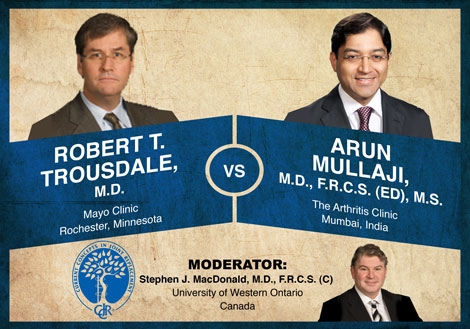
This week’s Orthopaedic Crossfire® debate is “Computer Navigation in TKA: More Bother Than It’s Worth.” For the proposition was Robert T. Trousdale, M.D. from Mayo Clinic in Rochester, Minnesota. Against the proposition was Arun Mullaji, M.D., F.R.C.S. (Ed), M.S. of The Arthritis Clinic in Mumbai, India; moderating was Stephen J. MacDonald, M.D., F.R.C.S. (C) from the University of Western Ontario in Canada.
Dr. Trousdale: “Arun’s got that fancy accent, so it’s tricky to debate him, but the good news is that I’m on the right side of science. Computers in TKA [total knee arthroplasty] remain cumbersome, time consuming and expensive—they are not ready for prime time. We want the replacement to be reliable, durable, and safe, and we want it to alleviate pain and improve function. Computer Assisted Surgery (CAS) has no proven clinical benefits in TKA.”
“There have been lots of studies showing that it doesn’t provide range of motion, function, durability; and a couple of validated outcome tools with no difference between standard instrumentation and computer instrumentation. In a meta-analysis researchers looked at 11 Level 1 studies comparing conventional surgery to CAS. The conclusion was that navigated knee replacement provides few advantages over conventional surgery, and its clinical benefits are unclear and remain to be defined.”
“If you look in The Journal of Arthroplasty, another Level 1 study with 71 patients comparing CAS to standard TKA, CAS had a bit better alignment. But there was no difference at five years—no difference in Knee Society Score (KSS), SF-36, WOMAC, or patient satisfaction.”
“We do know that CAS is a better tool to hit a specific target than manual instruments. The problem with CAS is we don’t know the right target for our individual patients. But it’s a good tool to capture information for research. CAS has also been shown to increase surgical times. The cost is increased, and there’s an increase in the prevalence of specific complications.”
“The fundamental premise of CAS—that you’re going to get better alignment—which you do—there are less outliers—and that it’s going to improve the survivorship of the knee. I think there’s been some data that’s cast doubt on that. Where should we put our mechanical axis? I think we don’t know for our individual patients. If you look at the data that supports a neutral mechanical axis, a lot of the data is weak, and uses short X-rays to evaluate the anatomic axis. Some are review articles…there’s really very little data. Mark Pagnano spearheaded a study, which I think gets misquoted. We looked at 399 knees, three different knee designs; most had osteoarthritis. We looked at 15-year follow-up; Mark divided these patients into five zones. In the neutral mechanical axis there were 300; 60 were in a bit of valgus, 34 in a bit of varus, and 1 marked varus outlier. We showed at 15 years no difference in implant survivorship in the well aligned knees versus the outlier knees. Same if you use the endpoint of revision, aseptic loosening, wear or osteolysis—no difference in the well aligned knees or the outlying total knee replacements.”
“The future of CAS is with the computer outside of the operating room. That technology can potentially decrease costs and help avoid complications. This means 3D reconstructions, patient specific solutions—not generic solutions encouraged by current navigation.”
Dr. Mullaji: “I use navigation for all my cases—I’ve done so for nearly 3, 000 cases. People look the same, but their legs are different. Navigation allows me to provide a bespoke solution for every knee…in other words, it’s a customization tool which enables me to position and size my implant individually so that I can ensure consistent, predictable, and optimum results across a wide spectrum of patho-anatomy.”
“These are the things that can be different in different people: an altered hip center, femoral bowing, altered valgus correction angle (VCA), extra-articular deformity, intra-articular pathology, hindfoot valgus. In all these conditions, navigation helps. For example, if there is an altered hip center from trauma, you can get perfect alignment. If you have coronal plane bowing as we have in Asia, the straight femur has a five to seven degree VCA—this increases if you have bowing. And we’ve shown that this VCA can be as much as 2 to 12 degrees of variation. With navigation we can ensure that we can get it right in all our cases.”
“It’s also useful for extra-articular deformity. Hindfoot valgus is often present in a lot of our patients and because of this you get a lateral deviation of the weight-bearing axis. So even if you’re hip-knee-ankle axis is perfect, but if your ground reaction point is shifted laterally, then your ground mechanical axis shifts laterally. With navigation, you can control all this.”
“It’s of great value in the obese. You can’t see where the femur is, where the head of the femur is, and navigation reduces the incidence of outliers. In a series, 44% of obese patients done with conventional surgery were outliers; in our study we have shown the same figure. Furthermore, it’s unaffected by hardware in the femur. In all these conditions when we’ve compared navigation to conventional techniques, we’ve been able to reduce the outliers to just 9%—and now in our largest series to just 7%.”
“It achieves balance and stability; it helps you because you can quantify your releases, you can do soft tissue balancing very precisely. You can accurately assess it and titrate your releases so that you’re balanced not only at 0 and 90 degrees along with the alignment, but also right through the range of motion you can check your stability. Once you’ve got your extension gap you can obtain an equal flexion gap by virtue of surgery. You can adjust the femoral component size and position in order to achieve your gaps by moving anteriorly, posteriorly, flexing/extending, or upsizing and downsizing it.”
“We’ve shown that you can accurately restore not only the posterial femoral offset, but also the joint line. It ensures that you do not leave behind any residual deformity. In a patient with a severe flexion deformity—at two weeks he is completely out straight with an excellent range of motion. He doesn’t need physiotherapy for weeks on end because you can ensure that this result is perfect on the table.”
“This is reflected in much better International Knee Scores. If you don’t have outliers these are superior; similarly, the SF-12 Physical Scores and the Mental Scores have been shown in a paper from Choong. The most important reason I’d suggest is that you might be able to reduce your revision rates for mechanical causes. So for that we looked at our own series. When we started using CAS in 2005 we looked at the last 1, 000 cases done with conventional techniques and found that we had 15 revisions due to mechanical causes. When we looked at our first 1, 000 cases with navigation we reduced this number to three revisions.”
“Extra benefits: much better gait on gait analysis, reduced blood loss, reduced incidence of fat emboli and notching. And there is no difference in the learning curve. The outcome and complications from the first case are no different if you compare experienced versus beginner centers. Also, the cost effectiveness has been shown in several studies that this is dependent on the volume. In conclusion, navigation eliminates trial and error, it can get you the desired alignment, perfect balance, you can correct the deformity completely, and you can achieve durable results.”
Moderator MacDonald: “The reality check is that navigation has been around for a decade, but hasn’t gained a lot of traction. Why?”
Dr. Mullaji: “Several reasons: the aggressive marketing that the computer would do the job for the surgeon—that’s not the case…you still have to think while navigating a knee. Also, the cost factor. But if you look at the technology that Rob is trying to promote and saying that you use patient specific blocks, again there is no clinical data on that and it’s more expensive…$3, 000 more per case. And people are using that with very little support in the literature. Whereas here we have a lot of documentation to show that you can get much better outcomes from this.”
Moderator MacDonald: “But the lack of uptake—is it cost that’s been the driver?”
Dr. Mullaji: “That’s one thing.”
Moderator MacDonald: “Rob, what do you think will make navigation ready for prime time?”
Dr. Trousdale: “What will put it over the hump is when we know for each individual patient what their alignment should be postoperatively.”
Dr. Mullaji: “Just because you don’t know what the alignment should be doesn’t mean that the tool is bad. You may want to keep someone in two or three degrees of varus…what technology can ensure that?”
Dr. Trousdale: “Agreed, but are the cost and patient specific complications worth it when we don’t know what the target should be?”
Moderator MacDonald: “Arun, what does the future hold?”
Dr. Mullaji: “There are developments occurring, including handheld devices that enable you to use that technology in a more efficient manner. And you have much faster software, much better hardware. In fact you can do a lot of steps while you are inserting the pins—you’re preparing the patella, excising the cruciate.”
Dr. Trousdale: “The soft tissue balancing is tricky…every time I’ve checked the soft tissue balancing I bring it out to extension. If I tweak the alignment suddenly the numbers on the medial side skyrocket and the lateral side go down, depending on how you hold it. Maybe you can update us, Arun, on how good that technology is, how reliable it is from person to person. And I would argue the same with alignment. You mentioned that you want your gaps to be even—I’m not sure that’s the case. We don’t want them extremely loose or tight in flexion and the same in extension. But maybe every patient shouldn’t have an even flexion/extension space.”
Dr. Mullaji: “You’re right, but that’s what navigation can help you do. If you want to leave it a little more lax in flexion you can actually measure how much you are leaving it lax in flexion.”
Moderator MacDonald: “So Rob, the difference between navigation, robotics…are these going to come together at some point?”
Dr. Trousdale: “Robotic assisted surgery, whether it’s the knee or hip is a souped up navigation technique…I think they’ll merge. But you’ve got to show the technology/robot makes a clinical difference. It’s possible that we don’t have tools sensitive enough to pick up the differences between the two. Maybe the knee range of motion is not going to show up different in Level 1 studies…maybe that’s not the right tool. Maybe gait studies would show a little bit of a difference.”
Dr. Mullaji: “Navigation is here to stay and will only improve. But we need to persist in order to take it to the next level.”
Moderator MacDonald: “Gentlemen, thank you.”
Please visit www.CCJR.com to register for the 2012 CCJR Winter Meeting, December 12 – 15 in Orlando, Florida.
 “You may now view CCJR meeting content on your mobile device on the CCJR MobileTM App. Please scan the QR code to download from iTunes.”
React:
Discussion
This is a fascinating development. In my practice we've seen similar outcomes with the revised protocol. The key differentiator seems to be patient selection criteria. Has anyone else noticed the correlation with BMI thresholds?
Great point. I'd push back slightly on the conclusion, the sample size in the cited study is too small to draw population-level inferences. That said, the directional signal is compelling and worth a larger RCT.
We implemented a similar approach last year. Early results are promising but we're still gathering 12-month follow-up data. Happy to share our protocol if anyone is interested.
Join the conversation
Orthopedic professionals are discussing this. Sign in and upgrade to read every comment and add your voice.