
High on the list of concerns for athletes, whether they are Olympic contestants, NFL football players or weekend warriors are injuries such as ACL and meniscus tears to the knee, rotator cuff injuries and Achilles tendon ruptures. Some recent innovations to improve care for these injuries have relied on scaffolds made from nano-sized fibers, which can guide tissue to grow in an organized way. Unfortunately, says Drs. Mauck and Baker, these approaches have not been very successful at colonizing cells because the scaffold fibers are too tightly packed.
New Hope for Meniscus Tear Repair
2 min read Premium comments
Secondary
Two Ph.D.s, Robert L. Mauck, professor of Orthopaedic Surgery and Bioengineering, and Brendon M. Baker, previously a graduate student in the Mauck lab at the Perelman School of Medicine, University of Pennsylvania, are tackling this problem of cell colonization and have developed and validated a new technology in which composite nanofibrous scaffolds provide a loose enough structure for cells to grow and stay put. Moreover, the looser scaffold retains the ability to instruct colonizing cells how to lay down new tissue. Their findings appear online in the Proceedings of the National Academy of Sciences.
“These are tiny fibers with a huge potential that can be unlocked by including a temporary, space-holding element, ” says Mauck, in the August 7 news release. The fibers are on the order of nanometers in diameter and are made of a slow-degrading polymer together with a water-soluble polymer that can be selectively removed to increase or decrease the spacing between the fibers.
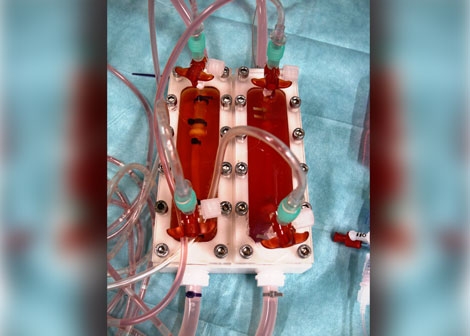
The fibers themselves are made by electrically charging solutions of dissolved polymers, spraying them onto a rotating drum and collecting them as a stretchable fabric. Researchers can then shape this textile for medical applications and they can add cells. Alternatively, doctors can implant it directly into damaged tissue for neighboring cells to colonize. In laboratory tests, the biologic material had tensile properties nearly matching that of human meniscus tissue.
“This approach transforms what was once an interesting biomaterials phenomenon into a method by which functional, three-dimensional tissues can be formed, ” says Mauck. He believes that this is a major step forward in the engineering of load-bearing fibrous tissues, and will eventually find widespread applications in regenerative medicine. Mauck and his team are currently testing their materials in a large animal model of meniscus repair and for other orthopaedic applications.
Author
React:
Discussion
This is a fascinating development. In my practice we've seen similar outcomes with the revised protocol. The key differentiator seems to be patient selection criteria. Has anyone else noticed the correlation with BMI thresholds?
Great point. I'd push back slightly on the conclusion, the sample size in the cited study is too small to draw population-level inferences. That said, the directional signal is compelling and worth a larger RCT.
We implemented a similar approach last year. Early results are promising but we're still gathering 12-month follow-up data. Happy to share our protocol if anyone is interested.
Join the conversation
Orthopedic professionals are discussing this. Sign in and upgrade to read every comment and add your voice.