
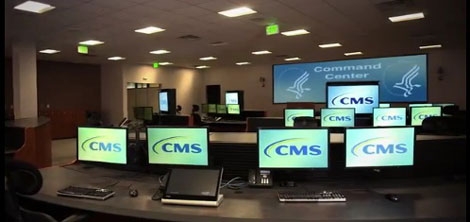
Medicare has a new high-tech fraud war room. The agency opened the $3.6 million command center in a commercial office park in Baltimore at the end of July.
Medicare Opens Fraud War Room
2 min read Premium comments
Secondary
There are a couple dozen computer workstations arrayed in concentric semicircles in front of a giant screen that can display data and photos, and also enable face-to-face communication with investigators around the country.
Some Republican lawmakers say a $77 million investment in a new computerized fraud detection system that went into operation last year is not working very well. According to an August 1, 2012 Associate Press story, Senators Orrin Hatch and Tom Coburn sent a letter to Health and Human Services Secretary Kathleen Sebelius questioning spending millions more on the command center until the bugs get worked out.
“The Center Will Pay for Itself”
But Medicare fraud czar Peter Budetti, M.D., CMS Deputy Administrator and Director of the Center for Program Integrity, told reporters during a tour that the command center could be a turning point. Responding to the criticism, Budetti said, “Our expectation is that this center will pay for itself many times over.”
Medicare fraud is estimated to cost more than $60 billion annually, and for years the government has been losing a game of “pay and chase, ” trying to recoup losses after scam artists have already cashed in.
Medicare officials say the new antifraud computer system aims to adapt tools used by credit card companies to stop theft from Medicare and Medicaid. The AP story said the system was launched with great fanfare last summer. But by Christmas, it had stopped just one suspicious payment from going out, for $7, 591. Administration officials say that shouldn’t be the only yardstick, and the system has made other valuable contributions.
There are three groups of staffers working in the war room. One group is responsible for developing computer models to query billing data for suspicious patterns; another is in charge of investigating data generated by the computer models, looking for mistakes as well as real fraud; and the third handles coordination with law enforcement around the country. The staffers said they expect the coordination to cut the time it takes to investigate suspected fraud schemes from months to days and weeks.
New Predictive Analytics
Budetti wrote on the CMS blog that the new command center is bringing together Medicare and Medicaid officials, as well as law enforcement partners from the HHS Office of the Inspector General, the Federal Bureau of Investigation, and CMS’ anti-fraud investigators. “The Command Center will gather experts from all different areas—clinicians, data analysts, fraud investigators, and policy experts—into the same room to build and improve our sophisticated new predictive analytics that spot fraud, and to then move quickly on a lead, once potential fraud is identified. The technology also allows us to connect with field offices to track down leads in real time.”
“The result is that investigations that used to take days and weeks can now be done in a matter of hours. And this new technology can help detect and prevent potential problems and payments. That can mean millions of taxpayer dollars staying out of the hands of fraudsters.”
Author
React:
Discussion
This is a fascinating development. In my practice we've seen similar outcomes with the revised protocol. The key differentiator seems to be patient selection criteria. Has anyone else noticed the correlation with BMI thresholds?
Great point. I'd push back slightly on the conclusion, the sample size in the cited study is too small to draw population-level inferences. That said, the directional signal is compelling and worth a larger RCT.
We implemented a similar approach last year. Early results are promising but we're still gathering 12-month follow-up data. Happy to share our protocol if anyone is interested.
Join the conversation
Orthopedic professionals are discussing this. Sign in and upgrade to read every comment and add your voice.