
“Based on the data we have today there’s little indication for metal-metal articulations in total hip arthroplasty, ” says Bill Maloney. “You can’t consider all metal-metal as one, ” counters Fares Haddad. “You have to break it down into large head metal-metal, standard head sizes, and hip resurfacing.”
Maloney vs. Haddad: Out With Metal-Metal Hips?
8 min read Premium comments
Great Debates
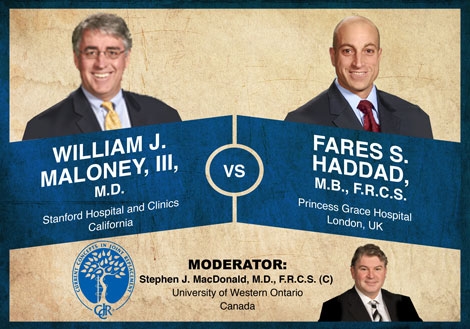
This week’s Orthopaedic Crossfire® debate is “Metal-Metal Hip Arthroplasty: Going, Going, Gone.” For the proposition was William J. Maloney, III, M.D. from Stanford Hospital and Clinics in California. Against the proposition was Fares S. Haddad, M.B., F.R.C.S. of Princess Grace Hospital in London, UK; moderating was Steven J. MacDonald, M.D., F.R.C.S.(C).
Dr. Maloney: “Remember where we were in the ‘90s. Osteolysis was a terrible problem in conventional polyethylene in young patients; and we were having significant problems with fixation, at least in North America, with cemented femoral components.”
“The goal was to reduce the particle load by reducing the wear volume. The hypothesis was that if you did that, you’d reduce the incidence of osteolysis and aseptic loosening; it’s being tested and we have data now. Femoral component fixation is essentially solved with multiple cementless designs; we have 10-year data with new bearings, and we’re seeing unique complications, especially with metal-metal articulations.”
“These include adverse tissue reactions that can be simple foreign body reactions, toxicity secondary to cell necrosis, and hypersensitivity, and some cases of systemic toxicity (cobaltism). An Oxford article identified 17 patients, 20 hips, all women with pseudotumors—a reaction to cobalt and chromium particles, ions, and maybe corrosion products. These were all resurfacing patients, not large head metal on metal; they were associated with extensive necrosis, lower Oxford Hip scores, and higher serum cobalt levels.”
“Take the case of a 65-year-old man who was four years post metal-metal hip resurfacing as part of an IDE [investigational device exemption] study. His cell count is low, whereas the cell count in infection is quite high. Histology: a combination of lymphocytic infiltration and fibrosis and tissue necrosis with the characteristic pattern…much different than what you see with polyethylene, titanium, or bone cement. When you’re revising these the outcomes are not as good as typical revisions, especially when you’re looking at revisions of failed surface replacements for femoral neck fracture.”
“Large head metal-metal is an even bigger problem. In a patient that had bilateral large head metal-metal total hip arthroplasty…the pseudo tumor grew up the iliopsoas tendon sheath, up the iliac crest, displacing the bladder medially.”
“Data from Keith Berend and Adolph Lombardi: they did almost 1, 800 metal-metal total hip replacements. They had a 5% failure rate at 31 months; 3% were related to cup failures, they now have data at 43 months and that failure rate is up to 7%. They have stopped doing metal-metal.”
“The large head metal-metal is more prone to this reaction than the small head metal-metal, but we have seen it with small heads. We did serial dilutions with cobalt and chrome versus titanium. If you look at the difference, titanium is inflammatory; the cells ingest the particles and release bone resorbing cytokines at the same particle concentration—cobalt is toxic and kills the cells.”
“We have seen systemic toxicity; a Stanford patient, for example, probably has cobaltism, and there are some case reports in the literature of these patients having cardiomyopathy, cognitive impairment, auditory impairment, peripheral neuropathy, hypothyroidism and rashes. If you look at 2009 data from the Australian registry with head size less than or equal to 28mm, adjusted for age and gender…the metal-metal has a significantly higher failure rate than the other bearings. If you look at the larger heads the difference is even greater. 2011…all comers with different bearing surfaces…you see that the metal on highly cross-linked polyethylene (HCLP), ceramic on HCLP, ceramic on ceramic are all about the same. The metal-metal has a significantly higher failure rate; at about eight years the failure rate is about 8%—about double the failure rate of the other bearing surfaces.”
“When you get into the large heads it’s really a problem with the metal-metal…the failure rate rises significantly and you have a much higher rate of socket loosening and metal hypersensitivity or adverse local tissue reaction in the English and Wales registry, looking at survivorship and combining both fixation and bearing surface. The highest failure rate was large head metal-metal; second highest was metal-metal; at five years you’ve got almost a 10% failure rate with a large head metal-metal.”
“Based on the data we have today there’s little or no indication for metal-metal articulations in total hip arthroplasty.”
Mr. Haddad: “The registry data is certainly worrying; the Medical Health Related Device Agency has told us that there are concerns about these cases.”
“The use of large head metal-metal has decreased dramatically in the UK. But you have to break it down into large head metal-metal, standard head sizes, and hip resurfacing. Large head metal-metal is flawed…we’re seeing black fluid in joints, soft tissue destruction, femoral osteolysis, and bony destruction on both sides of the joint. We have decreed in the UK that we should no longer perform large head metal-metal 36mm or above, except in a properly conducted and ethically approved research study.”
“Standard head sizes? Migaud’s prospective randomized study showed no difference or slight improvement with metal-metal. Kim…99.1% [survivorship] at six years. Grubl et al.…98.6% at 10 years. There are other studies like this…and there is still an argument for maintaining small head metal-metal, or at least not tarring it with the same brush.”
“The issue becomes much greater with resurfacing. We know that the early results of hip resurfacing in appropriate centers when well-done were staggering. If we select the patients appropriately, it’s much better in young males with large heads. In the Australian registry—under 55s—the outcomes of the BHR [Birmingham Hip Resurfacing] are better than those of total hip replacement. If you look at all comers in the UK for the resurfacings that had an ODEP 10A [Orthopaedic Data Evaluation Panel] rating, you’ll see that those satisfy our criteria for 10 year survivorship.”
“High volume people—someone like Ronan Treacy—his data with the removal of the septic cases at 10 years in the under 50s are 0%—100% survival. So there’s got to be something to work with here. There’s a higher failure rate when we extend the indications to women, those over 65, and to inflammatory arthritis, AVN [avascular necrosis] or DDH [developmental dysplasia of the hip].”
“We did a comparative study that started over 10 years ago looking at resurfacing and comparing cementless hip replacement. These were resurfacings of all sizes. Inclination and anteversion: the BHRs and THRs [total hip replacement] have pretty similar positions. We found that the hip resurfacings had better Oxford, UCLA, and Satisfaction Scores early, but then in the standard hip scoring systems that have a ceiling effect we found no difference beyond one year.”
“When we probed further—looking at their single leg stance, hopping, stair climbing, we found differences. We haven’t lost any patients to follow-up; we haven’t seen any aseptic failures or osteolysis. There is a bit of neck narrowing, but they are doing well. If we look at function score at 10 years there’s a statistically significant difference between the hip resurfacings and the hip replacements.”
“In summary, there’s no doubt we’ve got new clinical problems. But there’s a danger that we could throw out the baby with the bathwater. Right now, large head metal-metal is out. With standard head metal-metal I wouldn’t suggest you take it up, but we should continue to study it. Although hip resurfacing isn’t for everyone, it works well in the right patient in a well carried out operation.”
Moderator MacDonald: “I think we agree that all metal-metal isn’t created equally, but that message seems to be lost…how do you turn that around?”
Mr. Haddad: “I think it all goes back to how you look at technology, how you introduce implants. We have an ODEP rating, so it’s whether an implant has lasted the test of time in small studies in regulated cohorts. If an implant has a good 10 year survivorship, it doesn’t matter what bearing it is then we can use it. We should be careful with ‘me too’ products, very careful not to translate.”
Moderator MacDonald: “Did you help draft the British Hip Society statement?”
Mr. Haddad: “I did.”
Moderator MacDonald: “Bill, the Australian registry says for young males—55 up to 65—metal-metal seems to be slightly better at this point in this time. What are your thoughts and does that sway you?”
Dr. Maloney: “Those graphs are pretty close together. It’s not the same difference that you see with a large head metal-metal, and I think it’s a risk/benefit analysis with the data you have at the moment. Maybe the outcomes are a bit better in terms of revisions. If you want to hop around on one leg a lot, resurfacing is a good operation. You’ve got to look at the operation in Fares’ hands, who is meticulous about it and the difference in releasing it to the community where patients don’t come in for follow-up.”
Moderator MacDonald: “Do you agree?”
Mr. Haddad: “The first big paper everybody quotes was in the under 55s and everybody thought he was crazy…why is he looking at this high end population, active patients. But it’s when we extend the indications that the problems start.”
Dr. Maloney: “Steve, remember that these metal ions are going to hang around. What happens when the 55 year old is 70 and their creatinine goes from 1.2 to 3? Now their ion level is going to go up and the tissue concentration is going to go up, so I think the 10-year results are great, but they’re not going to tell the whole story. In fact, Keith Berend and Adolph Lombardi have 10 year results on their smaller head metal on metal that were originally doing well and now they’re seeing soft tissue reactions 10 years later.”
Moderator MacDonald: “Tell the audience…how many resurfacings should they be doing to maintain their skills?”
Mr. Haddad: “You must be able to do the operation well. It’s definitely more difficult than doing a hip replacement. I couldn’t give you a certain number.”
Moderator MacDonald: “How much time do you have to spend with patients talking about this before you operate? How much detail do you get into about the complications?”
Mr. Haddad: “Most of them have read the press so they’re attuned to that idea. You just have to give them the pros and cons, give them your data and ultimately they make the choice. It’s a 10-15 minute longer conversation than it is with a standard bearing.”
Moderator MacDonald: “Bill, a lot of metal-metals were done in your area. Have you seen an increasing number of referrals to you with the complications now?”
Dr. Maloney: “We thought this was going to be an early complication based on the Oxford data, but we’re actually seeing it five to seven to ten years out…and the smaller head metal-metals seem to present later. So if you look at the 10 year plus data we’re seeing some of the 28mm Metasuls with soft tissue reactions that are adverse.”
Moderator MacDonald: “Thank you, gentlemen.”
Please visit www.CCJR.com to register for the 2012 CCJR Winter Meeting, December 12 – 15 in Orlando, Florida.
 “You may now view CCJR meeting content on your mobile device on the CCJR MobileTM App. Please scan the QR code to download from iTunes.”
React:
Discussion
This is a fascinating development. In my practice we've seen similar outcomes with the revised protocol. The key differentiator seems to be patient selection criteria. Has anyone else noticed the correlation with BMI thresholds?
Great point. I'd push back slightly on the conclusion, the sample size in the cited study is too small to draw population-level inferences. That said, the directional signal is compelling and worth a larger RCT.
We implemented a similar approach last year. Early results are promising but we're still gathering 12-month follow-up data. Happy to share our protocol if anyone is interested.
Join the conversation
Orthopedic professionals are discussing this. Sign in and upgrade to read every comment and add your voice.