
Could there be a connection between a common type of athletic hip disorder and the risk of a sports hernia? According researchers in the orthopedics department at the University of Virginia, the answer is “yes.”
Hernias Connected To Hip Disorder
1 min read Premium comments
Secondary
Sports hernias, a tear of the oblique abdominal muscles, are a common cause of groin pain in athletes but little has been known about why they occur. The Virginia study suggests that a condition called femoral acetabular impingement (FAI)—essentially friction between the hip ball and socket—may be a contributing factor.
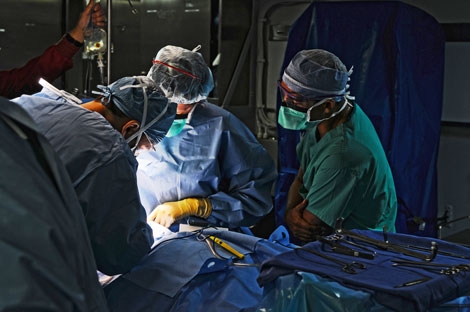
Researchers reviewed the records of 43 patients who underwent surgery to repair sports hernias between 1999 and 2011. Of those patients, 37 (86%) showed evidence of some form of femoral acetabular impingement on MRI, CT scans or X-rays.
Our study illustrated that those patients with FAI tend to have a change in hip biomechanics, which, in turn, leads to increased stress across the groin, ” study lead author Kostas Economopoulos, M.D. said in a July 13 news release. “With these stresses, a sports hernia is more likely to occur.
He added, “We hope our study encourages physicians who see sports hernia and chronic groin pain in athletes to further investigate the possibility of FAI, and, in turn, can recommend better treatment options for this puzzling condition.” The study was presented at the annual meeting of the American Orthopaedic Society for Sports Medicine in Baltimore.
Author
React:
Discussion
This is a fascinating development. In my practice we've seen similar outcomes with the revised protocol. The key differentiator seems to be patient selection criteria. Has anyone else noticed the correlation with BMI thresholds?
Great point. I'd push back slightly on the conclusion, the sample size in the cited study is too small to draw population-level inferences. That said, the directional signal is compelling and worth a larger RCT.
We implemented a similar approach last year. Early results are promising but we're still gathering 12-month follow-up data. Happy to share our protocol if anyone is interested.
Join the conversation
Orthopedic professionals are discussing this. Sign in and upgrade to read every comment and add your voice.