
The FDA promised to improve its medical device application review times when industry agreed to double user fees to $595 million over the next five years in MDUFMA (Medical Device User Fees Modernization Act) III recently passed by Congress and signed into law by the President.
FDA Proposes Faster 510(k) Clearance Process
2 min read Premium comments
Secondary
The agency is now proposing a new basic administrative checklist to pre-assess submissions for a certain level of completeness and reject submission before passing them on for agency review. Submissions dubbed incomplete will be rejected.
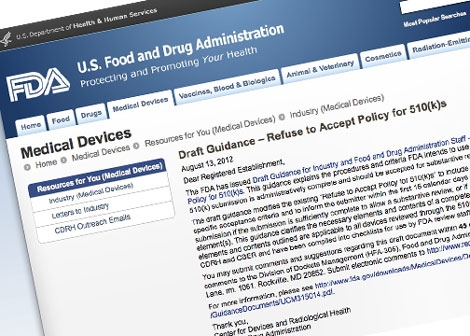
A draft guidance released on August 13, entitled “Refuse to Accept policy for 510(k)s, ” states that the agency will only accept a premarket notification submission for substantive review it is deemed to be “complete.” The document outlines the procedures and criteria it will use to determine completeness of an application.
FDA agreed to performance goals based on the timeliness of reviews, ” the proposal reads. “Acceptance review therefore takes on additional importance in both encouraging quality submissions from sponsors of 510(k) notifications and allowing FDA to appropriately concentrate resources on complete submissions.
The agency provided an early version of the new checklist it plans to use to assess applications, which includes basic criteria such “Submission contains table of contents” and “All pages of the submission are numbered, ” as well as noting the inclusion of engineering drawings and identification of predicate devices.
Missing one or more organizational elements, such as the table of contents or page numbers, will not generally result in a “refuse to accept” decision, the FDA noted, but details outlined in the checklist’s “Elements of a Complete Submission” area are individually grounds for rejection.
The draft guidance modifies the existing “Refuse to Accept Policy for 510(k)s” to include an early review against specific acceptance criteria and to inform the submitter within the first 15 calendar days of receipt of the submission if the submission is sufficiently complete to allow a substantive review, or if not, to identify the missing element(s). This guidance clarifies the necessary elements and contents of a complete 510(k) submission. The elements and contents outlined are applicable to all devices reviewed through the 510(k) notification process in CDRH and CBER and have been compiled into checklists for use by FDA review staff.
You may submit comments and suggestions regarding this draft document before September 27, 2012. Submit written comments to the Division of Dockets Management (HFA-305), Food and Drug Administration, 5630 Fishers Lane, rm. 1061, Rockville, MD 20852. Submit electronic comments to http://www.regulations.gov.
For more information, please see http://www.fda.gov/downloads/MedicalDevices/DeviceRegulationandGuidance/GuidanceDocuments/UCM315014.pdf.
Author
React:
Discussion
This is a fascinating development. In my practice we've seen similar outcomes with the revised protocol. The key differentiator seems to be patient selection criteria. Has anyone else noticed the correlation with BMI thresholds?
Great point. I'd push back slightly on the conclusion, the sample size in the cited study is too small to draw population-level inferences. That said, the directional signal is compelling and worth a larger RCT.
We implemented a similar approach last year. Early results are promising but we're still gathering 12-month follow-up data. Happy to share our protocol if anyone is interested.
Join the conversation
Orthopedic professionals are discussing this. Sign in and upgrade to read every comment and add your voice.