
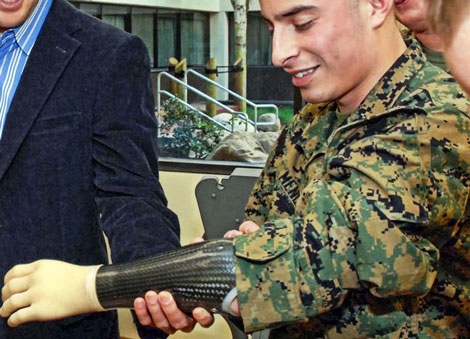
As previously reported in OTW, a team of researchers and surgeons from the University of Utah and the George E. Wahlen Department of Veterans Affairs (VA) Medical Center in Salt Lake City are working to provide an alternative solution for the attachment of prosthetic limbs. Skin issues or short remaining-limb length can cause amputees to reject the typical socket-type attachment systems. For the last six years, the Utah team has been developing a device that can be implanted directly into a person’s residual bone, passing through the skin, so technicians can securely attach a prosthetic limb without the need for a socket.
Can Prosthetics Anchor Directly on Bone?
2 min read Premium comments
Secondary
The researchers’ work has recently achieved two milestones. One is a partnership with DJO Surgical, a global developer, manufacturer and distributor of medical devices, which has licensed the implant technology and is assisting with the remaining research and development. The other milestone is acceptance into a new Food and Drug Administration (FDA) program that allows the researchers to design a human early feasibility study. DJO Surgical applied for the FDA study and is responsible for managing its implementation.
“We are trying desperately to provide relief to the many veterans who have lost a limb, ” said Roy Bloebaum, professor of orthopedics at the University of Utah and the director of the VA Bone and Joint Research Lab. “Most of these people are very young and have many years to live. Our goal is to give them back all of the abilities they had before they were injured.”
According to Science Daily on July 26, nothing like this procedure has been done at a U.S. hospital, and it has only been attempted an estimated 250 times worldwide in Europe and Australia, with mixed results. The early feasibility study will last up to three years. During that time, members of the clinical research team will implant their device into 10 patients.
The research team reports that it faced three fundamental problems:
-
getting the bone to grow into the device
-
preventing infection
-
determining how to address the skin interface.
They claim to have addressed most of these problems, as the solutions lie in the design of their device and the materials used. Key to the device’s success is the fact that it is coated with a porous titanium material called P2, a proprietary coating that is owned by DJO. Skin and bone grows into the material, forming a secure bond.
Bloebaum is working with two other University of Utah professors—Kent Bachus, an engineer and a professor of orthopedics and director of the Orthopaedic Research Lab at the University of Utah, and Peter Beck, an orthopedic surgeon and adjunct professor of orthopedics.
Author
React:
Discussion
This is a fascinating development. In my practice we've seen similar outcomes with the revised protocol. The key differentiator seems to be patient selection criteria. Has anyone else noticed the correlation with BMI thresholds?
Great point. I'd push back slightly on the conclusion, the sample size in the cited study is too small to draw population-level inferences. That said, the directional signal is compelling and worth a larger RCT.
We implemented a similar approach last year. Early results are promising but we're still gathering 12-month follow-up data. Happy to share our protocol if anyone is interested.
Join the conversation
Orthopedic professionals are discussing this. Sign in and upgrade to read every comment and add your voice.