
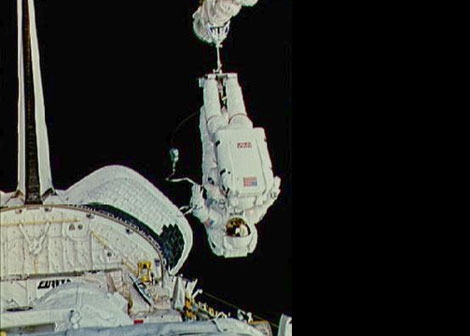
No, they’re not dirty dancing in space…but they are lifting weights and watching their diets. New research from NASA indicates that eating the right diet and exercising hard in space helps protect International Space Station astronauts’ bones.
Bones in Space: News From NASA
2 min read Premium comments
Secondary
The researchers, whose work is published this month in the Journal of Bone and Mineral Research, evaluated the mineral density of specific bones as well as the entire skeleton of astronauts who used the Advanced Resistive Exercise Device (ARED), a 2008 addition to the space station that can produce resistance of as much as 600 pounds in microgravity. Resistance exercise allows astronauts to “lift weights” in weightlessness.
Researchers compared data measured from 2006 until the new device arrived, when astronauts used an interim workout that offered about half the total resistance of the ARED. The astronauts using the advanced exercise system returned to Earth with more lean muscle and less fat, and maintained their whole body and regional bone mineral density compared to when they launched. Crew members using ARED also consumed sufficient calories and vitamin D, among other nutrients.
“After 51 years of human spaceflight, these data mark the first significant progress in protecting bone through diet and exercise, ” said Scott M. Smith, NASA nutritionist at the agency’s Johnson Space Center in Houston and lead author of the publication, in the August 24, 2012 news release.
Earlier studies of Russian Mir space station residents found an increased rate of breakdown, but little change in the rate of regrowth that resulted in an overall loss in bone density. In the new study, researchers looked at preflight and postflight images of bone using X-ray densitometry, as well as in-flight blood and urine measurements of chemicals that reflect bone metabolism. In crew members who used the ARED device during spaceflight, bone breakdown still increased, but bone formation also tended to increase, likely resulting in the maintenance of whole bone mineral density.
“The increase in both bone breakdown and formation suggests that the bone is being remodeled, but a key question remains as to whether this remodeled bone is as strong as the bone before flight, ” said Dr. Jean Sibonga, bone discipline lead at Johnson and coauthor of the study.
There is no shortage of related research underway. Some scientists are evaluating bone strength before and after flight, while others are trying to determine the best possible combination of exercise and diet for long-duration crews. Dietary effects on bone are being studied on the space station right now, with one experiment evaluating different ratios of animal protein and potassium in the diet on bone health. Another is looking at the benefits for bone of lowering sodium intake.
React:
Discussion
This is a fascinating development. In my practice we've seen similar outcomes with the revised protocol. The key differentiator seems to be patient selection criteria. Has anyone else noticed the correlation with BMI thresholds?
Great point. I'd push back slightly on the conclusion, the sample size in the cited study is too small to draw population-level inferences. That said, the directional signal is compelling and worth a larger RCT.
We implemented a similar approach last year. Early results are promising but we're still gathering 12-month follow-up data. Happy to share our protocol if anyone is interested.
Join the conversation
Orthopedic professionals are discussing this. Sign in and upgrade to read every comment and add your voice.