
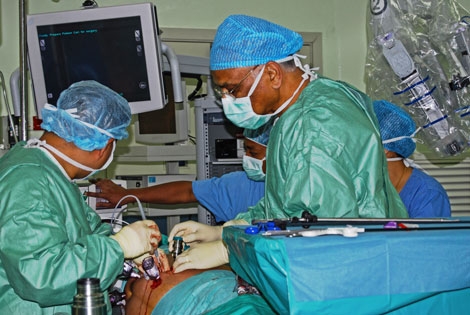
A Mumbai surgeon, Dr. Nilen Shah, operating at the SK Mehta hospital, successfully performed knee replacement surgery on a patient who was only 3’ 10” tall. Ramesh Shah, who suffers from achondroplastic dwarfism, a rare congenital genetic disorder that does not allow proper bone formation, had been suffering for three years from arthritis of the knee. Several doctors had turned him down because of their perceived inability to find implants to match his size. “Due to my rare condition, I was told that knee replacement will not work for me, ” he said.
Surgeon Replaces Knee on 3’10” Patient
1 min read Premium comments
Secondary
Then he found Nilen Shah, M.D., a surgeon with the same name, who, after a long search, found a knee implant that he could make fit. “This is the first such case I have seen in 20 years of my career as an orthopaedic surgeon. Dwarfism itself is rare. The life span of these people varies, and only a few reach adulthood. This guy is one of them, ” said Shah.
According to the surgeon Shah, there are several ‘dwarfs’ residing in the country who do not opt for knee replacement surgeries due to a lack of awareness that the surgery could be available to them. He hopes that successful surgeries like this one will encourage them to try. Achondroplastic dwarfism, in which the cartilage does not mature and become bone, especially in the long bones of the hands and legs, affects 1.3 people out of every 1, 00, 000 [sic] births per the July 6 press release.
Author
React:
Discussion
This is a fascinating development. In my practice we've seen similar outcomes with the revised protocol. The key differentiator seems to be patient selection criteria. Has anyone else noticed the correlation with BMI thresholds?
Great point. I'd push back slightly on the conclusion, the sample size in the cited study is too small to draw population-level inferences. That said, the directional signal is compelling and worth a larger RCT.
We implemented a similar approach last year. Early results are promising but we're still gathering 12-month follow-up data. Happy to share our protocol if anyone is interested.
Join the conversation
Orthopedic professionals are discussing this. Sign in and upgrade to read every comment and add your voice.