
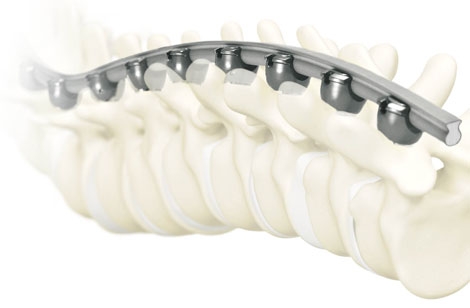
K2M, Inc. has announced the debut of its new Rail 4D Technology at the 19th International Meeting on Advanced Spine Techniques (IMAST) in Istanbul, Turkey. This 4D Technology will first be featured in the form of the MESA Rail Deformity Spinal System to address the most complex spinal curves.
New in Spine: K2M Launches Rail 4D
2 min read Premium comments
Secondary
The company indicates that this product was inspired by structural I-beam geometry, and that the uniquely shaped and one-of-a-kind Rail is an alternative to the traditional round spinal rods offered with other products. The Rail provides enhanced structural rigidity, while maintaining a lower-profile than set screw based systems. As compared to a standard 5.5 mm Cobalt Chrome rod, says K2M, its 5.5 mm Cobalt Chrome Rail is 210% stronger in flexion-extension and 46% stronger in lateral bending. This technology is exclusive to K2M, as it has been designed to complement the company’s existing MESA Locking and Cricket Reduction Technologies.
In the July 17, 2012 news release, Oheneba Boachie-Adjei, M.D., chief of the Scoliosis Service at the Hospital for Special Surgery, said, “The Rail provides a strong, stable, and durable construct for correction of spine deformities. The rod flattening scenario commonly seen with other more flexible rods is improved by the Rail’s high flexural rigidity in the sagittal plane, and the race between bone fusion and implant failure is less of a worry with the stronger Rail.”
Due to the beam-like shape, reducing the Rail Cricket devices will inherently result in rotation of the vertebral bodies as they are pulled up to the Rail. The design offers fixation options for surgeons by helping to apply forces during axial correction of difficult spinal curvatures. It has the potential to reduce intraoperative rod “flattening” that is undesired by surgeons. The Rail may decrease the need for over-bending the construct and give surgeons more predictability and direct control over sagittal balance.
“Rail 4D is a breakthrough technology providing surgeons that treat the most complex spinal deformities with a brand new alternative for predictable rigid fixation, ” stated Eric Major, K2M’s president and CEO. “Based on the clinical feedback to date, we are confident that Rail 4D has the potential to disruptively change the complex spine market and, most importantly, offer surgeons a new and improved intraoperative option for treating patients with scoliosis.”
Major told OTW,
The breakthrough in product development occurred when the team realized we would be able to create a new option for predictable rigid fixation to address the issues of sagittal balance by using a unique geometry, while also utilizing the low profile characteristics of the MESA Locking Technology. This combination provides an advancement in innovation and alternatives for surgeons. The disruptive nature of the Rail is critical to our explosive growth in the complex spine market.
React:
Discussion
This is a fascinating development. In my practice we've seen similar outcomes with the revised protocol. The key differentiator seems to be patient selection criteria. Has anyone else noticed the correlation with BMI thresholds?
Great point. I'd push back slightly on the conclusion, the sample size in the cited study is too small to draw population-level inferences. That said, the directional signal is compelling and worth a larger RCT.
We implemented a similar approach last year. Early results are promising but we're still gathering 12-month follow-up data. Happy to share our protocol if anyone is interested.
Join the conversation
Orthopedic professionals are discussing this. Sign in and upgrade to read every comment and add your voice.