
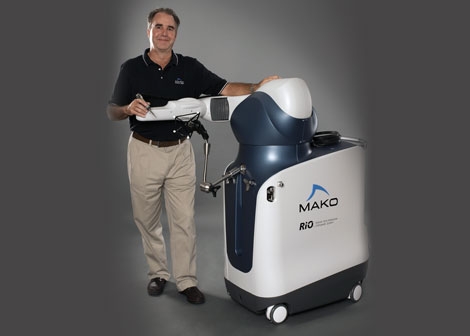
On July 9, MAKO Surgical Corp. announced “slower than expected growth” for the first half of the year.
MAKO Disappoints in 2Q; Shakes Up Management
2 min read Premium comments
Secondary
Sales Leader Resigns
By July, 12, the company announced that its senior VP of sales and marketing for the last six years, Steven Nunes, would resign on July 17, 2012. Maurice R. Ferré, M.D., MAKO’s president and CEO, will assume sales responsibilities on an interim basis while MAKO conducts a search for a senior vice president of sales. Ivan Delevic, MAKO’s senior vice president of strategic marketing and business development, will transition to the new role of senior vice president of marketing and assume commercial marketing responsibilities, in addition to his existing strategic marketing responsibilities.
Lowered Guidance
In addition to announcing the less than expected growth, the company also, once again, lowered guidance. The company now expects to sell 42-48 systems and perform 11, 000 to 12, 000 procedures for the year. Previously the company had expected to sell 52-58 systems and perform up to 13, 000 procedures.
Mike Matson, Mizuho Securities USA senior analyst, said it appears that MAKOplasty adoption has slowed and that MAKO is struggling to gain traction beyond its initial early-adopter customers.
Second Quarter Sales
During the second quarter, MAKO sold 9 RIO Systems and performed 2, 590 MAKOplasty procedures. Matson had expected 11 systems sold and 2, 620 procedures performed. The second quarter number of procedures was up 66% over the same quarter in 2011. Of the nine RIO Systems that were sold, eight were sold in the U.S. (of which two were sold to existing customers) and one was sold to a hospital in Hong Kong (via a distributor). These nine RIO systems bring MAKO’s worldwide commercial installed base of RIO systems to 126 systems and domestic commercial installed base to 123 systems as of June 30, 2012.
Utilization Improvement
In a June 4, 2012 article titled: “Was MAKO’s Miss a Hit on Surgical Robotics?”, OTW Publisher Robin Young noted the economic rationale for expensive surgical robots rests on showing that the added cost of the robotic instrument substantially improves the performance of the surgeon and the implant. The MAKO system which costs just under a million dollars, adds 20-30 minutes to operating room time. MAKO had good news here for the quarter by reporting that utilization rates jumped from 6.4 to 7.2 procedures per system from the second quarter of 2011.
Investor Reaction
It’s been a tough six months for MAKO.
After the July 9 announcement, investors displayed their disappointment as the company’s stock fell from around $25 per share to $14 per share. It was a similar situation in May when the company announced disappointing first quarter results. Then the stock price fell from around $40 to $25 per share. Numerous shareholder lawsuits are underway as some investors claim company management misled investors.
“With six months of 2012 behind us, we have experienced slower than expected growth, ” said company leader, Dr. Ferré in the July 9 press release. “While our core belief in the significant market opportunity and the transformational value of our technology remains intact, management’s near term focus will be to improve our execution for the remainder of 2012 and beyond.”
Author
React:
Discussion
This is a fascinating development. In my practice we've seen similar outcomes with the revised protocol. The key differentiator seems to be patient selection criteria. Has anyone else noticed the correlation with BMI thresholds?
Great point. I'd push back slightly on the conclusion, the sample size in the cited study is too small to draw population-level inferences. That said, the directional signal is compelling and worth a larger RCT.
We implemented a similar approach last year. Early results are promising but we're still gathering 12-month follow-up data. Happy to share our protocol if anyone is interested.
Join the conversation
Orthopedic professionals are discussing this. Sign in and upgrade to read every comment and add your voice.