
“You get much better range of motion with the reverse, ” says Reuben Gobezie. “Nope, ” argues Bill Seitz, “The reverse has been tried repeatedly over the last 30+ years and it has failed.”
Gobezie and Seitz Square Off on Reverse CTA
8 min read Premium comments
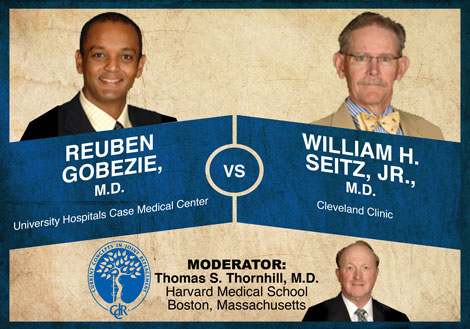
This week’s Orthopaedic Crossfire® debate is “Reverse Shoulder for Cuff Tear Arthropathy: Optimal Implant Solutions.” For the proposition was Reuben Gobezie, M.D. from University Hospitals Case Medical Center. Against the proposition was William H. Seitz, Jr., M.D. of Cleveland Clinic; moderating was Thomas S. Thornhill, M.D. of Harvard Medical School.
Dr. Gobezie: “I’m going to call this ‘one and done.’ My colleague has been around for a long time. If we look at the evolution of aviation in reverse you’ll see a lot of parallels. In 1496 DaVinci came up with the Aerial Screw and thought this was a good idea. Bill [Seitz] thought this was good too, but it never made it off the paper. If we look at the first steps in shoulder arthroplasty…1893 with Pean who did the first total shoulder replacement. While it was a major advance, the operation failed due to infection. In 1868 Jean Marie Le Bris developed the Albatros II. Bill said, ‘That’s weird. I’d like to try it.’ The plane crashed and the pilot died. Likewise, the Stanmore Shoulder.”
“From 1969-1975 we see a lot of attempts to make a hemiarthroplasty—or, in this case—a total shoulder—work. These are semi-constrained glenoid designs that came out of Europe and failed miserably. Bill and I are both from Ohio and despite what the Carolina guys say, the Wright brothers are from Ohio. In 1978 a Frenchman, Paul Grammont, came up with the idea of a reverse ball and socket prosthesis which relied solely on the deltoid for movement and stability. A great idea…and what it looked like was a glenoid sphere, which was large, and a ball with no neck, and a humeral cup with an inclination of 155 degrees. This would put the deltoid in tension. The next step in aviation is the development of jets; likewise there have been very significant developments in arthroplasty. The question is, ‘Where is my colleague, Bill?’”
“Let’s define the current problem. The case: a massive rotator cuff (RC) tear with pain in a 70-year-old female. Function is not a problem…yet. But, is she 70 going on 60 or 70 going on 90? What happens to this massive tear over time, and how long can we expect her to live?”
“The average female in this country lives about 80 years, so we need to choose something that will give her at least 10 years of relief. If we treat her with a hemiarthroplasty what’s going to happen to her cuff? There’s a study in the Journal of Bone and Joint Surgery (JBJS) on symptomatic progression of asymptomatic rotator cuff tears; of 195 patients with RC tears, 44 developed pain. They were followed for only 1.93 years. Conclusion: if you develop pain, there is a high probability of increasing your tear size and worsening your function.”
“Another study on nonoperative RC tears; 59 shoulders followed by MRI for 20 months, with 58/59 having an isolated supraspinatous tear. And 52% had progression of the tear. Conclusions: factors associated with tear progression: age>60, full thickness tear, and fatty degeneration (note: all in this case).”
“Hemiarthroplasty was originally described by Charles Neer as ‘Limited Goals’ surgery for the treatment of these tears. That meant that patients had no or mild pain, were pleased with the outcome, and were capable of independent self care. How much shoulder function do you need for that? Not much. If you set your goals low, every case is a winner. Let’s look at the results.”
“Another study on hemiarthroplasty for RC deficient shoulders; 34 shoulders with RC arthropathy. ‘Limited goals’ was the outcome measure and the mean American Shoulder and Elbow Society average score postop was 67; no difference between the cuffs they could repair and the cuffs they couldn’t.”
“There’s one looking at reverse replacement in RC tears by Mark Frankle; only four patients…something that looked like our case here, and they had a tough time with that. But 95% of the patients were satisfied; flexion was 134 degrees.”
“Overall, if you look at outcomes for hemiarthroplasty for massive cuff tears you see that all of them were evaluated according to limited goals. Whereas if you look at the reverse—you’ll see much better range of motion.”
“Conclusion: it’s like a scene from the Deer Hunter…how lucky do you feel?”
Dr. Seitz: “Reuben, that was great. I noticed on your disclosure that you have a lot of stock in the History Channel. So I’m going to discuss not using a backwards shoulder prosthesis for this case with a contained rotator cuff tear arthropathy. It is a 70-year-old woman with 170 degrees of elevation. By definition, that is a contained grade one or two RC tear. There’s no escape—or the patient would not be able to get this motion. There is a posterior RC or she would not be able to get 40 degrees of external rotation. There is some wear of the shoulder surface, although the congruence is pretty good. What she does have is a high riding humeral head, and the tuberosities are hitting against the top of the arch. But it’s contained within the arch; there is no superior/anterior escape.”
“So let’s accept the new, stable center of rotation…not by putting one of those old stemmed, half a joint hemiarthroplasties in, but by doing a procedure which burns no bridges, maintains good motion, offers pain relief, but not complications.”
“Looking back over the reverse, it’s been tried repeatedly over the last 30+ years. Time and again, with long term follow-up, these have failed. Albeit the new generation of reverse shoulder has shown some very good outcomes in sedentary patients, even in a first report, there were only 49/70 good or excellent results and three very early glenoid failures. When this operation fails at the glenoid side you have a salvage procedure on your hands. In a report by Sirveaux, 18.7% major complications requiring revision; he described a classification of progressive degeneration or osteolysis of the inferior glenoid, resulting in notching.”
“Walch was one of the developers of this system, and reported in 2006 very significant problems in active patients who are physiologically young; he stated categorically that it should be reserved for patients over 70 years old.”
“So Reuben, you have this active person who starts out with 170 degrees of elevation, 40 degrees of external rotation, you perform a reverse total shoulder arthroplasty and wind up with something worse than when you started. Now what is your bailout?”
“We reported in 2004 on a successful use of a hypervalgusly placed resurfacing arthroplasty which resects virtually no bone. It provides a seamless resurfacing so that you basically have an ice cream cone sitting smoothly within that arch…not a hemiarthroplasty with incongruous edges. But it does require an intact arch. The cuff tears in these cases are irreparable, but the use of this technique gives very good pain relief and surprisingly good motion.”
“There is a role for the reverse—when there is no arch containment. We must be conscientious stewards of our shrinking healthcare dollars. The operation Reuben has recommended…the implant alone costs more than the DRG [Diagnosis-Related Group] that the hospital gets for doing the operation—and it’s about three times the cost of the other surgery.”
“So what cup arthroplasty or resurfacing arthroplasty with a smooth, seamless head offers is: resurfacing without taking away bone, in-growth/on-growth fixation without cement, is conservative, and is an excellent procedure for a physiologically younger, active patient with good bone stock and a stable joint. When you look at these patients—and you look at 3D reconstructions, you see that in many of these the medialization and superioralization into the glenoid creates more of an acetabulum. In these cases this resurfacing procedure is an excellent way of maintaining motion and alleviating pain.”
“Reuben, use your head…is there really a choice here?”
Moderator Thornhill: “Let me just clarify something unrelated to this. Do you both agree that in somebody with an intact cuff and severe osteoarthritis of the shoulder you’re better off with a total shoulder than a hemi?”
Dr. Seitz: “Yes.”
Dr. Gobezie: “Yes.”
Moderator Thornhill: “This patient had 170 degrees of forward elevation so she’s really not escaped through. And her joint surface didn’t look terrible, but maybe superiorally where she’s out a bit it’s OK. The X-ray was somewhat lordotic, making the acromial space look smaller. Would you do a CT to see what cuff was there before you made a decision?”
Dr. Gobezie: “What is this patient’s physiologic age? On the slide it’s fine, but is she young and healthy-looking? If not, I’m not going to put a reverse in her. On this case—the 70-year-old lady—I would do a reverse all things being equal.”
Moderator Thornhill: “Bill, would you resurface her glenoid?”
Dr. Seitz: “No. the glenoid here is almost out of play. The head is sitting up under the CA arch [coracromial arch]…it’s already migrated up and posteriorly as opposed to anteriorly. So I would let the head sit in that area, but give it a smooth contour with a resurfacing.”
Moderator Thornhill: “You could just do a large hemi and let it articulate with the CA arch. You could do an offset cam to try to get you to clear; or you could do a resurfacing. I remember years ago Steffee just popped a hip on top. You were showing several cases of just putting resurfaces up in valgus. What would you do for this lady?”
Dr. Seitz: “Just that. When you saw the MRI there was extensive fat replacement of the supraspinatous; the other muscles were clearly involved in their upper portions. But she still had lower external rotation; she still had her teres minor intact. And by being seated she was using her deltoid. Now the stemmed implants have a problem. Even the ones with a little edge in that the head goes where the stem dictates. With this you cover everything, including the tuberosities; you shape down the tuberosities and put the cup over the top in this hypervalgus—about 165 degree—posture—a bit posteriorly angulated—and it stays in the arch.”
Moderator Thornhill: “Reuben, oftentimes associated with the problems that you see in CTA is a fair amount of osteopenia. These tend to be elderly people, which would threaten glenoid fixation. Are you concerned about less than optimal glenoid fixation—and component failure with that—and what determination do you make intraoperatively?”
Dr. Gobezie: “I’m concerned, no question. Most of the outcomes for reverse arthroplasty show failure at the base plate and if you look at Gilles Walch’s biggest series you see 92% survivorship at 10 years, although there’s a drop-off 7-9 years into it—mostly from glenoid failure…from notching. I think it depends on what reverse design you’re using. Bigliani’s reverse with a more shallow neck shaft angle…less notching; Encore prosthesis/DJO…far less notching; the Grammont style…a lot more notching has been reported.”
Moderator Thornhill: “Thank you for a timely, entertaining debate.”
Please visit www.CCJR.com to register for the 2012 CCJR Winter Meeting, December 12 – 15 in Orlando, Florida.
 You may now view CCJR meeting content on your mobile device on the CCJR Mobile™ App. Please scan the QR code to download from iTunes.
React:
Discussion
This is a fascinating development. In my practice we've seen similar outcomes with the revised protocol. The key differentiator seems to be patient selection criteria. Has anyone else noticed the correlation with BMI thresholds?
Great point. I'd push back slightly on the conclusion, the sample size in the cited study is too small to draw population-level inferences. That said, the directional signal is compelling and worth a larger RCT.
We implemented a similar approach last year. Early results are promising but we're still gathering 12-month follow-up data. Happy to share our protocol if anyone is interested.
Join the conversation
Orthopedic professionals are discussing this. Sign in and upgrade to read every comment and add your voice.