
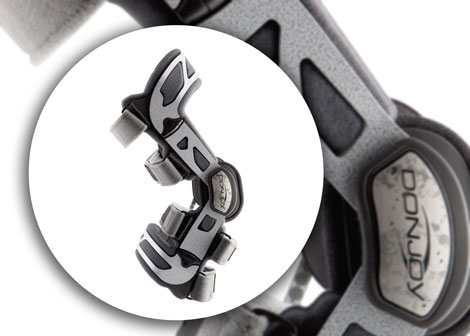
Bringing high tech from the basketball court to the water cooler…DJO Global, Inc. has announced the launch of OA Nano, calling it the world’s lightest off-loading knee brace—14.2 ounces—for patients with mild-to-moderate osteoarthritis. Sold under the DonJoy brand by DJO Global, the OA Nano is clinically proven to reduce pain and increase the stability of the knee. The brace also offers a range of design benefits that ensure patients will use as directed, thus improving their quality of lives.
DJO Global Launches World’s Lightest Knee Brace
2 min read Premium comments
Secondary
“Increasingly, physicians and surgeons are advocating for a conservative care treatment regimen that preserves joints and helps patients avoid or stave off more expensive, addictive or riskier treatments. Noninvasive, non-addictive treatment options, such as knee bracing, can empower patients to proactively take control of their osteoarthritis without the cost, recovery time or potential for adverse events associated with surgical procedures or narcotic pain management, ” said Mike Mogul, president and CEO of DJO Global. “OA Nano is based on the advanced knee brace technology that professional athletes have used for years and helps patients reduce pain, increase stability and maintain their desired activity levels.”
OA Nano, which decreases pressure on the knee by offloading stress, is manufactured using nanoMAG TTMP, a new kind of metal that is as light as magnesium with the strength of aircraft-grade aluminum.
“In addition to the weight and aesthetics, my patients cite the comfort of the brace as one of the most important factors in whether or not they will comply with my treatment recommendations and use osteoarthritis braces consistently, ” said Dr. Joseph Hellmann of OMNI Orthopedics in Canton, Ohio, in the July 9, 2012 news release. “In the growing movement of conservative care, compliance is one of the most important factors that can enable patients to successfully preserve their knee joints and maintain mobility. Given that The National Arthritis Foundation granted the OA Nano its Ease of Use commendation, I can be assured that my patients will actually be able to put on the brace.”
Mogul told OTW,
DJO Global found that people wanted a brace that effectively decreased pain and increased stability, while being comfortable and lightweight. OA Nano is designed to address these factors and to help the growing segment of Americans with osteoarthritis return to their active lives. Patient compliance has been an issue for other OA knee braces, given that they have historically been bulky, heavy and uncomfortable. The OA Nano is low profile and the world’s lightest OA knee brace, meaning that patients can wear it all day.
Regarding the development process, Mogul told OTW, “The OA Nano was designed by the same team of engineers that develops braces for professional basketball and football players and 21 of the top 25 AP college football teams.”
React:
Discussion
This is a fascinating development. In my practice we've seen similar outcomes with the revised protocol. The key differentiator seems to be patient selection criteria. Has anyone else noticed the correlation with BMI thresholds?
Great point. I'd push back slightly on the conclusion, the sample size in the cited study is too small to draw population-level inferences. That said, the directional signal is compelling and worth a larger RCT.
We implemented a similar approach last year. Early results are promising but we're still gathering 12-month follow-up data. Happy to share our protocol if anyone is interested.
Join the conversation
Orthopedic professionals are discussing this. Sign in and upgrade to read every comment and add your voice.