
“The dream of cementless TKA does not meet the reality, ” says Michael Dunbar. “Cement/non-cement…they both work, ” counters Hugh Cameron. “But cement adds 20 minutes to a TKA. If you use cement over a lifetime of doing TKA this means that you’ll be standing around for about a year waiting for the cement to harden.”
Cementless TKA: Dunbar Debates Cameron
8 min read Premium comments
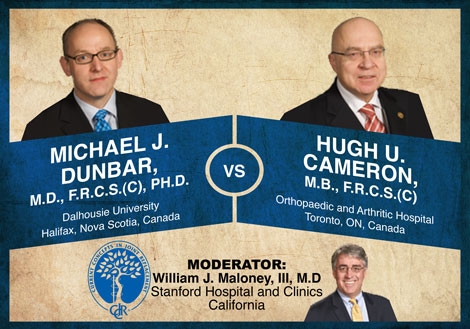
This week’s Orthopaedic Crossfire® debate is “Cementless Fixation: Down the Boulevard of Broken Dreams.” For the proposition was Michael J. Dunbar, M.D., F.R.C.S.(C), Ph.D. from Dalhousie University in Halifax. Against the proposition was Hugh U. Cameron, M.B., F.R.C.S.(C) of the Orthopaedic and Arthritic Hospital in Toronto; moderating was William J. Maloney, III, M.D. from Stanford Hospital and Clinics in California.
Dr. Dunbar: “My challenge is to present to you that cementless total knees are the best way to go. So, what is the dream of cementless total knee arthroplasty (TKA)? Better survivorship, an implant that is ideal for young, high demand patients and which could perhaps preserve bone stock and ideally it would be cheaper.”
“Dr. Cameron will argue that there are a lot of papers out there that tell us that uncemented TKA has exceptional outcomes. He will probably quote papers and his own experience, talking about 100% survivorship in up to 1, 000 patients. But we need to understand that the papers produced by the design surgeons are not the reality in the rest of the world…and we see this in the registry data.”
“There’s no registry in the world that shows 100% survivorship at 10 years. The number we can hang our hat on is from the Swedish Knee Registry that shows about 93% survivorship at 10 years. This is compelling when you consider that the revision burden in the U.S. is higher than the revision burden in Sweden; so the question becomes, ‘Where are all these revisions in the literature?’”
“Registry data: The Swedish Knee Arthroplasty Registry of 2011—basically all the knees are cemented. In the UK—the England and Wales registry—93% of all the knees are cemented. Outstanding survivorship for the cemented…it beats the cementless. In New Zealand…about 90% cemented…their data show a clear advantage for cemented. Australia is a bit of an outlier with 52% cemented. Regardless, cemented knees outperform cementless in these registries.”
“I think we are forgetting the lessons that Leif Ryd taught us where if you have migration, prostheses fail prematurely. I think we are forgetting the data of Fukuoka from Japan who, at the time of surgery, placed a load cell on a tibial implant, then implanted RSA [Radiostereometric Analysis] beads with strain gauges and correlated the migration he saw at the time of inducable displacement to long term outcomes—and he found a strong correlation.”
“And I think we’re forgetting the fact that it’s unequivocal that cemented fixation gives you better stability initially. Looking at an in vitro study utilizing RSA on two different constructs—a simple construct with simple cement versus the ‘Inquisitional’ looking device with belts, suspenders, large keel, and spikes, etc. And despite that, when you look at the RSA data, in every case whether it’s maximal total point motion, subsidence, or liftoff, by far that simple cemented device outperforms a cementless device.”
“We’ve randomized a trial at our center looking at an uncemented versus a cemented device. We found that the uncemented device using model-based RSA had significantly higher migration patterns. They didn’t fail, but they moved a lot more; it was also interesting that the preoperative gait predicted that motion.”
“This is germane based on Michael Meneghini’s paper where he looked at 106 patients with the same device. And although we didn’t find failures, he found in a group of tall, heavy, males a 7.5% failure out of those 106, suggesting that this migration may not be a good thing in our younger, high demand patients.”
“And what about stress shielding and whether you get an advantage based on the fixation. It’s a moot point because it’s the materials; the modulus of 120 far outweighs any issues you’re going to get with cemented versus uncemented in that stressed distal femur. And it’s irrelevant if they fail prematurely.”
“So, based on everything I’ve presented, the dream is broken.”
Dr. Cameron: “The literature has not been favorable, but this has not been my experience. I began working in porous metal in 1971. We did a lot of experiments to define the parameters of porous metal and eventually it was commercialized as the AML stem.”
“I worked with Mike Freeman in London and I learned to use the ICLH knee, which was a non-cemented tibial component held in place with plastic pegs. After a couple of years I became unsatisfied with the trochlea because the patella kept falling off the side. So I went to Richards and they made a Tricon P for me.”
“There were various forms of it—the Tricon P was the plastic tibial component, then the M, then we went to a long stem, and then to the Tricon II. So I’ve looked at these series, starting with the Tricon M, since 1984; we had about 400 cases. There were four revised for loosening, all in the tibia, none in the femur. We had more late sepsis than supracondylar fractures, but the big problem was wear (13.1%).”
“In 1986 we went to the Tricon Long Stem series…435 cases with 1.1% revised for aseptic loosening (all tibia, no femur). Three had end of stem pain, some late wear. It was getting better, but it was still 6.6%. When we went to the Tricon II in 1987 with 305 cases, some of them were HA [hydroxyapatite] coated. We compared an HA tibia with a grit blast tibia, which in retrospect was a mistake.”
“The Tricon II results: loose femoral components were nil. Loose tibial components with the HA was one and the grit blasted was five, so HA is obviously better. Wear is no longer a major issue. We’ve only had seven cases revised for wear, so wear is going away as a problem.”
“The Profix series, which we began in 1995, had about 600 cases and most of the femoral components were non-cemented. Some of them were cemented (68) because I didn’t like the initial fixation. No tibial components were cemented in this series. This is probably the best tibial component ever developed. We never had a single case of loosening—or I never did.”
“We revised 1.3% for loosening, but this was all on the femoral side, not on the tibial side. We revised none for wear; late supracondylar fracture and late sepsis are still issues, but wear has gone away.”
“I now use the PFC Sigma, and I’ve done several hundred of them in the last seven years. I have the odd loose case, but now, when I get one, it’s usually both sides and I assume that it is infected.”
“Conclusion: the non-cemented Tricon femoral component had no loosening in 25 years. The PFC Sigma now has a rougher, thicker coating that should eliminate the loose femoral components. The non-cemented Profix tibial component—I never had any loosening. We now know that a femoral component should have a three degree opening wedge design. HA seems as good as porous metal and has the advantage that it can be removed by simply hitting it. The absorption of HA over time is worrying, so it’s probably better to stick with porous. Cement/non-cemented…they both work. But cement adds 20 minutes to a TKA. If you use cement over a lifetime of doing TKR this means that you’ll be standing around for about a year waiting for the cement to harden.”
Dr. Dunbar: “Well, you started off by saying that you weren’t going to use the data to support your argument and I think you were successful in doing that. The largest series you showed was 600 patients; I showed you 700, 000 patients. And yes, it takes 15 minutes more, but like the credit card commercial, the price of doing a cemented implant: 15 minutes. The price of avoiding a revision: priceless.”
Moderator Maloney: “Hugh?”
Dr. Cameron: “There is no margin for error if you’re going to go with a cementless knee replacement. And that means that you’re not going to get much teaching of cementless knee replacement in a university hospital. The only place you’re ever going to get decent cementless results in knee replacement is in a high volume private system. And with better instruments more guys could do it. But if that tibia rocks even a little bit it won’t work.”
Dr. Dunbar: “Exactly.”
Moderator Maloney: “If there’s no margin for error, Mike, can we use it in the general population?”
Dr. Dunbar: “No. That’s the exact point of the registries.”
Moderator Maloney: “Registries group patients and devices together. Is that fair?”
Dr. Dunbar: “That’s fair.”
Moderator Maloney: “All cementless implants are not created equal.”
Dr. Cameron: “The only time I cement is when I screw up.”
Moderator Maloney: “In your work you showed early migration of a specific implant, but you had a recent publication showing that it didn’t make any difference.”
Dr. Dunbar: “Great point. That is an unforeseen and previously unknown RSA migration pattern, so there’s something happening with these advanced porous metals…with the way they can deform under load, which may be promising. But I don’t want to say—based on that—that uncemented technology is the future.”
Moderator Maloney: “Hugh, your point is, ‘They all work.’ I agree with that. Cementless is a harder operation. Maybe the high volume surgeon can get away with it…but why? What about the cost argument? Cementless is $1, 000 more.”
Dr. Cameron: “If you’re a high volume surgeon you don’t pay less. You negotiate. I pay 50% of list price.”
Moderator Maloney: “You’re Canadian. In this country we have to take the burden of price. Mike, are you going to save time on the cementless side…is that a valid argument?”
Dr. Dunbar: “Invalid argument. Tell that to a trial lawyer…why you wanted to save the 15 minutes.”
Moderator Maloney: “Hugh, you can’t tell me it takes you 20 minutes longer to do a cemented TKA. I’ve seen you operate.”
Dr. Cameron: “You can’t just start closing the wound when you cement the femoral component. You have to wait until the cement has hardened and go around the back and take the excess off.”
Moderator Maloney: “But a lot of surgeons don’t do that. They assemble the implant, cement it in, do one sweep around, and start closing. Mike, what are your thoughts?”
Dr. Dunbar: “It’s a mistake. You’re there to make the patient better for 20 years and if you need to spend an extra 10 minutes you should do it.”
Moderator Maloney: “Mike, you did that randomized study…did you look at the difference in operative times cemented/uncemented?”
Dr. Dunbar: “No, but it’s probably a bit quicker to do uncemented.”
Dr. Cameron: “Over a lifetime that’s a year sitting around with your thumb in your ear waiting…”
Dr. Dunbar: “You’ll need that year to do all the revisions.”
Moderator Maloney: “Thanks for a great debate.”
Please visit www.CCJR.com to register for the 2012 CCJR Winter Meeting, December 12 – 15 in Orlando, Florida.
 You may now view CCJR meeting content on your mobile device on the CCJR MobileTM App. Please scan the QR code to download from iTunes.
React:
Discussion
This is a fascinating development. In my practice we've seen similar outcomes with the revised protocol. The key differentiator seems to be patient selection criteria. Has anyone else noticed the correlation with BMI thresholds?
Great point. I'd push back slightly on the conclusion, the sample size in the cited study is too small to draw population-level inferences. That said, the directional signal is compelling and worth a larger RCT.
We implemented a similar approach last year. Early results are promising but we're still gathering 12-month follow-up data. Happy to share our protocol if anyone is interested.
Join the conversation
Orthopedic professionals are discussing this. Sign in and upgrade to read every comment and add your voice.