
“There are no advantages of modularity, ” says Michael Dunbar. “Come on, ” says Hugh Cameron “…a modular neck is like a modular head: this is love at first sight.”
Proximal Modular Neck in THA – Love it or Hate it?
7 min read Premium comments
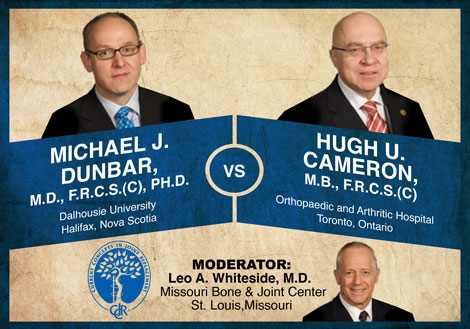
This week’s Orthopaedic Crossfire® debate is “The Proximal Modular Neck in THA [total hip arthroplasty]: A Bridge Too Far.” For the proposition was Michael J. Dunbar, M.D., F.R.C.S.(C), Ph.D. from Dalhousie University in Halifax, Nova Scotia. Against the proposition was Hugh U. Cameron, M.B., F.R.C.S.(C) of the Orthopaedic and Arthritic Hospital in Toronto, Ontario; moderating was Leo A. Whiteside, M.D. from the Missouri Bone & Joint Center in St. Louis.
Dr. Dunbar: “When we think about new technology we should understand the issues we are trying to solve. With modular necks it’s stability, impingement, and some sort of effort to reconstitute leg length and offset. Let’s try to cut Dr. Cameron off at the pass.”
“Instability: In a good series out of London, Ontario, with 1, 500+ patients they have a dislocation rate of 0.4%. So to me, it’s not about the implant, it’s about surgical volume, exposure, and experience or technique. There’s evidence that it’s the opposite with respect to the implant itself when we look at the experience from the acetabular modularity from Australia.”
“When you look at the dislocation rate, reasons for revision being dislocation, the cemented cup is the baseline at 1.0x revision risk, whereas the modular uncemented cup actually has the higher dislocation rates (1.6x).”
“Impingement: it’s an issue with ceramics. The easy answer? Don’t use ceramics. Impingement is also related to the acetabular component. The answer? Get the cup in the right position.”
“Leg length and offset: Some companies are quite ambitious when looking at modularity. One company’s version for a stem—compared to their standard—changes the leg length and offset by 0.2 mm. If the patient is picking up on that it’s the princess and the pea phenomenon. If you consider a terrible case…a young lupus patient…you can do a good job implanting a cemented stem and have all the advantages of the modularity. Within a continuum you can infinitely adjust the leg length and varus/valgus, and you can almost infinitely adjust the femoral version.”
“So those were the advantages of modularity, of which there were none. Disadvantages. The first is that we’re introducing a new mechanical construct and there could be fretting and corrosion, as well as dissociation and fracture. Second issue: long term outcomes are unknown, and there’s some evidence that there will be problems with the retroverted necks. Third disadvantage: increased cost.”
“We’ve been concerned about fretting and corrosion at the one interface; with two interfaces there’s two times the fretting and corrosion potential. When talking about a threshold with metal ions…we don’t know, but stay tuned.”
“There are case reports of dissociation. Even with newer stems we’ve had a run of these…and it means big revisions.”
“Retroversion and component placement: retroverting a neck is not necessarily a benign thing. In a paper from Oxford—an RSA [Radiostereometric Analysis] study of the effect of femoral version on RSA migration patterns as a surrogate to long term failure they found that anteversion is protective if you consider the force magnifier or the lever arm that’s produced by going from anteversion where you have a modest deforming force to neutral, and in fact, as you go into 30 degrees of retroversion you significantly increase the retroverting lever arm.”
“Cost: I think we’re going to be called to the mat soon on what we’re doing in terms of innovation for the sake of innovation and the costs that are being driven up.”
Dr. Cameron: “I use a modular neck for cemented stems. I don’t cement that many stems, but a modular neck is like a modular head: this is love at first sight. The modular neck in most common use is the Cremascoli neck. The neck I use is different, but the principle is the same.”
“I began to run into a problem with cemented stems when Richards stopped making the stem that I had used for years. When I looked at other companies’ components I found that they all had proportionality…as the stem got bigger the neck got longer. Osteoporosis is an endosteal phenomenon, so as one gets older the canal gets bigger. The companies wanted me to stuff a longer neck into some little old ladies.”
“The Rizzoli group in Bologna used a Cremascoli modular neck in more than 2, 000 cases. They showed that without a modular neck it was not possible to recreate length and version…especially in a woman. The Cremascoli neck has a 20 year history; it has a double taper neck. Some of them do break. Modular necks make things like stubby stems possible because you can change the neck length on the version after the stem’s gone in because you don’t have much control over where the stem’s going with stubby stems.”
“Impingement…it can produce dislocation, noise, particle generation, and locking mechanism failure. To reduce dislocation you can restore the hip mechanics and reduce impingement. The ceramic-ceramic bearings have a risk of impingement, edge loading, chipping and squeaking. With metal-metal, impingement is potentially a problem. The poly sandwich cups have failed due to impingement. A chrome cobalt liner will erode a titanium neck.”
“The highly cross linked polyethylenes [HCLP] have a reduced fracture toughness, so if you get impingement it may damage the locking mechanism. So don’t use offset liners with HCLP. With all the newer bearings, impingement becomes potentially a major problem. The solution is if it’s possible to change the version after stem insertion.”
“A recent paper showed problems with a pure Morse taper neck stem. We had anticipated this and added cogs for additional rotational stability. You can also change offset and length after insertion. If you’re doing a revision you can pop the neck off and access to the acetabulum is not compromised. This makes isolated acetabular revisions easier. You have visualization, new version, and a new taper.”
“I’ve used the thin mantle technique of cementing for the last 25 years. This means that you broach minimally and use the biggest stem possible. This means that the stem goes in to match the canal version. I insert the cup at about 20 degrees of anteversion; I now do it to 10 degrees or less. The stem goes in to best fit the femur. The position of the neck goes in for the least impingement—usually in the one or two retroverted position. For the last 25 years I’ve been getting slight posterior impingement with cemented stems.”
“Complications: I had one fractured taper three years post-op and one neck taper dissociation; I also had one periprosthetic fracture. The easiest way to fix these is to revise the stem. With the one that broke, others had broken stems and it was immediately taken off the market. The taper strength was doubled and lengthened; it was reintroduced about five years ago. Since then I’ve done 156 cases with one dislocation and no other problems.”
Moderator Whiteside: “Mike, if you have a patient with a very varus femur, wide offset, is it necessary to keep that as a wide offset?”
Dr. Dunbar: “If you don’t pay attention to it then you’re going to end up making the error of lengthening it on average. However, you don’t necessarily have to put it exactly where it was because there’s not a lot of evidence suggesting that’s the best thing to do. Putting it too far away would be bad thing because of trochanteric bursitis, etc. You don’t have to be stuck with one kind of implant for all cases; you can choose different implants with different degrees of offset built in. Some systems have multiple stems with multiple offsets. With that, and a combination of the acetabular component with offset liners you can make up for that offset.”
Moderator Whiteside: “You ever tilt a femoral component to get it into varus to give yourself more offset?”
Dr. Dunbar: “You can, but I’m using cemented so, yes, but you need to be very careful because it can change the biomechanics. Pick a stem that’s forgiving to that.”
Moderator Whiteside: “Hugh, when you see a major offset difference do you…?”
Dr. Cameron: “I shrink it…especially in big men because those are the ones that are going to break. An even bigger problem is the tall girls with small implants.”
Moderator Whiteside: “You have concerns about the strength—the mechanical bond—between the neck and the stem. If you choose a larger offset does that not apply bending loads that are unacceptable?”
Dr. Cameron: “Absolutely. Some companies advise…the implant box says that this high offset neck must not be used in heavy patients.”
Moderator Whiteside: “Do you use this modular neck primarily now for retroversion/anteversion management?”
Dr. Cameron: “I started off primarily because of length problems. The problem was that you go to put a big stem in and find you’ve got a big, long neck in this little old lady. Then I was surprised in the changes in offset.”
Moderator Whiteside: “Mike, what do you do with a severely retroverted hip?”
Dr. Dunbar: “It’s a combination of acetabular side and femoral side so I’d be more concerned with a retroverted acetabulum. But assuming you can work on some osteophytes and get the cup where you go, you’ve got a lot of liberty to put that stem in a neutral position…maybe slightly retroverted. But you need to be careful considering the RSA data, and you need to choose a stem that’s forgiving to torsional resistance in that plane.”
Moderator Whiteside: “How do you manage fretting, and even fracture of the neck?”
Dr. Cameron: “It worried me initially—still does a bit—especially when you’ve got a big man who wants more offset. What has changed for me is that for the first time I can truly center the head and the acetabulum. If I can stop impingement—even if it’s with polyethylene—I’m cutting down on the number of polyethylene particles available, cutting down possibly on my dislocation rate. And it’s not so important for the hard/soft bearings, but crucial for the hard/hard bearings.”
Moderator Whiteside: “Thank you both.”
Please visit www.CCJR.com to register for the 2012 CCJR Winter Meeting, December 12 – 15 in Orlando, Florida.
 “You may now view content from the CCJR Meetings on the CCJR Mobile™ App. Please scan the QR code to download the CCJR Mobile App to your Android or iOS mobile device, or visit www.ccjrmobile.com.”
React:
Discussion
This is a fascinating development. In my practice we've seen similar outcomes with the revised protocol. The key differentiator seems to be patient selection criteria. Has anyone else noticed the correlation with BMI thresholds?
Great point. I'd push back slightly on the conclusion, the sample size in the cited study is too small to draw population-level inferences. That said, the directional signal is compelling and worth a larger RCT.
We implemented a similar approach last year. Early results are promising but we're still gathering 12-month follow-up data. Happy to share our protocol if anyone is interested.
Join the conversation
Orthopedic professionals are discussing this. Sign in and upgrade to read every comment and add your voice.