
“Good studies show that LTO is the best method of treating subscapularis insufficiency at the time of total shoulder, ” says Wayne “Buz” Burkhead. “Osteotomy is complex, ” counters John Sperling, “and there is a lack of strong evidence of superiority.”
Burkhead v. Sperling on Lesser Tuberosity Osteotomy
7 min read Premium comments
Great Debates
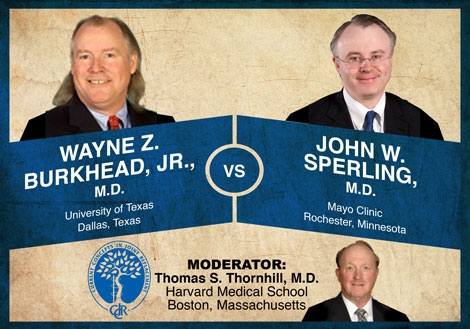
This week’s Orthopaedic Crossfire® debate is “LTO Minimizes Subscapularis Insufficiency in Shoulder Replacement.” For the proposition was Wayne Z. Burkhead, Jr., M.D. from the University of Texas in Dallas. Against the proposition was John W. Sperling, M.D. of Mayo Clinic in Rochester, Minnesota; moderating was Thomas S. Thornhill, M.D. of Harvard Medical School.
Dr. Burkhead: “First of all, I love John. So I won’t refer to him as a minion from a well known institution or what Marlon Brando said to Martin Sheen…an errand boy sent by postal clerks. But I did plan on eviscerating him—then I got the case. This is a new technique…they’re handicapping this thing now.”
“The case illustrates: First, the importance of a good history, physical, and old records. Second, the importance of an historical perspective. Third, post reconstruction instability is a subset of osteoarthritis (OA) with its own unique features.”
“This is a Putti-Platt. This man has horrible external rotation, and what he probably has is scapulothoracic. So in regards to this case I surrender. I would go so far as to say that this case is a relative contraindication for lesser tuberosity osteotomy (LTO). The Putti-Platt creates an extremely thick anterior segment that’s almost the exact same thing you would do if you did a Z plasty of the tendon. So the subscapularis capsule construct should be gained with a soft tissue approach.”
“The Magnusen Stack is a contraindication that most people probably haven’t heard of. The subscapularis is taken lateral to the lesser tuberosity, so if you do a lesser tuberosity on this patient you’ve amputated two centimeters of the subscapularis.”
“Who is the ideal candidate for LTO? Nearly everybody else with OA and mild to moderate internal rotation contracture. The subscapularis footprint has been well described, and it can generate 250 Newtons and that’s key because every repair gives you at least 250 Newtons. But that’s just of an internal rotation moment that’s created by the subscapularis. That doesn’t measure the strength of an over-aggressive physical therapist early on after the procedure.”
“We’ve done a number of the ‘Fleck’ osteotomies with anatomic dual row repair, taking the position that a dual row repair is stronger—and clearly it is in every study that’s been shown. We did a human cadaveric shoulder study with a dual row repair and compared it to a tenotomy group. To be fair, they were Mason-Allen sutures with the more simple stitch component placed on the tendinous side. So there wasn’t a huge difference between double and single row techniques as we had done the single row technique…or the tenotomy in terms of the ultimate strength. But the tenotomy just barely got you to the critical amount.”
“Double row: no gross rotational motion. Clearly, both techniques control the moment of the internal rotation and the medial pull of the subscapularis, but this technique controls the rotation of that fragment much better.”
“Tenotomy fails at the tendon—single row was variable, double row always failed at the bone. So it improves a reproducible restoration of subscapularis integrity. Scott Simon showed that a tenotomy was just as good. He used a figure eight suture–tendon to tendon repair; I suggest a figure of eight suture. But the model that he tested for the LTO is simple drill holes…this is not the way Christian Gerber described it and it’s not the way we do it. This is ineffective. This is not going to control rotation of that fragment because you only have one plane of control. So if you want to do an LTO you should use Gerber’s technique, 632 Newtons, with only 4.6mm of displacement after millions of cyclic loads.”
“Conclusions: Biomechanical studies and reasonably well designed high level evidence-based studies would lead an intelligent orthopedic surgeon to assume that LTO is the best method of treating the subscapularis at the time of total shoulder. But there are situations where it’s not the best choice. Recognition of the unique features of soft tissue, soft tissue to bone, and bone to bone fixation will allow you to choose the best method for your patient.”
Dr. Sperling: “I’m going pro-tenotomy…subscapularis tenotomy really is the optimal approach to shoulder arthroplasty. Very little attention was directed at subscapularis integrity in the past; recent papers have highlighted abnormal subscapularis function following shoulder arthroplasty.”
“Subscapularis compromise can be due to re-rupture, poor quality tissue, excessive tension at time of surgery in regard to overstuffing, and nerve injury during mobilization.”
“LTO was described as an effort to minimize subscapularis repair failure. The goal is bone to bone healing, and it’s thought by many to be superior to bone to tendon healing. The challenges of LTO: it’s more complex, you may crush the metaphyseal bone, possible fragmentation of the lesser tuberosity, as well as the potential for non-union.”
“The benefits of tenotomy: it’s simple, reproducible, and a time efficient method to provide a secure repair of the subscapularis. Tony Romeo’s group: tenotomy versus osteotomy with 24 pairs of cadaveric shoulders. They underwent cyclic loading; there was no difference comparing tenotomy versus osteotomy in regard to stiffness, elongation amplitude, or cyclic elongation.”
“Akin Cil looked at a cadaveric study comparing osteotomy to tenotomy. Tenotomy did better than osteotomy in regard to displacement and maximum load to failure. George Athwal did a prospective, double blind, randomized trial comparing these two groups. He found no difference at two year follow-up in regard to strength and outcomes scores. George also looked at a follow-up biomechanics study—he found there was no difference.”
“This is the classic study that’s been used to defend tenotomy—it was by Dr. Nevaiser. Forty-five patients with a total shoulder arthroplasty that underwent a tenotomy and repair; protected post-operative motion. What he found in regard to clinical testing in this tenotomy group, 41/45 had a negative lift-off test and 45/45 had a negative belly-press test. The authors thought that the issue of subscapularis healing really is related to the postoperative rehabilitation.”
“Another concerning study was by Christian Gerber, a large proponent of this. He looked at CT scans after an osteotomy, and there was a 44% rate of progressive fatty infiltration. Clearly, damage is being done to the subscapularis with an osteotomy.”
“Conclusion: the complexity of an osteotomy, together with concerns over non-union, fragmentation, fatty infiltration, as well as a lack of strong evidence of superiority don’t warrant changing from tenotomy.”
Moderator Thornhill: “Buz, what percentage of total shoulders now are done with LTO versus tenotomy—in the world?”
Dr. Burkhead: “I don’t know.”
Moderator Thornhill: “John?”
Dr. Sperling: “It’s hard to give a number…30%?”
Moderator Thornhill: “Would it be fair to say that the movement has been away from tenotomy and that younger guys are doing more LTOs?”
Dr. Sperling: “It’s split. Some people who try to do an osteotomy and then sometimes see the problems associated with it—fragmentation of the lesser tuberosity, nonunion.”
Moderator Thornhill: “So Buz, you folded up like a $3.00 suitcase on this argument.”
Dr. Burkhead: “At least I didn’t give up in the ready room like Seitz did last year.”
Moderator Thornhill: “One of the problems following Putti-Platts is residual posterior subluxation of the shoulder and oftentimes even instability. So your reason for not doing that would be to allow you to lengthen the subscapularis?”
Dr. Burkhead: “I’d reverse the Putti-Platts. Subscapularis Z lengthening is a lost art. It got an unfair, bad reputation. Rockwood and Neer did it from different sides. I think Rockwood would start laterally and move medially and Neer did the opposite. You could see how that surgery was done, that you probably would want to start laterally, dissect it down and then have two good levers. For every centimeter of length that you get you have gained 20 degrees of external rotation. In someone like this I would try to get about two centimeters of length. And I’d even be willing to augment that with one of the dermal matrices if I was concerned about the thinness. But usually in these patients who have had a Putti-Platt, it is so thick that you really have plenty of tendon to work with. You would sew these together with figure of eight sutures to maximize your strength.”
Moderator Thornhill: “What about rheumatoids?”
Dr. Burkhead: “If you ask me who I do the osteotomy on…male, osteoarthritics with minimal internal rotation contracture of about 30 degrees. You can’t medialize the osteotomy. If you do that you’re creating a situation similar to a lesser tuberosity malunion where they’re going to have loss of internal rotation.”
Moderator Thornhill: “When you do your tenotomy do you try to close the rotator interval, move it, or put it back anatomically?”
Dr. Sperling: “I put a few stitches in the rotator interval, but I put them on before I put the real head on. If you try to put those interval stitches once you have the real humeral head on it can be difficult. So I put maybe two stitches in the interval, put the real humeral head on, start closure. You have to dial in the amount of external rotation you want. If you close the interval with the arm at the side you’ll never get the external rotation.”
Moderator Thornhill: “Buz, if you do a well-fixed LTO you can start external rotation earlier, and if so how early? Also, do you think your ultimate subscapularis strength by lift off or belly press is better?”
Dr. Burkhead: “The answer to the first question is, ‘No, I don’t think you should start it that much sooner. But you can strengthen them sooner and you have a radiographic endpoint, so once you see that your LTO has healed it’s much like a Bristow procedure versus a soft tissue reconstruction. Once the bone is healed and the tendon intact that patient can be strengthened, stretched aggressively if they need that.”
Moderator Thornhill: “If you do a LTO your ultimate strength of the subscapularis is better?”
Dr. Burkhead: “Yes.”
Dr. Sperling: “No.”
Moderator Thornhill: “Now that we have consensus, thank you.”
Please visit www.CCJR.com to register for the 2012 CCJR Winter Meeting, December 12 – 15 in Orlando, Florida.
 “You may now view content from the CCJR Meetings on the CCJR Mobile™ App. Please scan the QR code to download the CCJR Mobile App to your Android or iOS mobile device, or visit www.ccjrmobile.com.”
React:
Discussion
This is a fascinating development. In my practice we've seen similar outcomes with the revised protocol. The key differentiator seems to be patient selection criteria. Has anyone else noticed the correlation with BMI thresholds?
Great point. I'd push back slightly on the conclusion, the sample size in the cited study is too small to draw population-level inferences. That said, the directional signal is compelling and worth a larger RCT.
We implemented a similar approach last year. Early results are promising but we're still gathering 12-month follow-up data. Happy to share our protocol if anyone is interested.
Join the conversation
Orthopedic professionals are discussing this. Sign in and upgrade to read every comment and add your voice.