
“Open repair provides better outcomes…not just pain relief, but tendon quality and tendon healing, ” says John Brems. “But watch out, ” says Leesa Galatz, “The complications of an open repair can be quite devastating.”
Brems Debates Galatz on Open Rotator Cuff Repair
8 min read Premium comments
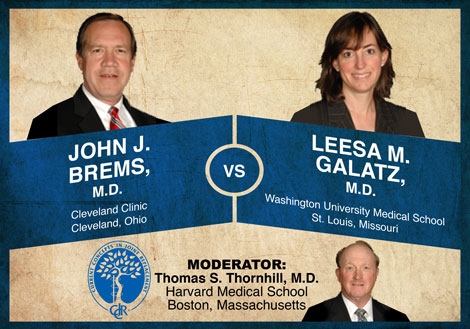
This week’s Orthopaedic Crossfire® debate is “Open Repair of a Torn Rotator Cuff: Optimizes Outcome.” For the proposition was John J. Brems, M.D. from Cleveland Clinic. Against the proposition was Leesa M. Galatz, M.D. of Washington University Medical School; moderating was Thomas S. Thornhill, M.D. of Harvard Medical School.
Dr. Brems: “We have a specific case that walks into all of our offices. He is a 45-year-old male, avid tennis player with two years of symptoms and a large rotator cuff tear (RC) who has exhausted nonoperative management. The degree of fat replacement muscle atrophy is significant. Some cuff tears can be treated with arthroscopic technique, but not all should be.”
“So why would open technique be the better option in this case? Consider multiple factors: tear size, tear configuration, tissue quality, degree of fat replacement, bone quality, and the effect of delamination. We don’t often see acute tears…retraction is an orthopedic myth. In large chronic tears, which we commonly see, the tendon is gone. The bony footprint in these large chronic tears is often osteopenic and anchor failure is not uncommon. So now we recommend a double row technique, but more recent studies show that by putting more and more pressure on the tendon on the footprint, you can cause hypovascularity and have healing issues as well.”
“Open technique permits large bone tunnels and a transosseous fixation with a low risk of fixation failure. In those cuff repairs that I go back in on, I don’t think I’ve ever seen a bone tunnel fail, nor have I seen a suture fail…the issue is always the tissue that fails (around the suture or bone tunnel).”
“Arthroscopic technique is more like spot welding versus the seaming that occurs in a normal healing. In a paper that was just published in April 2012 the authors looked at arthroscopic cuff repairs and did MR [magnetic resonance] arthrography and found that despite the fact that there was not much clinical correlation, that 15/17 had leakage at the MR arthrogram at an average of 48 months after the repair. So even though it’s not clinically symptomatic, the tendons are not healing.”
“I think there are three major differences between open and arthroscopic technique. Arthroscopic has better incisions; length and permanency of the scar can be very real in patients who are more conscious about these issues. Difference two: arthroscopic is a temporary winner…how long you hate your doctor. While arthroscopic tears are much less painful, pain can be a good thing in keeping them from actively using their arm before they should. Difference three: open is the clear winner…definitely better outcomes…not just pain relief, but tendon quality and tendon healing.”
“What is not different? Patients do not heal faster, nor return to work sooner, nor return to sports any sooner; patients should not resume strengthening any sooner because the rate limiting step is that the RC tendon must heal to the bone…and that’s independent of technique.”
“Dr. Altchek in 2009 did ultrasounds of 127 patients with arthroscopic repair and found that as the tear size became larger the likelihood of re-tear increased by at least nine times. In another group of patients—47 shoulders with two-year follow up—postop MRI scans at two years showed 22% re-tear. But because the patients weren’t feeling any worse they market it as a very good operation. My esteemed colleague [Dr. Galatz] did a study in 2004 on 18 patients—small series—two-year follow up…94% failed in terms of ultrasonography.”
“Open repairs do stand the test of time, and this is supported by several studies showing that these patients have excellent outcomes at long-term follow up.”
Dr. Galatz: “There are historical reports of an open rotator cuff repair that show excellent outcomes, both anatomically and clinically. Dr. Brems referenced this study [by Dr. Galatz] that was followed up at two years; then when I was his fellow we followed these patients at 10 years and found 92% good to excellent results. Open repair is a good operation.”
“However, complications can potentially be quite devastating. We see increased stiffness, deltoid dehiscence (and thus far we don’t have a good answer for this), infection…and iatrogenic anterior superior instability (ASI) is a significant problem and there are many patients with large tears who lose elevation after surgery.”
“The trend toward minimally invasive approaches is based on less scarring, less trauma to the deltoid, decreased incidence of ASI, cosmesis, and decreased pain. But the problem with an arthroscopic approach has always been healing. In my study: remember that this is very early experience, they were all older patients with a single row and early repair technique, yet we still had good results.”
“In an open repair we don’t have 100% healing. In Harryman’s study in 1991 we had a 60% healing rate and the failure rate was higher in larger tears. The healed tears did better and age was a significant factor. We looked at this series of studies where we had a large failure rate at 10 years to see how they were doing. The patients were now an average of 75; 10 men, five women. Only two of them had had subsequent surgical procedures. There are no major differences in function or ASES [American Shoulder and Elbow Society] score, and this is in spite of a significant increase in the Hamada, or the glenohumeral joint degenerative changes. So we did see significant changes, yet most of them were still doing well. In the long term I think it’s safe to say that we did no harm.”
“There are many studies in the literature that show equal or equivalent rates of healing with modern techniques. We do have better healing now with double row techniques. Looking specifically at studies on open versus arthroscopic repair—32 open, 32 arthroscopic—there was improvement in both groups and no difference. So I’m not here to say that an arthroscopic repair is necessarily better, but I’m arguing that at this point with modern repair techniques we have approached equivalence.”
“Getting back to the complications of an open RC repair…in a patient with an aggressive acromioplasty and a takedown of the deltoid, we ended up fusing her because we couldn’t get her comfortable any other way. We used muscle transfers for salvage operations for these patients in revision situations. To have iatrogenic ASI which would necessitate something like this postoperatively is quite unusual.”
“So in the case of the male attorney, right hand dominant, tennis player…we see fatty degeneration and changes, but in the literature there is nothing to support that healing in this severe case is better with an open repair. In summary, healing is more likely related to the biology of the patient and the muscle tendon unit than the surgical approach; the complications are fewer and far less devastating, and they preserve your future reconstructive options.”
Moderator Thornhill: “Both of you mentioned studies where there was a high incidence of re-tear or lack of a repair, yet the patients did well. Do we repair too many RCs, Leesa?”
Dr. Galatz: “We’re getting better at identifying patients who will benefit from a repair. Our trend is to be more aggressive in the younger patients with smaller tears because we have an opportunity with those people to intervene in the natural history of that shoulder. We used to do a lot of surgeries in older people and are now realizing that the likelihood of healing is quite low and perhaps those patients are better treated nonoperatively.”
Moderator Thornhill: “John, what about someone with a documented RC tear?”
Dr. Brems: “First of all, as Leesa just said, we can’t change the biology of the tendon. In a younger person the effort should be to repair a cuff tendon if possible. But in the older population I think we are doing too many repairs. We know from many autopsy studies that many people have cuff tears as incidental findings. And the mere presence of an MRI scan proven-tear does not mandate that it should be attacked surgically in any form. The older population doesn’t need cuff repairs except as a pain operation. Patients can function relatively well despite anatomic loss of integrity after repair. My concern is in a 45-year-old gentleman… that I would make every effort—and if there’s going to be anatomic integrity I could get it better open than arthroscopic.”
Moderator Thornhill: “John, if you have a high incidence of re-tear and a high incidence of good results is it the decompression aspect of it that makes them better…and the tear is incidental.”
Dr. Brems: “I don’t know where the pain comes from in RC disease. We see large tears that are pain-free, and we see small tears that are disabling because of the pain. I would treat pain as the primary aspect for surgery.”
Moderator Thornhill: “Leesa, when you have a 75-year-old with a large tear when can you predict whether that patient is going to go on to cuff tear arthropathy?”
Dr. Galatz: “When we looked at our patients long term we did see significant progression of degenerative changes on X-ray, but we didn’t have enough patients to identify factors associated with that. If a patient is 75 and they don’t have a lot of changes thus far I think it’s safe to assume that the tear has been there for a long time, and if he doesn’t have changes by that point it’s unlikely. If you’re going to start to see changes those likely occur earlier, so maybe at 65 it’s a question, but if someone is 75 and they’re bumping along just fine they’ll likely continue to do so.”
Moderator Thornhill: “You both discuss fat replacement in the musculature. Is that best determined by MRI/CT/Ultrasound?”
Dr. Galatz: “This case is a good example. This person has a lot of changes which are likely irreversible. However, muscle is very pliable and is filled with pluripotential cells and thus far we don’t know when someone—especially at the age of 45—has reached the point of no return. Certainly in an older person if I see a lot of fatty degenerative changes, I counsel them that these are likely irreversible, that their tear is unlikely to heal, and we should do what we can to treat them without surgery. In a younger, active person, though, maybe we should be more aggressive.”
Moderator Thornhill: “Doing it either way you must be accomplished at doing it, and the evidence based studies are going to help guide us on what to do in the future. Thank you both.”
Please visit www.CCJR.com to register for the 2012 CCJR Winter Meeting, December 12 – 15 in Orlando, Florida.
 “You may now view content from the CCJR Meetings on the CCJR Mobile™ App. Please scan the QR code to download the CCJR Mobile App to your Android or iOS mobile device, or visit www.ccjrmobile.com.”
React:
Discussion
This is a fascinating development. In my practice we've seen similar outcomes with the revised protocol. The key differentiator seems to be patient selection criteria. Has anyone else noticed the correlation with BMI thresholds?
Great point. I'd push back slightly on the conclusion, the sample size in the cited study is too small to draw population-level inferences. That said, the directional signal is compelling and worth a larger RCT.
We implemented a similar approach last year. Early results are promising but we're still gathering 12-month follow-up data. Happy to share our protocol if anyone is interested.
Join the conversation
Orthopedic professionals are discussing this. Sign in and upgrade to read every comment and add your voice.