
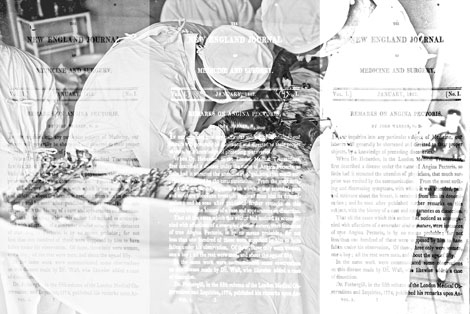
To celebrate its 200th birthday, the New England Journal of Medicine has been publishing a series of articles reviewing the history of medicine as it was reported in their pages. Atul Gawande, M.D., M.P.H. was invited to comb the Journal’s archives to see how the history of surgery has been told. Here are a few of the highlights.
200 Years of Surgery in the NEJM
7 min read Premium comments
The Game Changers
In 1868 John Stough Bobbs explored a woman’s abdomen through a four inch incision to look for an ovarian cyst. He found a five-inch-wide oval tumor. He cut through the wall, releasing a limpid fluid that propelled “several solid bodies about the size of ordinary rifle bullets.” Bobbs drained the sac, extracted some 50 concretions and closed her up.
She recovered with laudanum and lemonade.
Unbeknownst to Bobbs he had removed gallstones and performed the world’s first gallbladder operation.
In 1880 Tait performed the first transabdominal resection of a gangrenous appendix and Rehn performed the first subtotal thyroidectomy for Grave’s disease.
In 1884, Bennett and Godlee reported the first successful removal of a brain tumor. Methods for suprapubic prostatectomy, total gastrectemy, chest surgery and joint repair were worked out.
Alexis Carrell won the Nobel Prize in 1912 for devising a method for suturing blood vessels and performing surgical grafts.
The First Surgical Reports
The first volume of the New England Journal of Medicine and Surgery, and the Collateral Branches of Science, published in 1812, demonstrates the constraints faced by surgeons and the torture endured by patients before the discovery of anesthesia and antisepsis.

Painting by Gaspare Traversi. Source: Wikimedia Commons, photographed by August Bernhard RaveIn the April issue for that year, John Collins Warren, surgeon at the Massachusetts General Hospital and son of one of the founders of Harvard Medical School, published a case report describing a new approach to the treatment of cataracts by actually removing a cataract with a knife. Warren reported that inflammation required “two or three bleedings, ” but “the patient is now well, and sees to distinguish every object with the left eye.”
But general surgery remained a limited profession. Surgery was for management of external conditions. The primary procedure was amputating limbs and it was performed as quickly as possible in order to limit the extreme pain.
In 1831, a Mr. Preston reported in the Journal on a treatment of an acute stroke. Preston did perform bloodletting, but ligated the patient’s right common carotid artery. “By luck, ” writes Gawande, the man survived and “fortunately, ” the procedure did not catch on.
Conquest of Pain Gives Surgeons Time
Before anesthesia, orderlies pinned the amputation patient down while an assistant exerted pressure on the appropriate artery. Gawande reports surgeons using the circular method proceeded through the limb in layers, taking a long curved knife in a circle through the skin first, then, a few inches higher up, through the muscle, and finally, with the assistant retracting the muscle to expose the bone a few inches higher still, taking an amputation saw smoothly through the bone so as not to leave splintered protrusions.

Source: Wikimedia Commons and zeller.deThe limits of patients’ tolerance for pain forced surgeons to choose slashing speed over precision. One famous British surgeon, Robert Liston, operated so fast that he once accidentally amputated an assistant’s fingers along with a patient’s leg. The patient and the assistant both died of sepsis and a spectator reportedly died of shock. Resulting in the only known procedure with a 300% mortality.
On November 18, 1846 the young NEJM published an article by Henry Jacob Bigelow titled, “Insensibility during Surgical Operations Produced by Inhalation.” It described an anesthesia called “Letheon” which had first been administered by a Boston dentist named William Morton. This was ether. Ether, however, didn’t catch on immediately and was considered by many to be a “needless luxury.”
To champion the use of anesthesia, Professor George Wilson wrote in the Journal in 1847 about his own amputation:
“The horror of great darkness, and the sense of desertion by God and man, bordering close on despair, which swept through my mind and overwhelmed my heart…During the operation…my senses were preternaturally acute. I still recall with unwelcome vividness the spreading out of the instruments: the twisting of the tourniquet: the first incision: the fingering of the sawed bone: the sponge pressed on the flap: the tying of the blood-vessels: the stitching of the skin: the bloody dismembered limb lying on the floor.”
Before anesthesia, the sounds of patients thrashing and screaming filled operating rooms. After anesthesia observers were struck by the stillness and quiet in the operating room, allowing surgeons time to be meticulous.
Within a decade surgeons incorporated anesthesia and the first successful hysterectomy and bilateral ovariotomy proved that the abdomen could be penetrated safely.
Then came nitrous oxide, chloroform and eventually narcotics like laudanum to ease postoperative pain.
Antisepsis as Heresy
Anesthesia came before antisepsis. Mortality rates in cases of open fractures and limb amputations were an unimaginable 50% or higher because of the very high rates of infection.
The first article that laid the groundwork for antiseptic healthcare appeared 21 years after Bigelow’s landmark 1846 article describing practical anesthesia. In 1867, The Lancet reported on a new system of antisepsis using carbolic acid which had been devised by a young Joseph Lister. Again, however, like anesthesia, antisepsis was initially met with “overwhelming skepticism, ” and as the Journal mentioned at the time that such procedures were neither original nor beneficial.
Not until the end of the 1800s did the Journal even mention favorably the concept of antisepsis and it did so by describing an 1847 observation by Viennese obstetrician, Ignaz Semmelweiss that hand washing by birth attendants eliminated puerperal sepsis.
Younger Surgeons Led the Way
But younger surgeons took note. “Along with effective anesthesia, they were led to ‘unimagined treatments and discoveries, ‘” wrote Gawande.
Surgeons even began performing laparotomies for the purpose of diagnosis.
“The key barriers to surgical knowledge and imagination were gone, ” wrote Gawande.
The breakneck pace of innovation continued for nearly a century and surgery became the dominant force in medical advancement and the invasion of people’s bodies for cure was becoming normalized.
In 1917, the American College of Surgeons founded the Hospital Standardization Program (later renamed the Joint Commission for the Accreditation of Hospitals). The role of hospitals shifted from a place where poor sick people convalesced to a place providing safe and effective care of patients undergoing surgery.
Specialization developed, as evidenced by the formation of the Long Island Society of Anesthetists in 1905.
After World War I, national associations were formed for neurologic surgeons, orthopedic surgeons, urologists and other specialties. The American Academy of Orthopaedic Surgeons was founded in 1933.
Making Way for the Lab
Gawande measured the influence of surgery on medicine by noting that at the beginning of the Journal; just 20% of articles were about surgery. However, between the mid-1880s and the 1920s, that number rose to 50%.
Surgery defined much of medical culture in the early 20th Century. But by mid-century, that influence began to subside as the proportion of space devoted to surgery in the Journal dropped from one half to a third. By the 1950s, innovations from the “wet laboratory” dominated the Journal and the lab bench replaced the operating room as a source of discovery.
With the advent of chemotherapeutics, molecular medicine and other technologies, surgery was no longer the driving force behind medical breakthroughs.
By 1972 only a tenth of Journal articles were devoted to surgical advances.
Surgery Goes Mainstream
Gawande writes that the most striking story of surgery in recent decades has been how firmly it has become an established tool. “Virtually no one escapes having a condition for which effective treatment requires surgery.”

Source: Wikimedia Commons and Divya MYSurgeons now have more than 2, 500 different procedures at their disposal. Thus the focus has not been on “more, ” but on ensuring the success of treatments already available.
Minimal invasive procedures, according to Gawande, are arguably as significant as the discovery of anesthesia. Incisions have become puncture wounds and many procedures are now done on an outpatient basis.
Increased safety and ease of surgery have produced an explosion of volume. There are at least 50 million surgeries in the U.S. every year. This has created its own challenges of access and cost for patients and the public purse.
Next – Elimination of Invasion
The Journal is entering its third century of publication. “Yet, ” writes Gawande, ” We are still unsure how to measure surgical care and its results. Experiments in the delivery of care will probably provide the next major advancement in the field of surgery.”
“Meanwhile, the practice of surgery itself will continue to change…But if the past quarter century has brought minimally invasive procedures, the next may bring the elimination of invasion. One feels foolish using terms like nanotechnology—I haven’t the slightest idea what it really means or can do—but scientists are already experimenting with techniques for combining noninvasive ways of seeing into the body through the manipulation of small-scale devices that can be injected or swallowed. Surgical work will probably even become fully automated.”
Gawande concludes that the possibilities are tantalizing. “A century into the future, a surgeon will tell the tale—that is, if the world still makes such people.”
What started as a brutal, risky yet necessary invasion of the human body has evolved remarkably into such a routine procedure that, according to Gawande, the average American will have seven surgical procedures in their lifetime.
If the past is truly prologue, then we can expect that disruptive innovations (like the use of ether by William Morton, a Boston dentist, in 1846 and a report in 1867 in The Lancet of a new system of antisepsis using carbolic acid by Joseph Lister) will initially be treated with widespread skepticism, but will eventually be embraced by the younger generation of physicians who will champion change and extend the boundaries of medicine beyond our imagination.
Author
React:
Discussion
This is a fascinating development. In my practice we've seen similar outcomes with the revised protocol. The key differentiator seems to be patient selection criteria. Has anyone else noticed the correlation with BMI thresholds?
Great point. I'd push back slightly on the conclusion, the sample size in the cited study is too small to draw population-level inferences. That said, the directional signal is compelling and worth a larger RCT.
We implemented a similar approach last year. Early results are promising but we're still gathering 12-month follow-up data. Happy to share our protocol if anyone is interested.
Join the conversation
Orthopedic professionals are discussing this. Sign in and upgrade to read every comment and add your voice.