
She flew through the air and was pinned under a taxicab. Then there were OR lights and mutterings of amputation. Some said that Dominique Gambale would never walk again. But more than 12 months after being struck by a car, this wife and mother of two kept her leg and has approached her recovery with gusto. Her “Angel in Disguise?” Dr. Paul Girard, an orthopedic traumatologist with the University of California, San Diego.
War’s Lessons Make All the Difference for One Patient
2 min read Premium comments
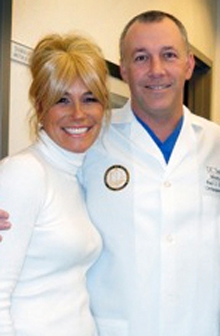
Dr. Girard, former lieutenant commander in the Navy, doesn’t just know how to treat “regular” fractures…he has treated the worst—severely wounded patients who survived bomb blasts in Iraq. He tells OTW, “Dominique’s wounds needed to be approached with flexibility because she had multiple fractures in the same bone, all associated with a massive soft tissue injury. I had to use different techniques and implants to simplify the injury; using one implant or technique would have been more difficult and more prone to complications. That’s one of the most important things I brought home from Iraq, namely that in treating such severe wounds you must be able to look at the whole picture and not get yourself pigeon holed into the same treatment used for simpler injuries.”
Dominique tells OTW,
“I was in a wheelchair for months; then I used a cane. And while I am much improved, I still struggle with daily aches and throbs that often are quite physically draining. I often reflect on how fortunate I am to have had a surgeon with military experience. My trauma was severe, but Dr. Girard never flinched. In fact, when I had to chance to speak at the American Academy of Orthopaedic Surgeons meeting this February, I made a point of telling the audience that what helped me so much from a psychological standpoint was the fact that my entire treatment team remained calm no matter the situation. I knew that chaos and the unknown were surrounding me, but when I looked at their calm faces I found comfort.
Dr. Girard adds, “Dominique has been a model of strength, and is so blessed to have a loving family to stand by her side. She has hit her recovery milestones earlier than anticipated and is an inspiration to others who suffer severe trauma.’
Asked how much she knew about orthopedics before this experience, Dominique told OTW, “Dr. Girard was so talented, and had such a great bedside manner that he became my idea of what all orthopedic surgeons are like.”
How has she changed? “I am able to see who I really am, and I am proud to have been told by many other people that I have inspired them. I am not dwelling on why this happened…I’m just moving forward.”
Dominique Gambale wants this message to go out to orthopedists: you alter the course of patients’ lives. There is nothing more powerful.
For more information on Dominique and her story, please visit www.orthoinfo.org/Dominique.
React:
Discussion
This is a fascinating development. In my practice we've seen similar outcomes with the revised protocol. The key differentiator seems to be patient selection criteria. Has anyone else noticed the correlation with BMI thresholds?
Great point. I'd push back slightly on the conclusion, the sample size in the cited study is too small to draw population-level inferences. That said, the directional signal is compelling and worth a larger RCT.
We implemented a similar approach last year. Early results are promising but we're still gathering 12-month follow-up data. Happy to share our protocol if anyone is interested.
Join the conversation
Orthopedic professionals are discussing this. Sign in and upgrade to read every comment and add your voice.