
“My motto: better living through chemistry, ” says Vincent Pellegrini. Not so, says Dr. Michael Mont, “Most times we can throw out the drugs. Except if you have a patient who is noncompliant with non-pharmacological prophylaxis.”
Deep Vein Thrombosis: To Drug or Not?
8 min read Premium comments
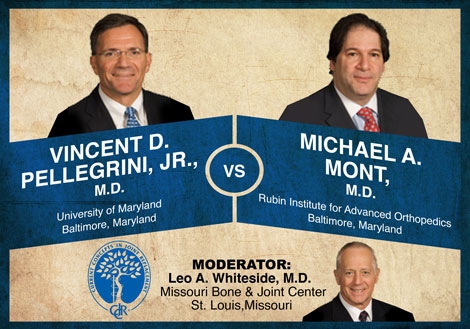
This week’s Orthopaedic Crossfire® debate is “DVT Prophylaxis: Better Living Through Chemistry.” For the proposition was Vincent D. Pellegrini, Jr., M.D. from the University of Maryland in Baltimore. Against the proposition was Michael A. Mont, M.D. of the Rubin Institute for Advanced Orthopedics in Baltimore; moderating was Leo A. Whiteside, M.D. from the Missouri Bone & Joint Center in St. Louis.
Dr. Pellegrini: “I will take the affirmative stance…better living through chemistry. Excluding aspirin, that will be our challenge. The problem is one of risk avoidance; we try to prevent everything on a venogram in return for loss of bleeding, or do we want to prevent PE [Pulmonary Embolism] death and minimize the bleeding risk? The ACCP [American College of Chest Physicians] people have told us that the bottom three [Warfarin, Low Molecular Weight Heparin (LMWH), Fondaparinux] have the Good Housekeeping seal of approval; they have actually recommended against the use of aspirin and pneumatic compression alone.”
“The Academy acknowledges that if you have a standard risk of embolism with an elevated risk of bleeding, that situation trumps even an elevated risk of embolism because the recommendations are identical if you have a standard or an elevated risk of embolism if the bleeding risk is increased.”
“Aspirin: In 1986 at the NIH [National Institutes of Health] Consensus Conference they told us it wasn’t very useful. But in the ‘90s it had a resurgence, based largely on a perceived lack of complications rather than demonstrated efficacy.”
“A meta-analysis from the Penn Group suggested that aspirin was quite helpful—entirely based upon the type of anesthetic…and these trials aren’t stratified for the type of anesthetic. The PEP [Pulmonary Embolism Prevention] trial was largely a hip fracture trial with 2, 600 arthroplasty patients…in fact, no difference between aspirin and placebo in terms of efficacy. One-third of these patients got fractionated heparin.”
“Two pieces of data suggest aspirin is helpful: in a multimodal situation a study from Hospital for Special Surgery (HSS) suggests that the readmission rate is around 3%; 20% of these folks got Warfarin, all of them had a hypertensive epidural and intravenous Heparin intraoperatively. Unless used in combination with regional anesthesia, the data for aspirin remain rather soft.”
“I would caution you: mechanical compression alone has been shown to have a much higher prevalence of proximal clots. Our own data showed this to be about four times greater, statistically significantly different, probably because the segmental clots in the femoral vein are due to intimal injury—compression doesn’t treat that. In our own hands, the general anesthetic was much more important than the compression, the aspirin, or the Warfarin.”
“The fancy drugs: the baseline is relative to Warfarin with about a 20% residual clot rate with a general anesthetic after hips, after knees on the order of 50%. After hips: fractionated Heparin gets that to 10% on a venogram; Fondaparinux to 5%. Pretty good numbers, but the bleeding risk is up to 5%. After knee arthroplasty, fractionated Heparin is about one-third, Fondaparinux is the only drug to get that down under 20%; the risk again is two to three times more bleeding.”
“Venograms are not a good surrogate for the clinical endpoint, but we can no longer argue that there’s no relationship because Eikelboom showed us that if we minimize venographic clots then clinical events follow.”
“In our own hands Warfarin is the best compromise—we use it as a low-intensity. Over some 20 years we’ve looked at nearly 3, 300 patients. The main difference is in the first decade. We didn’t give anyone Warfarin who had no venogram. For the second decade if they had no venogram and we didn’t know what was going on we treated them empirically with Warfarin. Punch line? The risk of readmission if you went home without Warfarin because you had a clean study, was seven to eight times greater than if you went home on Warfarin for any reason.”
“Similar story on the knee side. If you look at 3, 000 patients there wasn’t a single pulmonary embolism in any patient that was given outpatient Warfarin therapy over the 20 years. The bleeding risk—outpatient—is real…it’s about .06%. In our hands one of these bleeds was fatal. We must get to the point where the major bleeding risk and the clinical PE risk are not at odds; so we need to have a much lower bleeding risk than clinical PE.”
“A plea to our new drug manufacturers: we need a drug that is comparable in efficacy and safer.”
Dr. Mont: “We don’t need drugs at all. Patients without prophylaxis have these incredible numbers of 50-60% rates of deep vein thrombosis (DVT). There is the theory that symptomatic PEs originate from lower extremity DVTs, but I’m not sure that’s proven.”
“The ideal prophylaxis should be effective, have a low risk of side effects, be easy to administer and monitor, have known predictable onset, you should know the duration of action, there should be no interaction between drugs or foods, easily reversible, safe in the surgical setting, and cost effective. But most orthopedists hate drugs because of the risk of bleeding, and are therefore looking for an adequate mechanical device.”
“If you don’t use a chemoprophylaxis you have no bleeding and general safety, but you have these large bulky devices, poor compliance, and questionable studies. There are tremendous studies with chemoprophylaxis, but you’ve got the disadvantages of hematoma, impaired rehab, blood loss, and wound healing problems.”
“In a study using LMWH using the ACCP guidelines they had close to a 10% incidence of hemorrhage, bleeding, and all these complications. In a meta-analysis at HSS of 20 studies looking at three groups: a lower incidence of mortality in the compression stocking group—by half—and also a higher incidence in the other groups [Warfarin and Heparins] of fatal PE.”
“Non-pharmacological prophylaxis: compression stockings, intermittent pneumatic devices, foot pumps. We can also talk about functional means like early return to weight bearing; some people talk about continuous passive motion; and certain patients might need an IVC [inferior vena cava ] filter. The theory behind these things: you might simply think that there’s increased venous blood flow that prevents clot formation. There are studies that show that you prevent the release of endothelial derived relaxing factor and urokinase…and there is a fibrinolytic effect. All of these may prevent DVTs…we’re not sure about the mechanisms.”
“Mechanical devices haven’t been as intensively studied as pharmacological prophylaxes. There aren’t standards for size or pressure; they haven’t been specifically assessed in many clinical trials, and many of them have been unblinded. Even so, there is still Grade 1A evidence for the use of mechanical devices.”
“Compression stockings reduced DVT rates compared to other means by 57% (and it didn’t matter whether you were using below or above the knee). Another study showed that early return to activity reduces DVT rates. Foot pumps in one JBJS [Journal of Bone and Joint Surgery] study reduced DVT rates compared to LMWH by 50%. There are limitations to all of these studies.”
“I was involved with a nine center study. We used a portable, battery-powered compression device on the lower legs; it was timed with the patient’s breathing. Patient compliance was monitored. We compared this to Enoxaparin given in the hospital and on discharge and found no bleeding complications. But similar venous thromboembolic phenomena were present in both of the groups: non-fatal PE was 1% in both groups. There were similar DVT and PE rates as compared to Enoxaparin.”
“Summary: Drugs may do more harm than good.”
Moderator Whiteside: “It’s my job now to get this totally out in the open. Vince, how many total hips and knees do you do per year?”
Dr. Pellegrini: “About 150 hips and maybe 75-100 knees.”
Moderator Whiteside: “You use Coumadin as an outpatient prophylactic agent?”
Dr. Pellegrini: “Yes.”
Moderator Whiteside: “How do you manage that? Who takes all the calls?”
Dr. Pellegrini: “We do them through our office. I work at an academic center…I can’t get the hematologists interested in this. I have a flow sheet—they get monitored on Monday and Thursday and the results get faxed to my office. My secretary charts them and every night before I go home they’re in my folder. The results? Maybe 10-15% of them need to get changed, and either I or my nurse will make a phone call.”
Moderator Whiteside: “So it’s fairly time expensive for you?”
Dr. Pellegrini: “I’m at a state institution, Leo. I’m cheap.”
Moderator Whiteside: “Mike, what’s the added expense for you…the added expense of using venous compression? And do you have expenses in outpatient?”
Dr. Mont: “Patients do take these home with them. The expense is going to be adjusted by the companies that make these different devices. They can range from $200 to $1, 000. Hopefully, if these become mainstream, insurance companies will pick that up. There is not an outpatient expense in terms of monitoring the patient.”
Moderator Whiteside: “But in terms of using the device…do you use it as an outpatient at home?”
Dr. Mont: “Once they are given the device the question is, ‘Who is paying for that?’ The manufacturer has to get some reimbursement; the patient can return the device. So it’s a one time fee. There is no question that Coumadin as a drug costs pennies and what Vinny brought up is that it’s not the drug that’s the cost, it’s the monitoring of that drug. We can’t do that at our center when we’re doing about 1, 500 joint replacements. I’d like a one time fee for a device, which might be more expensive than the drug, but we don’t have to monitor it.”
Moderator Whiteside: “Have you had any patients who aren’t very compliant with Coumadin whom you can’t get near your target, and have had a complication of DVT, major DVT or pulmonary embolism?”
Dr. Pellegrini: “It has failed in my hands in a separate set of patients—folks who are on chronic Coumadin therapy preoperatively. We should worry about them being hypercoagulable when we take them off the Coumadin. In that subset we’ve had PE in the early postoperative period in hospital. So I bridge people who are on Warfarin preop.”
Moderator Whiteside: “Mike, have you had complications due to noncompliance with compression devices?”
Dr. Mont: “In a study there was a 1% non-fatal PE rate and there were DVTs. Compliance is a big issue. The good thing about this latest device is that there is a monitor for compliance. If you have a questionably compliant patient I would opt for what Vinny is doing. I’m in favor of Coumadin as well; I don’t like the LMWH.”
Moderator Whiteside: “Thank you both.”
Please visit www.CCJR.com to register for the 2012 CCJR Winter Meeting, December 12 – 15 in Orlando, Florida.
 “You may now view content from the CCJR Meetings on the CCJR Mobile™ App. Please scan the QR code to download the CCJR Mobile App to your Android or iOS mobile device, or visit www.ccjrmobile.com.”
React:
Discussion
This is a fascinating development. In my practice we've seen similar outcomes with the revised protocol. The key differentiator seems to be patient selection criteria. Has anyone else noticed the correlation with BMI thresholds?
Great point. I'd push back slightly on the conclusion, the sample size in the cited study is too small to draw population-level inferences. That said, the directional signal is compelling and worth a larger RCT.
We implemented a similar approach last year. Early results are promising but we're still gathering 12-month follow-up data. Happy to share our protocol if anyone is interested.
Join the conversation
Orthopedic professionals are discussing this. Sign in and upgrade to read every comment and add your voice.