
“Patient selection is key, ” says Wayne Paprosky, “And the skinny, passive, depressed individual is not going to do well no matter how small the incision.” Dana Mears counters, “Wait. Let’s look at the economics of this…there are not going to be enough healthcare dollars to support this proliferating number with the techniques we’re currently using.”
Paprosky vs. Mears: MIS Hype or Help?
8 min read Premium comments
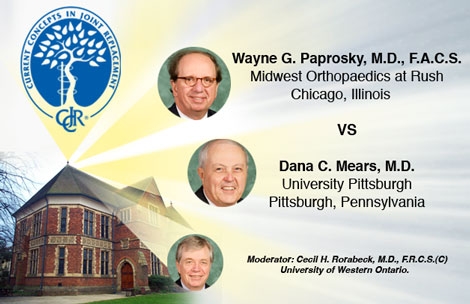
This week’s Orthopaedic Crossfire® debate is “MIS: More Hype Than Help.” For the proposition was Wayne G. Paprosky, M.D., F.A.C.S. from Midwest Orthopaedics at Rush in Chicago. Against the proposition was Dana C. Mears, M.D. of the University Pittsburgh; moderating was Cecil H. Rorabeck, M.D., F.R.C.S.(C) of the University of Western Ontario.
Dr. Paprosky: “MIS can stand for several things: Maybe It’s Safe. Maybe It’s a Scam; maybe it’s just for people who aren’t terribly normal (Mainly Insane Surgeons). I think it’s mostly selection.”
“One of the main goals should be early return to function. All the other things are nice, but are variable with respect to assessment. No matter the approach or size of incision, we must remember that we are dealing with patients—they are our focus, not individual outcomes.”
“Same day discharge: I come from an institution where patients go from the OR table to a taxicab. Discharge within 24 hours doesn’t affect the outcome; patients spending 2-3 days in the hospital after MIS procedures have outcomes as good as 24-hour patients. Patients must be properly anticoagulated, have good pain management with oral medication, and be proficient with physical therapy before they are turned loose.”
“It was said that the 2-incision was ‘it, ’ however that has turned out to not be the case. Mayo Clinic has shown slower recovery after 2-incision in a mini posterior-incision total hip arthroplasty (THA)—this was a randomized clinical trial (RCT). Patients actually felt the mini posterior was better than a 2-incision, which was going to revolutionize total hip surgery in general.”
“Then you have [a study showing that] the minimal incision technique in THA doesn’t improve postoperative outcome (an RCT). The Rothman Institute found that with minimally invasive surgery 80% of the patient data that has been published regarding MIS surgery was inaccurate. Larry Dorr has shown very good results with the mini posterior in a blinded study. So it’s a difference of opinion with respect to what should be done. [de Beer] says forget the incision, it doesn’t matter.”
“Joel Matta has introduced a different technique for those people who do not believe that the posterior approach is indicated. Generally, the indication for choosing anything from the front is because of a low dislocation rate, and that this is superior. He’s reported 0.61%, but you have to use a device that looks like something I’ve seen in a dungeon in New Orleans.”
“We’ve shown with a posterior approach with a capsular repair—on almost 1, 000 cases—dislocation rate was virtually the same. So that’s not an argument to choose one over the other. If you are going to do this…stick with what you know.”
“Patient selection and attitude are critical. Body habitus is not the only criteria. Pre-op education, pre-op analgesia, as well as perioperative anesthesia protocols are critical to the success of both procedures. If you load these people up with all of these chemicals, interoperatively you run more chemicals, giving more afterward is not going to hurt.”
“Motivated Interested Sharing Risk, Mainly In Shape. And the skinny, passive, depressed individual is not going to do well no matter how small the incision. Aggressive, exuberant [skinny] person…going to do it. Beware of the guy who may seem normal. He may not be, and may end up complaining about everything.”
“In conclusion, be honest, know your limitations…these perfect results that you see on TV may be 10-15% of the population. But MIS surgery does not benefit all THA candidates.”
Dr. Mears: “In attempting to define that MIS is more help than hype, I want to take a slightly different vantage point…the concern with the proliferation of numbers and the economics therein. Currently the estimated numbers are 250, 000 per annum total hips in the U.S. and 450, 000 total knees. Worldwide it’s 3x these numbers; there are not going to be enough healthcare dollars to support this proliferating number with the techniques we’re currently using.”
“To me, an outpatient procedure looms to consider no matter the surgical approach. As Wayne outlined, what are the attributes where this could be done in an outpatient setting truly at lesser expense? However you do it, some pain management modality is crucial. We’ve used peripheral nerve blocks and multimodal technique; we have a separate nursing unit with high intensity therapy, combined with preoperative education.”
“The patients get out of bed rapidly the day of surgery. Postural hypotension is a problem; they undertake activities consistent with home transfer using aspirin as a basis and attempting to have 23-hour discharge—some on the day of surgery.”
“With my anesthesiologist we set out a working hypothesis that we could attempt to identify where it would be feasible to have a protocol for outpatients, even though we would assess it inpatient in view of financial considerations…recognizing that subsets of patients would require longer inpatient stay. We assess, determine preoperatively gender, age, weight, ASA [American Society of Anesthesiologists] status, preoperative hemoglobin, as well as those during and after surgery.”
“Recently this work was approved for publication based on 676 consecutive patients at UPMC prospectively studied; 665 unilateral and 66 bilateral hips, with 11 preoperative exclusions. The mean age was 62, mean weight was 190lbs…followed for 3.5 years. The mean length of stay was 1.8 days for unilateral and 2.8 days for bilaterals, with 394 discharges the day after surgery.”
“Post discharge home support: 44% were discharged home within 23 hours. 87.8% had no home support, 12% went to a rehabilitation center. We compared this with our preoperative results for traditional methods, showing a substantial improvement. Our local insurance carrier, UPMC identified the finances, saving $2, 300 per patient, $6, 000 per bed, $2, 400, 000 per year. The main impact was cutting the rehabilitation centers—that amounted to $7, 000, 000 per year.”
“The problem with this is that it requires identification of patients. We had not assessed opioid abuse or dementia. These methods have not achieved widespread use; surgeons are resistant to techniques, and many patients have surgery performed in sites with small numbers of procedures. And you must change the pain management, therapy, nursing, and administration, along with a lot of other factors. To me, the worst problem is the lack of third-party payers; our payers have not gotten on board for changes that would save them money. I think that will change in the future.”
Moderator Rorabeck: “Help us define the indication for this operation.”
Dr. Mears: “In terms of patient size, we had set up prospectively a series of factors, including patient weight, that we thought would be germane to the distinction of short or long stay. Apart from the patients with the most severe forms of morbid obesity, weight was not a factor. Age was a factor over age 65, but mainly over the age of 75. But the two we have not considered, unfortunately, that we’re now attempting to study prospectively, was occult dementia and habituation to opioids.”
Moderator Rorabeck: “Is the driver here to improve the economics or patient care?”
Dr. Mears: “I think the patient care at the end of the day in terms of the quality of results, the potential complications, are not compromised in this way. But you do have to identify those patients where this would be realistic. At our site, a transplant center, if someone has had a heart/liver/lung transplant I would never dream of doing this procedure in an outpatient setting.”
Moderator Rorabeck: “Wayne, maybe you could encapsulate this. When does Wayne Paprosky do an MIS hip replacement in a routine case?”
Dr. Paprosky: “First of all, length of stay is down in general. If there aren’t medical complications it’s rare no matter what kind of incision you do. It’s clear that if you select a patient that appears motivated and is not obese, that is the patient to put the effort into to try and get that patient back to work in 8-10 days. But you cannot do this for all patients. If someone comes in and says, ‘I’m highly independent, ’ but there are five people accompanying him, don’t waste your time trying to get that patient back to work because he is getting a secondary gain out of getting breakfast in bed for a month (instead of going back to work). The other thing is you can’t dig 2.5 hours in a Medicare patient who may not be qualified for this and the hospital loses money.”
Moderator Rorabeck: “Dana, when you think about the potential costs in terms of an operation that may take an hour longer, does that factor into the economic analysis?”
Dr. Mears: “The surgery doesn’t take any longer for an established hip surgeon with any of these methods. When I was a resident a carpal tunnel release had to be done as a three day inpatient admission; complications would be accepted. Well now we look at that as patently absurd. You then look at ACL repair; that went to what is mainly now an outpatient procedure…technically more demanding, initially very controversial, now accepted. I see this driven in the same way and it will be driven by economic issues. Now, the U.S. payers largely don’t pay for an outpatient procedure in an outpatient setting. If they were to change and you selected the patients appropriately, that would change everything.”
Moderator Rorabeck: “How is navigation going to fit into this?”
Dr. Paprosky: “I don’t think navigation for this type of surgery is going to offer a whole lot. If you choose patients correctly and you’re doing a lot of them you can get real good at it. The question is…you’ve got to get there first. It’s like surface replacement. There is a learning curve. A guy who’s going to do 20 hips a year is not going to ever get real good at this so that he can take advantage of the potential economic gains of a patient going home the same day. I discharged about two dozen patients the same day and I had sphincter tightening and I was worried about someone popping off a PE…that just makes me nervous, especially in the elderly person.”
Moderator Rorabeck: “I think the message is that it’s an operation that has its place, particularly in the hands of an experienced hip surgeon. Thank you.”
Please visit www.CCJR.com to register for the 2012 CCJR Spring Meeting, May 20-23 in Las Vegas, Nevada.
 “You may now view content from the CCJR Meetings on the CCJR Mobile™ App. Please scan the QR code to download the CCJR Mobile App to your Android or iOS mobile device, or visit www.ccjrmobile.com.”
React:
Discussion
This is a fascinating development. In my practice we've seen similar outcomes with the revised protocol. The key differentiator seems to be patient selection criteria. Has anyone else noticed the correlation with BMI thresholds?
Great point. I'd push back slightly on the conclusion, the sample size in the cited study is too small to draw population-level inferences. That said, the directional signal is compelling and worth a larger RCT.
We implemented a similar approach last year. Early results are promising but we're still gathering 12-month follow-up data. Happy to share our protocol if anyone is interested.
Join the conversation
Orthopedic professionals are discussing this. Sign in and upgrade to read every comment and add your voice.